



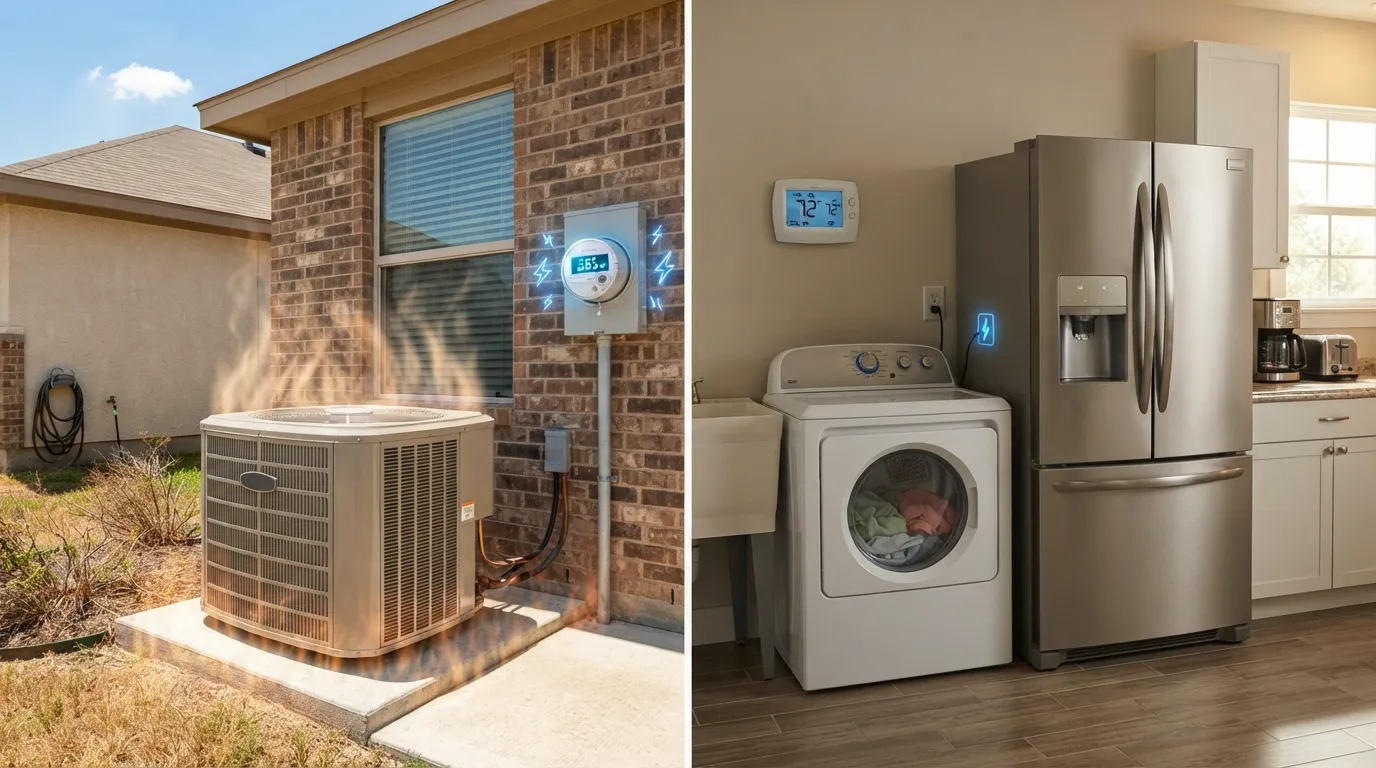
In a Central Texas summer, a high electric bill is mostly your air conditioner: it’s typically half to two-thirds of the July number all by itself. The rest of the spike hides in a short list of suspects — a second fridge sweating in the garage, a dryer breathing through a lint-choked vent, a water heater wearing a mineral jacket — and every one of them is auditable in a weekend.
A high electric bill in summer isn’t a mystery. It’s a lineup. Here’s each suspect, what it typically costs to run, and the fixes that actually move the number.
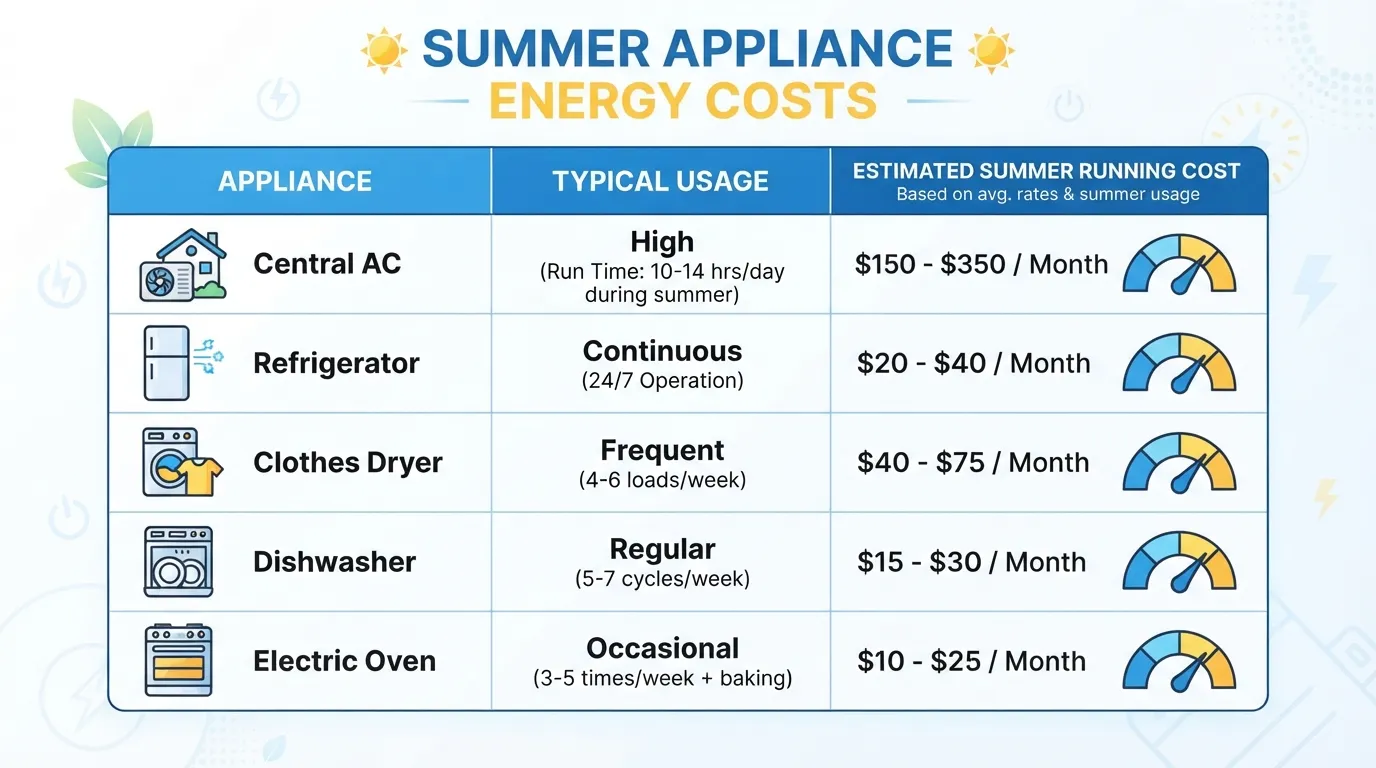
What each appliance costs to run in a Texas summer
The math below uses roughly 15 cents per kilowatt-hour, the ballpark EIA reports for Texas residential power, against typical summer usage. Your rate and your house will shift the numbers; the proportions are the point.
| Appliance | Typical July usage | At ~15¢/kWh | What makes it spike |
|---|---|---|---|
| Central AC, 3-ton, healthy | 900–1,500 kWh | $135–$225 | Heat domes, thermostat wars |
| Same AC, neglected or failing | 1,300–2,000+ kWh | $195–$300+ | Dirty filter, low charge, short-cycling |
| Kitchen fridge, modern | 40–60 kWh | $6–$9 | Dirty coils, tired gasket, hot kitchen |
| Garage fridge, older | 100–170 kWh | $15–$26 | 110° garage air, 2005 efficiency |
| Electric dryer, ~5 loads/week | 60–100 kWh | $9–$15 | Clogged vent doubling cycle times |
| Electric water heater | 250–400 kWh | $38–$60 | Mineral scale on the elements |
| Pool pump, single-speed | 300–400 kWh | $45–$60 | Running 8+ hours on an old motor |
Read the left column against the right and the strategy writes itself: fix the AC’s efficiency first, because a 15% improvement there beats unplugging everything else in the house combined. Then collect the cheap wins below it.
(Energy.gov’s appliance calculator will run your exact models if you want tighter numbers than these typical ranges.)
The AC: half your bill, sometimes more
A 3-ton system pulls around 3 kilowatts while running, and in a 100°+ heat dome it can run 10 to 14 hours a day. That’s the whole story of the July bill, and it’s why the cheap AC fixes have the best payback in the house:
The filter, monthly in summer. A choked filter makes the blower drag and the system run longer for the same cooling. After our spring oak pollen season, most filters are ready for the trash by June. This is a $15 part; treat it like one.
The outdoor coil. Cottonwood fluff, grass clippings, and dust blanket the condenser and make it shed heat badly, so the system runs longer to do the same job. Breaker off, gentle hose rinse from the inside out, done. (Bent fins from hail season are a tech visit, not a DIY straightening project.)
The tune-up, honestly framed. A professional tune-up won’t transform a healthy system’s bill; anyone promising 30% savings from one is selling. Its real value is catching the weak capacitor and the low charge while they’re $40-class problems instead of a dead-compressor July. Here’s what a tune-up costs and what’s in one.
The thermostat, without folklore. Setting it warmer when you’re out saves real money, and the old claim that the system “works harder catching up” is wrong for standard AC; the physics runs the other way. We’d rather you set 78 with ceiling fans running than hold 72 and a point to prove, but that’s between you and your household treaty.
When the AC itself is the problem
Some bills aren’t about habits at all. A system that’s short-cycling (on-off-on every few minutes), running nonstop without holding temperature, or icing its lines is burning money on a fault. Low refrigerant charge, a failing capacitor, a dragging blower motor: all of them convert dollars to heat instead of heat to outside. Refrigerant and electrical work sit firmly on the tech side of the line, and that’s where our air conditioner repair crew earns the visit: fault named, written quote, then work.
One more overlap case worth knowing: a system that trips the breaker when it starts is announcing an electrical problem, and we wrote up why an AC keeps tripping the breaker separately. High bills and tripping breakers together usually mean the same failing part.
The old-AC question: bill as symptom
An AC from the 2000s can be running “fine” and still be the reason your summer bills climbed past your mortgage escrow. Efficiency standards have moved a long way, and a heat-dome July is exactly when the gap shows.
Here’s our honest framing, since we sell both repairs and systems: replacement almost never “pays for itself” as fast as a sales brochure implies, and we won’t pretend otherwise. But when a 15-year-old system needs a four-figure repair and posts $300 Julys, the math starts agreeing with the brochure. Run it with real numbers — what a new system costs in Waco has the full table — and get a second opinion before signing anything. Ours are free, and yes, we mean on other companies’ replacement quotes too.
The refrigerator: the quiet second shift
Refrigerator energy use is the bill’s background hum: it never turns off, it just varies. A modern kitchen fridge is genuinely cheap to run, $6–$9 a month in typical ranges. But three things push fridge electricity up hard, and summer is when they gang up:
Dirty condenser coils. The fridge sheds heat through them; furred-over coils mean longer compressor runs. Vacuum them twice a year.
A tired door gasket. Cold pours out, the compressor pays. Dollar-bill test: close the door on a bill, and if it slides out free, the gasket’s done working.
A hot room. Every degree of kitchen temperature is headwind. A fridge in an un-cooled space works a second job all summer.
And a fridge that’s struggling — running constantly, hot on the sides, not holding temperature — isn’t an efficiency project, it’s a repair call. Run the not-cooling checklist before the electric bill and the grocery bill both take the hit.
The garage fridge tax
The old beer fridge in a Texas garage is the most expensive cold drink in town. It’s usually a 2005-class unit (already thirstier by design), parked in 110° August air, which multiplies its run time. Typical damage: $15–$26 a month, every month it’s out there, or $180–$300 a year for backup capacity you use twice.
The decision tree is short. If it’s half-empty most of the year, unplug it and consolidate. If you genuinely need it (deer season, big family, serious meal-prep), it’s worth running the numbers on a garage-rated replacement, and worth reading how long refrigerators last first, because garage duty is exactly what shortens the answer.
The dryer: lint is money
An electric dryer pulls 3–5 kilowatt-hours per load, which is manageable, until a lint-clogged vent stretches every 45-minute cycle into 90. Same laundry, double the electricity, and the machine ages faster for the privilege.
The tell: clothes need a second cycle, the laundry room gets swampy, or the outside vent flap barely flutters when the dryer runs. Pull the lint screen every load (you knew that one) and clear the duct run once a year, which takes a $25 brush kit and a Saturday half-hour. It’s the least glamorous fix in this guide and the most reliably instant one.
The water heater and our hard water
An electric water heater already sits near the top of the baseline table. Central Texas water makes it worse: mineral scale settles on the heating elements, and scale is insulation, so the elements run longer to make the same hot shower. The same crust is at work in your dishwasher and your fridge’s water lines — hard water’s whole rap sheet is its own post.
The fixes escalate: dial the tank to 120°F yourself (safe, free, and plenty hot), and leave element replacement and tank flushing on old units to a pro, since a seized drain valve on a 12-year-old tank turns a maintenance video into a wet afternoon.
While you’re auditing the baseline crowd, don’t skip the pool pump if you have one. A single-speed pump running 8 hours a day is a $45–$60 line item all summer, and most pools do fine on fewer hours than the pump’s been running since 2019. Trimming the timer costs nothing and nobody notices but the meter.
Find your hog with the meter
You don’t have to guess which machine is guilty. Most Texas homes have digital meters that report usage in 15-minute slices to your utility or provider portal, and one evening of reading it beats a month of theories.
The method: pull up a 100° day and find the overnight hours, that flat floor is your baseline (fridges, water heater, always-on electronics). Then watch the afternoon stack: the tall repeating blocks are the AC’s cycles. A baseline that never drops below a kilowatt means the always-on crowd deserves an audit; afternoon blocks with no gaps mean the AC never rests. For single appliances, a $25 plug-in watt meter settles any argument about the garage fridge in 24 hours.
No portal, no problem: the breaker panel runs the same experiment analog-style. Flipping individual breakers off for an hour each while watching the meter is entirely within safe-DIY territory, and it’s how we’d find a mystery load in a house with no data. Label what you learn; the next owner of that panel will think you’re a genius.
Ten minutes with real data usually ends the family debate about who’s “running up the bill.” It’s the AC. It’s almost always the AC.
The one-weekend plan
In payback order, based on what we see actually work around Waco, Temple, and China Spring:
- Swap the AC filter and set a monthly summer reminder.
- Rinse the outdoor coil, breaker off first.
- Clear the dryer vent end to end, screen and duct both.
- Vacuum the fridge coils and dollar-test the gasket.
- Sentence the garage fridge: unplug, consolidate, or knowingly pay its tax.
- Set the water heater to 120°F.
- Read your meter portal on the next scorcher and see what’s left.
Do those seven and you’ve captured most of what’s capturable without a truck in the driveway. What remains, low charge, weak capacitors, a system aging out, is diagnosable in one visit with a written quote before any work.
Common questions about high electric bills
Why is my electric bill so high all of a sudden?
How much of my electric bill is the AC in summer?
Does a refrigerator use a lot of electricity?
Is it cheaper to leave the AC at one temperature all day?
Why is my bill high when nobody’s home?
Will a bigger AC lower my bills?
Do ceiling fans lower the electric bill?
Where to go from here
Filter, coil, vent, gasket, garage fridge, water heater, meter. If the bill’s still ugly after that list, the problem has a part number, and finding it is a one-visit job. Request a straight answer or call — we work both sides of the meter, the AC and the appliances, which is exactly why this audit fits on one page and one service call.
The On Point Team · On Point Service Company — family-owned HVAC & appliance repair, McGregor, TX · Serving Waco, Temple, Belton, and surrounding Central Texas towns · Licensed & insured, TDLR License TACLB00069239E ·