






To prepare your AC for summer in Central Texas, do six things in March or April: swap the filter, rinse the condenser coil, clear two feet around the outdoor unit, open and dust every vent, pour a cup of vinegar down the condensate line, and run a full 30-minute cooling test on a mild day. That’s the homeowner half. The other half belongs to a tech, and knowing where that line sits is what this guide is for.
The deadline is real, by the way. The first string of 95° days doesn’t send a calendar invite, and when it lands, every weak system in McLennan County fails the same week. April finds problems while they’re cheap and the schedule is empty. June finds them at the back of everyone’s line.
The Six-Step Homeowner Checklist
- Swap the filter. The single highest-value maintenance act in HVAC, and it costs a few dollars. If you can’t remember when you last did it, that’s your answer. Mark the date on the filter’s edge with a marker.
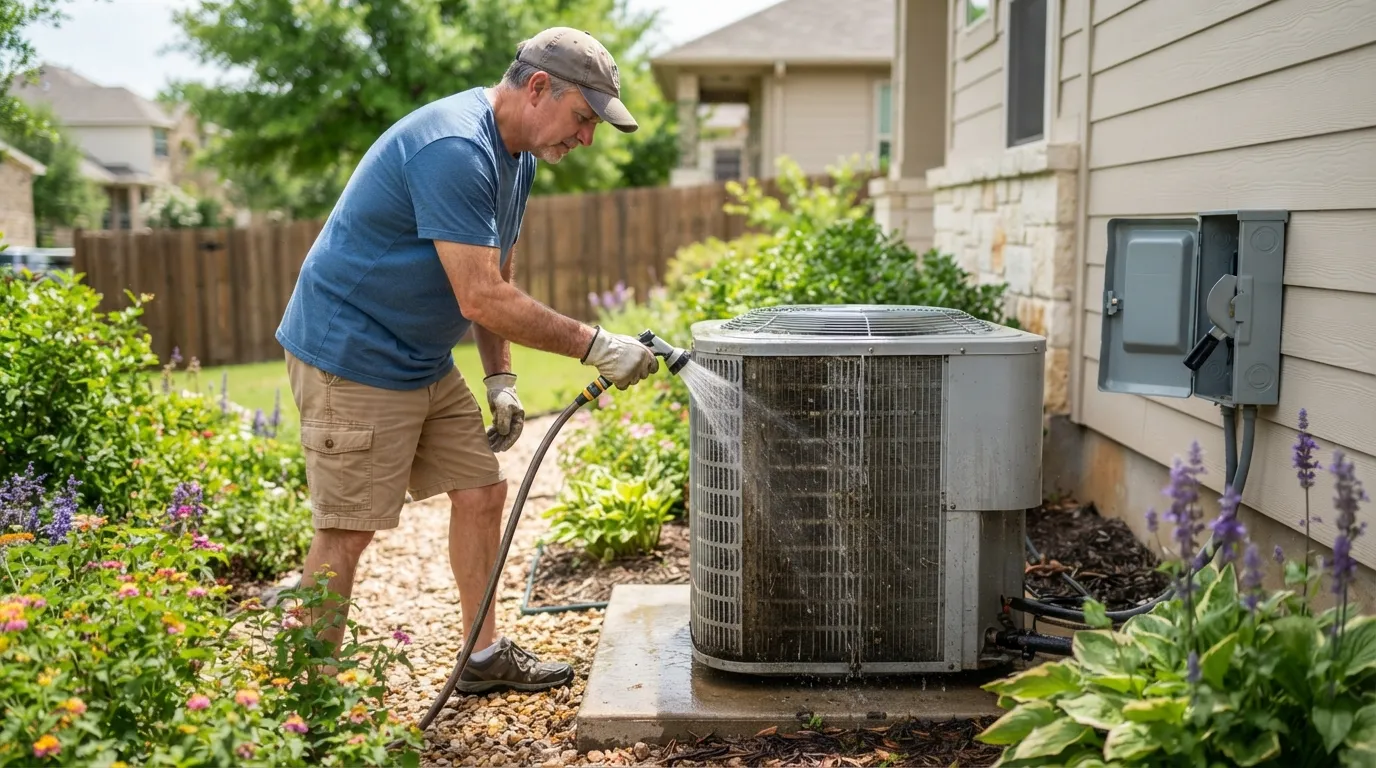
- Rinse the condenser coil. Breaker off at the outdoor disconnect first. Then a gentle garden-hose rinse from the inside out if you can pop the top, or from outside at an angle if you can’t. Never a pressure washer; flattened fins turn a free cleaning into a paid repair.
- Clear two feet around the unit. Shrubs, fence pickets, stacked pavers, last fall’s leaves. The condenser’s whole job is dumping heat, and it can’t breathe through a hedge.
- Open and dust the vents. Every supply register open, nothing parked on the floor grilles, returns vacuumed. Closing vents to “push air elsewhere” mostly just strains the blower.
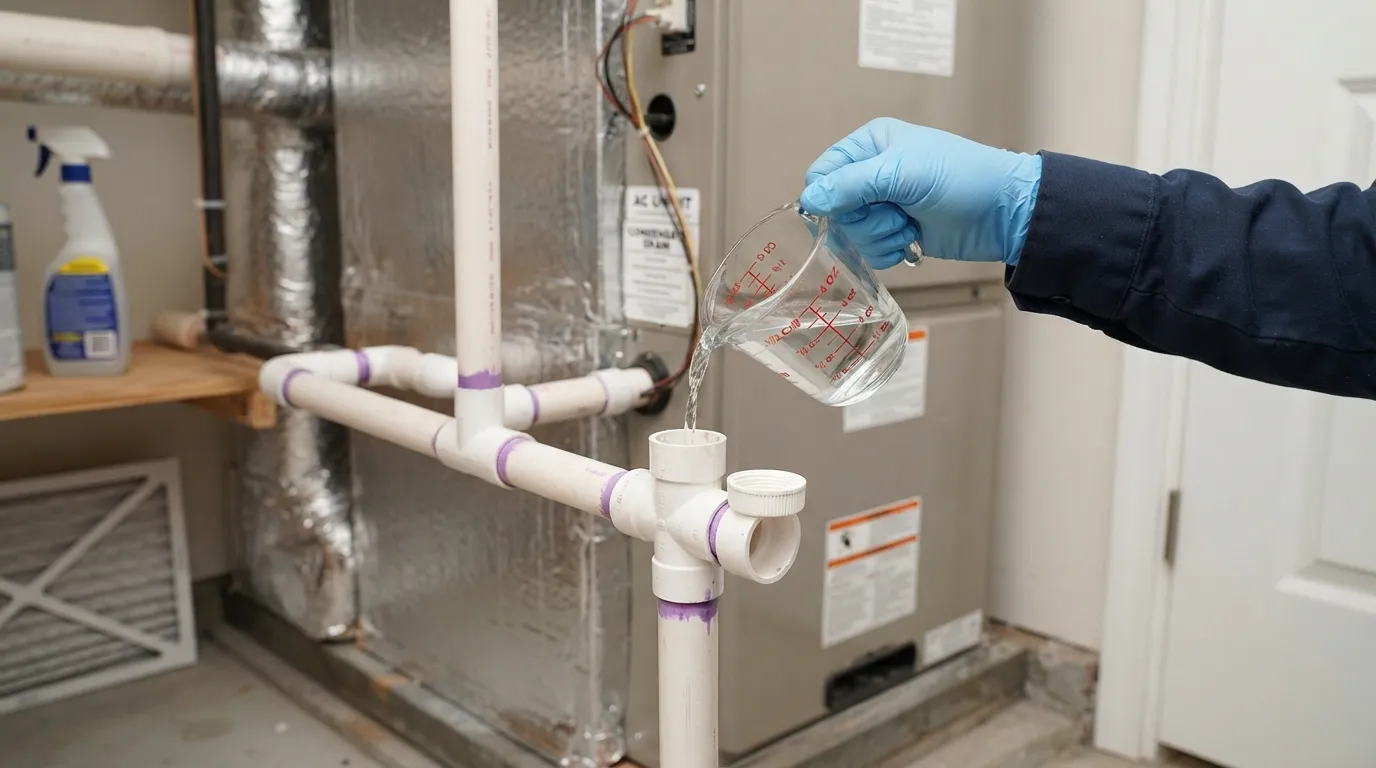
- Clear the condensate line. Find the PVC drain near the indoor unit, pull the cap on the tee, and pour in a cup of white vinegar. In our hard water, algae and crud choke these lines fast, and a clogged line is the most preventable AC shutdown in Texas.
- Run the test. Pick a mild 80° afternoon, set the thermostat five degrees below room temperature, and let it run 30 minutes. Cold air at every vent, outdoor fan spinning, no new noises, no ice on the copper lines? You’re ready. Anything else, you just bought yourself a calm April repair instead of a July crisis.
Do those six and you’ve done everything the Department of Energy’s maintenance guidance asks of a homeowner, minus the parts that need gauges and a license.
The Two Steps People Get Wrong
The coil rinse goes sideways two ways: rinsing with the power on, and blasting the fins flat. Power off at the disconnect, gentle water, straight-on angle. If the coil’s wearing a felt coat of cottonwood fluff or dust, let it soak a minute and rinse twice. What you’re removing is an insulation blanket your compressor has been paying for all season.
The test run gets skipped because the weather’s nice, and nice weather is exactly the point. A capacitor that’s drifting out of spec will start a compressor at 80° and fail it at 100°. Running the system hard in April surfaces the marginal parts while a repair visit is easy to book. We’d rather find your weak capacitor during a test run than during a heat dome, and honestly, so would your family.
What Only a Tech Should Do
Here’s the line, plainly. A professional spring visit typically covers refrigerant pressure checks, capacitor and contactor testing under load, electrical connection tightening, blower amp draws, evaporator coil inspection, and a deep coil clean when it’s earned. That work needs gauges, meters, and an EPA card, and it’s where the full tune-up checklist earns its keep.
Stop-and-call territory, no exceptions: refrigerant anything (federal law), capacitors (they hold a dangerous charge with the power off), and sealed electrical compartments. If a YouTube video is walking you toward any of those, close the tab and pick up the phone. What a pro visit costs in this market is covered in our tune-up cost guide, and how often you actually need one is its own honest question — for most Central Texas systems the answer is yearly, in spring, and twice for heat pumps.
What the Test Run Might Tell You
Warm air at the vents, a breaker that trips on startup, ice forming on the lines, or a condenser fan that hums without spinning: those are repair calls, and April is the cheapest month to make them. Our AC repair team books spring diagnostics with none of July’s triage pressure, the service fee is quoted up front, and it’s credited toward the repair on a written quote.
One opinion we’ll defend: don’t buy a “tune-up special” to fix a known problem. If your system already has a symptom, book a diagnostic and say so. Tune-up pricing is for healthy systems; symptom calls deserve a tech who showed up expecting to chase something.
FAQ: Getting Your AC Ready for Summer
When should I prepare my AC for summer in Texas?
Should I hose off my AC condenser myself?
What’s included in a professional AC tune-up?
Is an AC tune-up worth it every year?
Where to Go From Here
Six homeowner steps, one honest line, and a test run before the heat means something. That’s the whole play. If the test run turns up warm air, weird noises, or a breaker trip, get a straight answer and a written quote while it’s still April-calm. Preparing your AC for summer is mostly free. Ignoring it never is.
The On Point Team · On Point Service Company — family-owned HVAC & appliance repair, McGregor, TX · Serving Waco, Temple, Belton, and surrounding Central Texas towns · Licensed & insured, TDLR License TACLB00069239E ·