





By The On Point Team · Updated July 2026
A new central AC system in the Waco area typically runs $6,000–$12,500 installed in 2026. The low end is a straightforward changeout of a smaller system at base efficiency; the high end is a larger home, higher-efficiency equipment, or ductwork that needs real correction. Full system replacements that include the furnace or air handler push the range higher.
Wide range, we know. The whole point of this guide is to show you which end you’re on, and why, before anyone’s standing in your hallway with a clipboard.
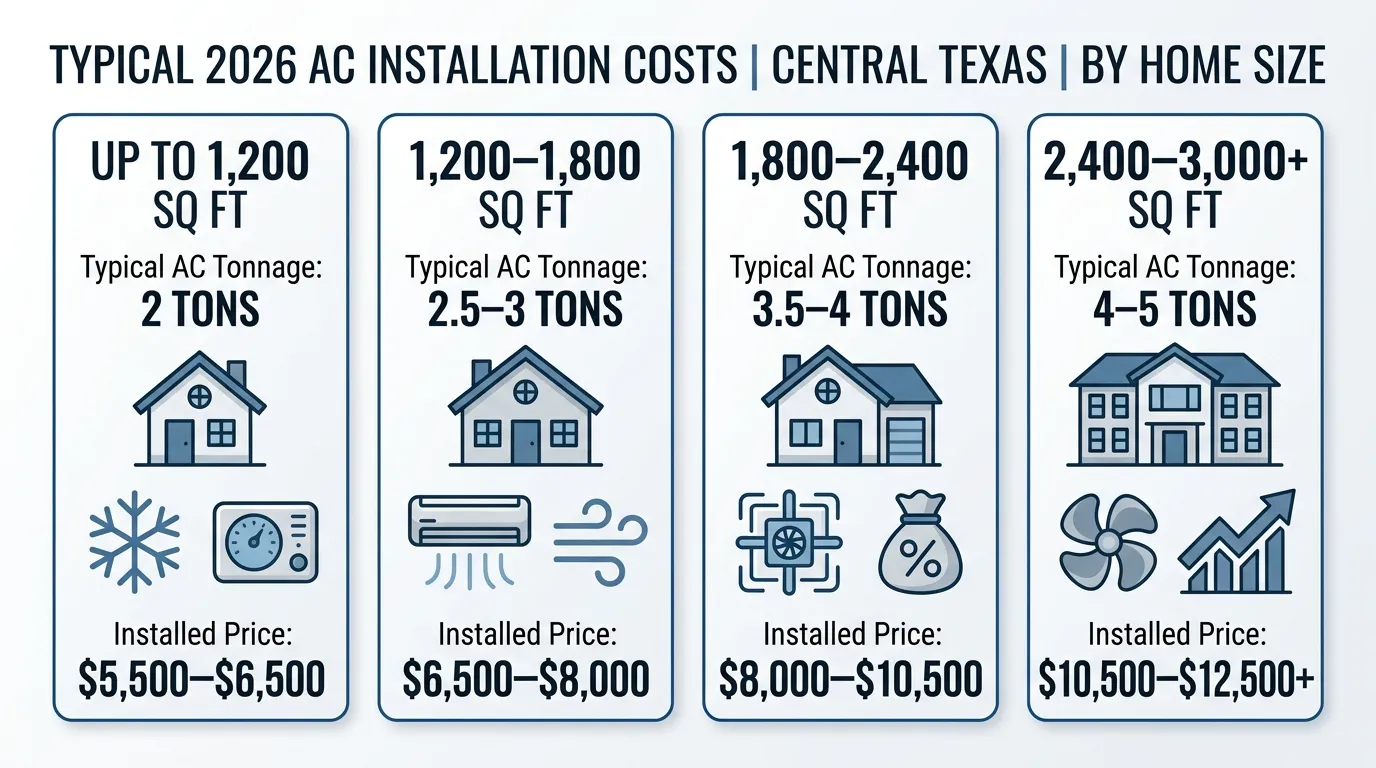
Cost by Home Size: The Tonnage Table
AC capacity is measured in tons (of cooling, not weight). In Central Texas heat, homes need roughly one ton per 500–600 square feet, noticeably more capacity per foot than milder states, and one reason national cost articles undershoot for Waco.
| Home size | Typical system | Typical installed range (2026) |
|---|---|---|
| Up to 1,200 sq ft | 2 – 2.5 ton | $5,500 – $8,500 |
| 1,200 – 1,800 sq ft | 2.5 – 3 ton | $6,000 – $9,500 |
| 1,800 – 2,400 sq ft | 3.5 – 4 ton | $7,000 – $11,000 |
| 2,400 – 3,000+ sq ft | 4 – 5 ton | $8,500 – $12,500+ |
These are industry-typical installed ranges for the Waco market (equipment plus labor, base-to-mid efficiency), not our price list. Your written proposal is the real number, and the spread inside each row comes down to the five factors below.
One honest caveat before the table gets treated as gospel: square footage is the starting guess, not the answer. A 1970s ranch near Baylor with original ductwork and single-pane windows can out-demand a new build in China Spring that’s 500 square feet bigger. That’s what the load calculation is for, and we’ll get there.
The Five Things That Move Your Number
- Equipment tier. Single-stage, two-stage, or variable-speed. Single-stage cools fine and costs least. Variable-speed runs quieter, holds humidity better through a muggy Texas evening, and costs meaningfully more up front. Our take: two-stage is the value sweet spot for most Waco homes; variable-speed earns its price in big or sun-hammered houses where humidity and hot rooms are daily complaints.
- Ductwork condition. The quiet budget-killer. Leaky, undersized, or crushed ducts can bleed a quarter of your cooling into the attic, and no new condenser fixes that. Sealing or correcting runs adds real money to a quote, and it’s frequently the difference between a system that hits its numbers and one that disappoints for fifteen years. Be suspicious of any bid on an older home that never mentions the ducts.
- Matching indoor equipment. If your furnace or air handler is as old as the AC, replacing both at once usually beats two separate labor bills a few years apart. It’s also sometimes required: new condensers need a matched indoor coil, and mismatched pairings void efficiency ratings.
- Electrical and code items. Disconnect boxes, breaker upgrades, pad replacement, line-set condition, permit costs. Small lines individually; together they’re often four figures on older Waco housing stock.
- Access and installation complexity. A ground-floor closet air handler with clean attic access installs faster than equipment wedged in a low crawlspace. Labor hours are part of every range above.
SEER2, Translated Into Texan
SEER2 is the federal efficiency rating: how much cooling you get per dollar of electricity, tested under 2023’s tougher standard. In our region (the South), new split-system ACs must be at least 14.3 SEER2, and most quotes you’ll see run 14.3 to 17-plus.
What the marketing brochures won’t tell you: efficiency payback depends on runtime, and Waco runtime is enormous. A SEER2 bump that would be a rounding error in Minnesota is real money across a Central Texas cooling season that runs April to October. But the curve flattens: the jump from 14.3 to 16 typically matters more per dollar than the jump from 16 to 18. Our advice: buy the efficiency step your budget takes comfortably, spend the next dollars on duct sealing instead, and check your actual kWh rate against the salesman’s savings math. The Department of Energy’s central AC guidance is a good neutral reference if you want the standards without a sales pitch attached.
The 2026 Refrigerant Change and Your Quote
Every new system installed in 2026 runs a low-GWP refrigerant (R-454B for most equipment lines) because federal rules retired R-410A from new residential units as of 2025. Two practical consequences for your quote:
- New equipment costs a bit more than the same tier did two years ago. The refrigerant transition added manufacturing and handling cost industry-wide. It’s not your contractor padding the bill; it’s every contractor’s reality.
- It’s also the silver lining of replacing now: you step off the R-410A service treadmill, where refrigerant-side repairs get pricier every year as supply steps down. A new system’s refrigerant future is stable for decades.
If a quote seems higher than what your neighbor paid in 2023, this, plus plain inflation in equipment and labor, is most of the story.
Heat-Dome Sizing: Why Bigger Isn’t the Answer
After a 105° week, the instinct is understandable: buy more tons. Resist it.
An oversized AC cools the air fast and then shuts off before it’s run long enough to wring the humidity out. You get a house that’s 74° and clammy, equipment that short-cycles itself to an early death, and hot-and-cold rooms because air never circulates long enough to even out. In a climate with genuinely muggy summers, oversizing is the more expensive mistake, and it’s the common one: plenty of existing Central Texas systems were sized by rule-of-thumb decades ago and then copied forward at every replacement since.
The fix is a Manual J load calculation: the industry-standard math on your actual house — orientation, windows, insulation, duct location, occupancy. It’s how you find out whether your “4-ton house” is really a 3.5-ton house with leaky ducts. Any installer quoting a size without doing one is copying the old unit’s label, and the old unit’s label might have been wrong since the Clinton administration.
For the record: correct sizing handles heat domes fine. A right-sized system running long and steady through a 103° afternoon is doing exactly what it’s designed to do. The short-cycling oversized unit is the one that falls apart under pressure.
Heat Pump or Straight AC?
If you’re replacing the cooling side anyway, the heat pump question deserves five minutes, because in Central Texas it’s a closer call than most people assume.
A heat pump is the same equipment as an AC with one added trick: run in reverse, it heats. In our winters, which are mild with occasional hard freezes, a heat pump handles the majority of heating hours cheaply and leans on backup heat only during the real cold snaps. Pairing one with an existing gas furnace (a dual-fuel setup) gives you the cheap electric heating most of the winter and gas muscle for the February freeze weeks.
The honest trade-offs: heat pumps typically cost more up front than an equivalent straight AC, and all-electric homes will feel the strip-heat backup on their bill during hard freezes if the system isn’t configured well. If you have a healthy gas furnace, a straight AC changeout is often the simpler, cheaper play. If your furnace is due too, or the house is all-electric, price the heat pump before you default to what was there before. Either way the sizing math above applies unchanged.
Why Two Waco Quotes Can Differ by $3,000
You’ll get bids that are thousands apart for what sounds like the same job. Before assuming the low one is a deal or the high one is a gouge, check what’s actually inside each number.
The usual suspects, in order: one bid includes duct sealing or repair and the other ignores the ducts entirely; one prices a two-stage system while the other prices single-stage at the same tonnage; one includes permit, electrical, and pad work as line items while the other leaves them as day-of “extras”; and warranty terms differ — parts warranties come from the manufacturer, but labor coverage varies company to company and is worth real money the first time a coil fails in year three.
A cheap bid that skips the ducts, the permit, and the labor warranty isn’t cheaper. It’s just quoted smaller. Line the proposals up item by item, and when something’s missing from one, ask why. The answer tells you more about the company than the price does.
What a Legitimate Quote Includes
You’re comparing bids, so here’s the checklist. A quote worth signing has, in writing: the load calculation result, equipment brand and model numbers (not just “3-ton, 15 SEER2”), the SEER2 rating as installed (matched coil included), scope on ductwork with its own line item, electrical and permit items, warranty terms on both parts and labor, and the total with no “estimated extras.”
Getting numbers on paper costs you nothing, by the way — estimates on new HVAC system installations are free, and that’s the one place we say that word: repair visits carry a service fee (travel plus diagnostic time, credited toward the work), but new-system estimates don’t. Financing is available if the timing is forced on you by a dead compressor rather than chosen. And one clarification worth making since we’re on pricing: the 10% senior/military discount applies to repairs, not new systems or equipment.
Request a written installation quote and we’ll do the load calc, walk the ductwork, and put every line above on paper.
Repair First? Run the Math
If your current system still runs and the replacement conversation started with someone else’s quote, slow down for one afternoon. A 10-year-old unit with a $300 failure is usually a repair, not a down payment — the decision rules, the age table, and the upsell defenses are all in our 10-year-old AC repair-or-replace guide, and part-by-part repair costs are in the Waco AC repair cost guide. If the symptom that started all this is warm air at the vents, run the cheapest-causes-first checklist before anyone talks tonnage.
And whichever way the decision goes, protect it: a new system that gets an annual tune-up keeps its efficiency numbers and its warranty paper trail; a neglected one starts drifting back toward this article within a few summers.
Second opinions on replacement recommendations are free. Every summer they save somebody in the Waco area four figures, and we’d rather be the shop that told you to keep your unit than the one that couldn’t look you in the eye at the McGregor grocery store.
FAQ: AC Installation in Waco
How much does AC installation cost in Waco?
How long does installation take?
When’s the best time of year to replace an AC in Central Texas?
What size AC do I need for a 2,000-square-foot house?
Is a higher SEER2 rating worth it in Texas?
Do I have to replace my furnace at the same time?
Can I finance a new system?
Get the Real Number for Your House
The table gets you in the neighborhood; the load calculation and a duct inspection get you the actual number. Free estimate on new-system installs, written proposal with model numbers and line items, and no pressure attached — if a repair still makes more sense, we’ll say so in the same visit.
Request your written quote before the next heat dome makes the decision for you.
On Point Service Company is a family-owned HVAC and appliance repair company in McGregor, TX, serving Waco, China Spring, Temple, and the surrounding area with 20+ years of combined experience. Licensed & insured · TDLR License TACLB00069239E