


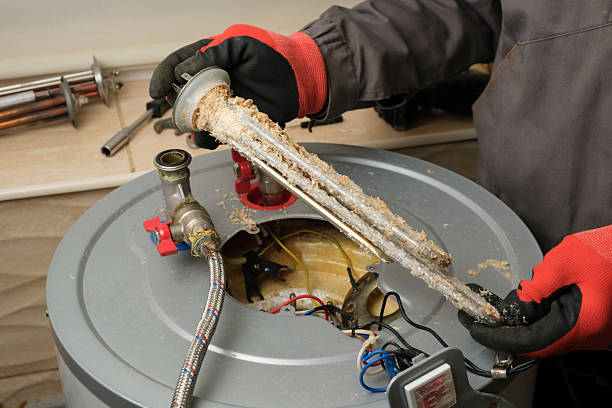
Yes — hard water damages appliances, and in Central Texas it’s not a maybe. Every water-using machine in a Waco-area home collects mineral scale: water heaters first, then dishwashers, washing machines, and refrigerator ice makers. It even reaches a few corners of your HVAC system, though not the ones most articles claim.
We repair both appliances and HVAC across McLennan and Bell counties, which means we spend a lot of time looking at what limestone water actually does to equipment. This guide maps it out machine by machine: what scale damages, what it costs you, what to do about it, and — because honesty is cheaper than a service call — which “hard water damage” stories are myths.
Does Hard Water Damage Appliances? The Short Answer
Hard water damages appliances by leaving calcium and magnesium scale on heating elements, valves, and spray parts every time water is heated or evaporates. Water heaters, dishwashers, washing machines, and ice makers wear out measurably faster in hard-water areas, and efficiency drops long before anything actually breaks.
The damage is slow, which is exactly why it’s expensive. Nobody calls us about scale. They call about a water heater that rumbles, a dishwasher that stopped drying, an ice maker that quit in August — and scale turns out to be the story behind all three.
How Hard Is Waco Water, Really?
Central Texas sits on limestone. Rain filters through that rock on its way to our lakes and aquifers, picking up dissolved calcium and magnesium, and those minerals ride the water main straight into your house. The USGS hardness scale calls water “hard” at 121–180 mg/L and “very hard” above that — and most Central Texas supplies land on the hard side of that scale. Well water out toward China Spring and Crawford often runs harder than city taps.
Want your actual number instead of a blog’s word for it? Your water utility publishes an annual water quality report (search your city’s name plus “consumer confidence report”) with hardness listed. One minute of looking beats guessing — and it should be the first step before you spend a dime on treatment.
Quick translation if your report uses grains per gallon: multiply by 17.1 to get mg/L. Ten grains is 171 mg/L — firmly hard.
Here’s the kettle test, no lab required: if there’s white crust on your kettle, showerhead, or faucet aerators, that same crust is forming inside every machine that heats or sprays water. The visible scale is the free preview.
The Damage, Appliance by Appliance
| Appliance | What scale does | Early warning | Typical repair territory (Central TX ranges) |
|---|---|---|---|
| Water heater | Sediment blankets the burner/element | Popping, rumbling, slower hot water | $100–$200 flush · $150–$500 element/valve work |
| Dishwasher | Clogs spray arms, films heating element | Cloudy glasses, gritty racks, poor drying | $150–$400 common parts |
| Washing machine | Chokes inlet valves and screens | Slow fills, stiff dingy laundry | $150–$350 valve replacement |
| Fridge ice maker / dispenser | Scales inlet valve and fill tube | Small, cloudy, or hollow cubes; slow trickle | $150–$400 valve/line work |
| Coffee maker & small appliances | Coats heating tubes | Slow brew, weak heat, mineral taste | $10 descaler or the trash can |
Those are industry-typical Central Texas ranges, not our price list — every quote we write is on paper before work starts.
Water heaters: first casualty, biggest bill
Heat forces dissolved minerals out of the water, so the hottest tank in the house scales fastest. Sediment settles on the bottom of a tank heater and forms an insulating blanket over the burner — the heater burns longer to move the same heat, and that popping or rumbling you hear at 9 p.m. is water flashing to steam underneath the sediment layer. The Department of Energy’s water heater maintenance guidance includes periodic tank flushing for exactly this reason.
Tankless units don’t get a pass; scale coats their heat exchanger passages instead, which is why manufacturers in hard-water areas call for descaling service — often annually — to keep the warranty happy.
Dishwashers: the appliance that shows it first
Your dishwasher advertises hard water damage before any other machine: cloudy glassware, white film, gritty rack wires, dishes that won’t dry. Scale narrows spray-arm holes, coats the heating element, and packs into the racks themselves. We’ve covered the fixes in detail — how to clean dishwasher racks the hard-water way for the scale, and dishwasher rack repair for what rust does once coatings wear through. When cleaning stops helping and cycles run long, the machine itself needs eyes on it.
Washing machines: death by inlet valve
Scale collects on the small screens and solenoid valves where water enters the machine. Fills get slower, the machine compensates, and one day the valve sticks. Meanwhile hard water neutralizes a chunk of your detergent’s cleaning power — the minerals react with surfactants before they ever touch the laundry — so clothes come out stiff and dingy and you respond by adding more soap, which builds more residue. That loop is why laundry feels different in Waco than it does in a soft-water city.
Refrigerators: the quiet one nobody suspects
Ice makers and door dispensers run the narrowest water paths in the house, so a little scale goes a long way. The classic pattern: cubes shrink, go cloudy or hollow, the dispenser slows to a trickle, and eventually the inlet valve or fill tube gives up — usually in July, when the ice matters most. If your cubes have been shrinking all spring, that’s a refrigerator repair visit before it’s a dead valve in a heat wave. Change the water filter on schedule; a scaled, overdue filter chokes flow and makes the valve work harder.
Coffee makers and countertop machines
Same physics, smaller pipes. If the brew has slowed to a sad drip, run a descaling cycle with citric acid or the manufacturer’s solution. At $10 for descaler versus a new machine, it’s the cheapest win in this entire article.
Hard Water and Your HVAC: What It Touches, What It Doesn’t
Here’s the section no dishwasher blog and no HVAC blog will give you, because most companies only work one side of this fence. We work both, so let’s be precise about where hard water actually meets your heating and cooling — and where it’s wrongly blamed.
Where hard water does reach your HVAC
Furnace-mounted humidifiers. A whole-house humidifier feeds on tap water, and in our water that means the pad or nozzle crusts with minerals every season. A scaled pad wicks poorly, humidifies weakly, and can dump white dust into the duct path. If you run one, its pad is an every-season replacement here, not a suggestion.
Hosing down your condenser. Rinsing the outdoor unit’s coil is good maintenance — but hard tap water dries on the fins and leaves a mineral film that traps the next round of dust and cottonwood fluff. Rinse on a schedule, let it dry, and don’t be surprised by white residue on the fins; that’s your water, not a coil defect. A proper coil cleaning during a seasonal HVAC tune-up deals with it correctly.
Anything with a heat exchanger fed by tap water. Tankless water heaters and hydronic setups scale exactly like a kettle. If your heating equipment touches supply water, hardness is on its maintenance schedule whether the manual says so or not.
Where it doesn’t — two myths worth killing
“Hard water clogged my AC drain line.” No. The water in your condensate line condensed out of the air on the evaporator coil — it’s essentially mineral-free, no matter what’s in your taps. The sludge that clogs Texas drain lines every summer is algae and dust, and the fix is drain-line cleaning, not water treatment. Different problem, different bill, and a company that blames your water supply for a condensate clog deserves a second opinion.
“Scale ruined my evaporator coil / refrigerant system.” Your refrigerant loop is sealed and never touches tap water. Coil problems come from airflow, filters, and refrigerant charge — not from what’s in your kitchen faucet.
We’d rather tell you what hard water doesn’t do than let the scary version sell you something. It has plenty of real damage to answer for.
9 Warning Signs Scale Is Winning
- White crust on faucets, showerheads, or the kettle — the free preview of every machine’s insides.
- Popping or rumbling from the water heater tank.
- Hot water that runs out faster than it used to — sediment is eating tank capacity.
- Cloudy glassware and gritty dishwasher racks even after cleaning.
- Slow washer fills and laundry that comes out stiff or dingy.
- Shrinking, cloudy, or hollow ice cubes, or a dispenser slowed to a trickle.
- Rising utility bills with no change in habits — scaled heating elements burn longer for the same result.
- Repeat repairs on the same valves — if a part fails twice, look at what’s flowing through it.
- Soap that won’t lather and a filmy feel after washing up.
Three or more of these, and you’re not collecting coincidences. You’re describing your water.
What Hard Water Quietly Costs You
Scale is an efficiency tax before it’s a repair bill. A layer of mineral on a heating element insulates it, so the element runs longer per cycle — you pay that difference every month, invisibly, in gas or electricity. Then components start dying young: water heaters and dishwashers in hard-water homes routinely give up years earlier than their soft-water twins, which turns a 12-year appliance into an 8-year appliance. Our guide on how long appliances should last gives the baselines; hard water is the biggest local reason homes miss them.
Stack it up: modestly higher energy use on every water-heating cycle, plus earlier replacement on the two or three most expensive machines in the house, plus the occasional $300 valve call in between. None of it arrives as a bill labeled “hard water.” All of it is.
How to Protect Your Appliances (Without Buying Gadgets)
Check your number first. Pull your utility’s water quality report before spending anything. Treatment decisions start with data, not dread.
A water softener is the real fix — with real trade-offs. Softening swaps calcium and magnesium for sodium before water reaches your plumbing, and it genuinely works; it’s the only whole-house solution we see hold up. It’s also a purchase: installed systems typically run $1,000–$3,500 in Central Texas depending on capacity and plumbing access, plus salt refills and occasional service. Plumbing outfits install them — we don’t sell softeners, we just repair what happens without them, so take this as an observation, not a pitch. And skip the clip-on magnetic “descalers”: there’s no credible evidence they change water chemistry.
Descale on a schedule, not on symptoms. A citric-acid cycle in the dishwasher and washer every month or two, coffee gear monthly, and humidifier pads every season. It’s fifteen minutes of prevention against the whole list above.
Flush the water heater once a year. Draining sediment off the tank bottom is standard maintenance in hard-water country. If you’re comfortable with the drain valve procedure, it’s a hose and an hour — but if it involves the gas control, the pilot, or anything you’d have to guess at, that’s where you stop and have a licensed tech do it. Scald-hot water and gas valves are a bad place to learn by experiment.
Keep filters honest. Fridge filters on schedule, rinse aid topped up, washer inlet screens rinsed once a year. Small, boring, effective.
When Scale Has Already Won: Repair or Replace
Descaling restores efficiency; it doesn’t restore metal. Once an element has burned out under sediment, a valve has stuck, or a heat exchanger is choked, you’re in repair-or-replace math: the age of the machine, the price of the part, and what the same money puts toward a new unit. As a rule of thumb we’ve used for years, a repair costing more than half the replacement price on a machine past two-thirds of its expected life is money better spent forward.
That call is easier with a written quote in your hand. Every visit ends with one before any work starts — and if another company has already named a scary number, a free second opinion is exactly what it’s for.
FAQ: Hard Water and Your Appliances
Is hard water bad for appliances?
Does hard water affect air conditioning?
Can hard water break a refrigerator ice maker?
How do I know if my home has hard water?
Does hard water damage tankless water heaters?
The Straight Answer, One More Time
Hard water is quietly taxing every water-using machine in your house — and around Waco, that’s not alarmism, it’s geology. Check your number, descale on a schedule, flush the tank, and treat the whole-house fix as a data decision. When a machine is already rumbling, trickling, or quitting, get a straight answer and a written quote — we’ll tell you whether it’s a $150 valve, a descaling job, or a machine that’s earned retirement. Seniors and military get 10% off repairs.
On Point Service Company is a family-owned HVAC and appliance repair company in McGregor, TX, serving the greater Waco area with 20+ years of combined experience. Licensed & insured · TDLR License TACLB00069239E ·