



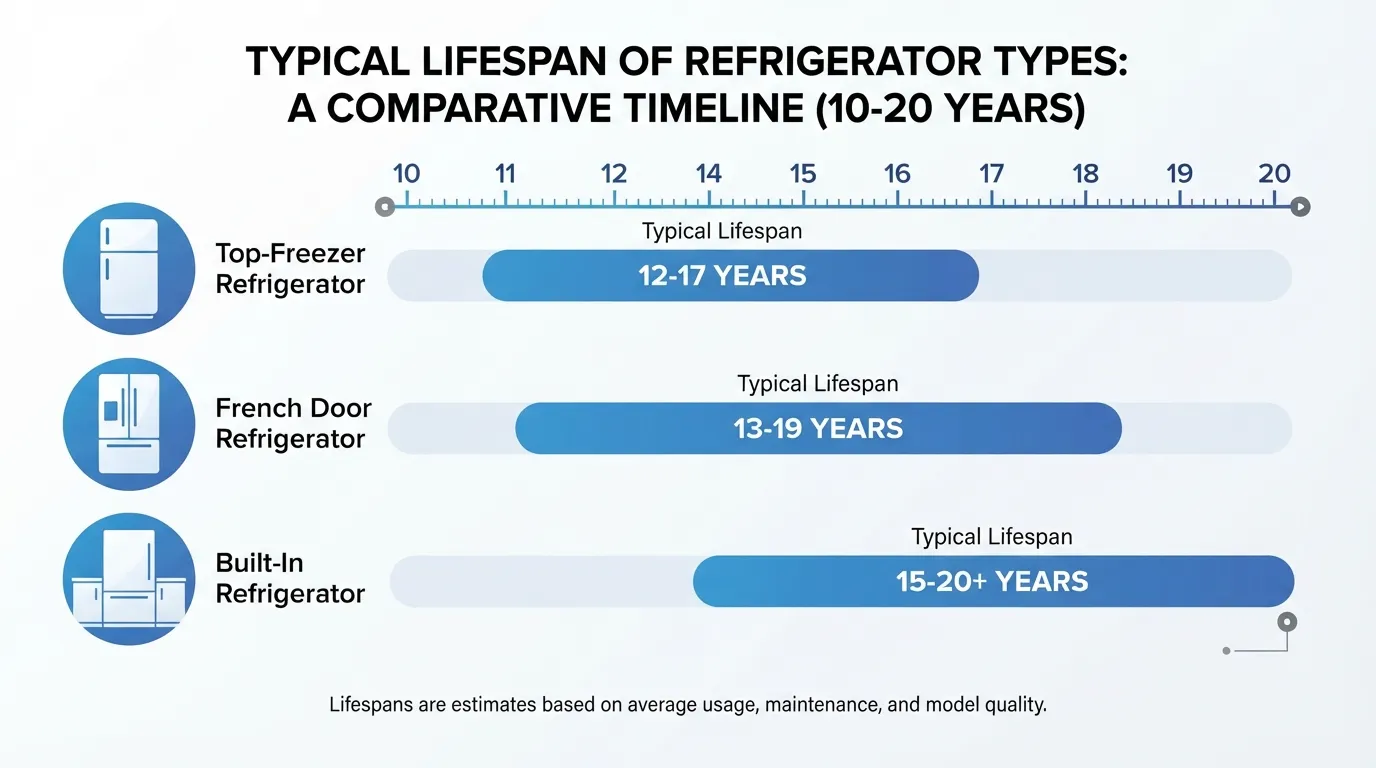
Refrigerators last 10 to 15 years, with most giving up around 12. Built-ins and simple top-freezer units run longer; feature-loaded French-door boxes tend to run shorter. And around here, subtract a year or two more: Central Texas hard water and garage duty age a fridge faster than the national averages assume.
That’s the whole answer. The useful part is what moves your fridge toward 15 instead of 9, so let’s do that.
The honest number, by fridge type
Refrigerator lifespan tracks build simplicity more than brand badge. A plain top-freezer with a dial thermostat is the pickup truck of kitchen appliances; 15 years is common and 18 happens. French-door units with door screens, dual ice makers, and touch panels carry more parts that can die, and every one of them is a potential $300 conversation. Built-in and premium boxes are engineered for 15–20, which is part of what you’re paying for.
ENERGY STAR draws its own line at 15 years, the point where replacement starts paying for itself in electricity even if the old box still runs. We’d add the repair-shop version: the last third of any fridge’s life is when the parts funerals start, usually one every year or two.
Our honest, slightly unfashionable opinion: if longevity is the goal, buy simpler. Fewer features, fewer failures.
What shortens a fridge’s life in Central Texas
Three local accelerants, in order of damage:
Hard water. Every drop feeding your ice maker and dispenser carries minerals that scale up the inlet valve, the line, and the filter housing. Valves that should last the life of the fridge die at year 6 instead. If your dishwasher’s already crusty, the fridge is on the same diet; here’s what hard water does to appliances across the whole kitchen.
Heat. A fridge sheds heat through its condenser coils, and shedding heat into a 95° room is simply harder work. Kitchens without good AC, west-facing walls in August, and garages (more on those next) all raise the duty cycle. More running hours per year means an older fridge at the same age.
Coil neglect. Not local, just universal. Dusty coils force the compressor to run hot and long. Five minutes with a vacuum twice a year is the difference between a compressor that retires at 9 and one that sees 15.
The garage fridge lives a hard, short life
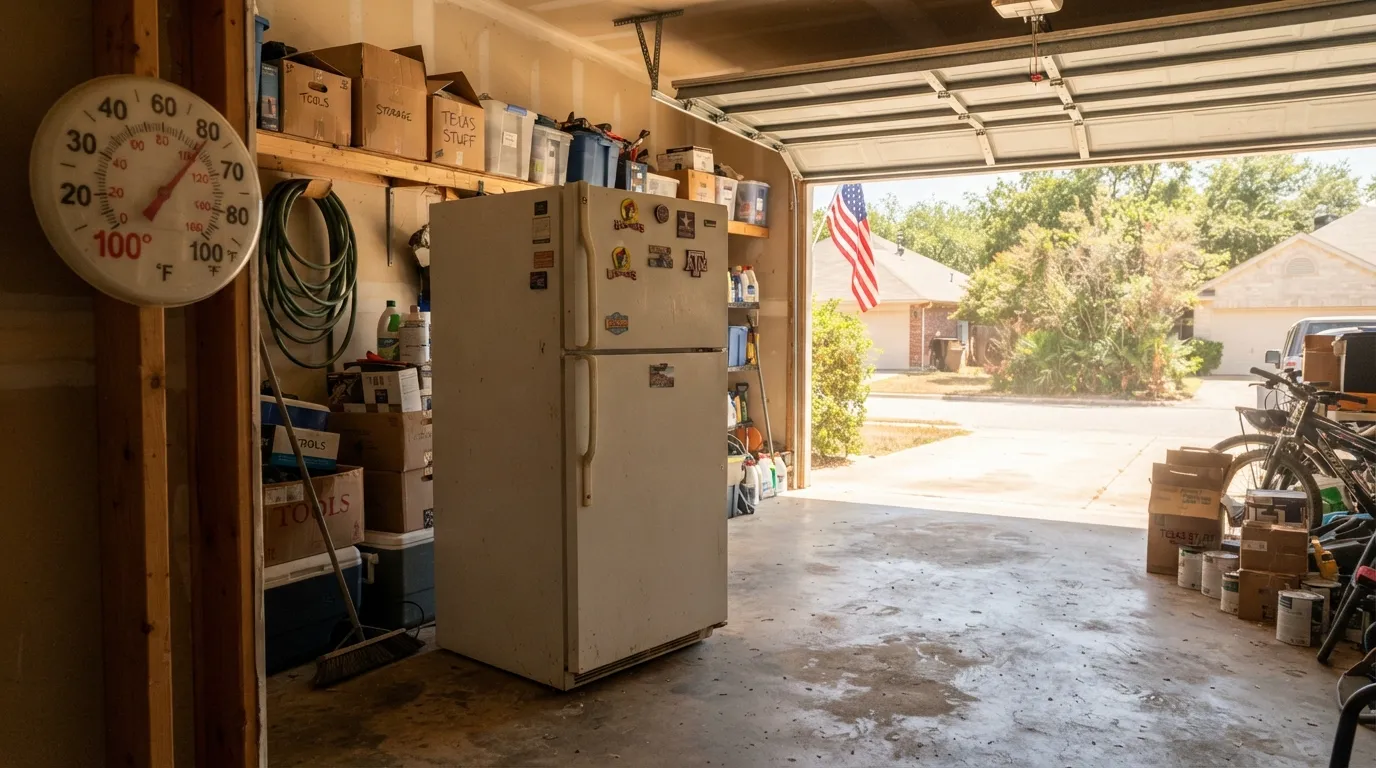
Texas garages are appliance purgatory, and both seasons take a swing.
Summer is the obvious one: 110°+ garage air half the year means the compressor barely gets to rest, and the beer fridge that moved out there at year 8 rarely sees year 12. Deer season through Fourth of July, it’s the hardest-working appliance you own.
February is the sneaky one. When a cold snap drops the garage below about 40°, a standard fridge’s thermostat decides the world is cold enough and stops running — and the freezer section quietly thaws your sausage while the fridge side sits there smug. If you keep a garage unit in Moody or Crawford for game meat, either buy one rated for garage duty or put a thermometer in the freezer and check it during freezes.
Count the garage years differently when you’re doing lifespan math, too. A fridge that spent a decade in conditioned air and then moved to the garage at year 8 will age its remaining years double-time. Plan its replacement on that schedule, not the calendar’s.
How to extend the life of your refrigerator
The list is short and none of it needs a tech:
- Vacuum the coils twice a year (spring and fall changeovers make a good calendar hook).
- Wash the door gaskets with warm soapy water and run the dollar-bill test; drag means seal.
- Keep it about three-quarters full. Thermal mass helps; suffocation doesn’t. Leave the air vents clear.
- Change the filter every six months. Sooner here, our water earns it.
- Give it breathing room. An inch or two off the wall keeps the coils out of a heat pocket.
- Level it so doors swing shut instead of hanging open a crack.
- Skip the extended warranty, in our opinion, and spend the money on a coil brush and a filter habit instead. Boring beats insured.
That’s the entire longevity program. There’s no secret eighth item.
When to stop investing in an old fridge
Age plus symptom decides it. A fridge running constantly, hot on the sides, frosting up, or spoiling milk ahead of date is spending its savings. Under 8 years old, fix it, almost always. Past 10, only the cheap fixes make sense, and the refrigerator repair cost guide runs that 50%-rule math in real numbers.
Part of our business is telling people at year 12 to put the quote toward a new box instead, which is a strange way to run a refrigerator repair service and exactly why folks call us back for the dishwasher. If you’re weighing every appliance in the house at once, our whole-kitchen lifespan guide covers the full lineup; this post is the fridge-specific deep file.
Common questions about refrigerator lifespan
How long do refrigerators last on average?
Can a refrigerator last 20 years?
Is it worth repairing a 12-year-old refrigerator?
Do garage refrigerators wear out faster?
Where to go from here
Vacuum the coils this weekend; that single habit moves the whole curve. And if your fridge is past 10 and making expensive noises, get a straight answer and a written quote or call before you commit either way — a free second opinion has talked more than one Waco kitchen out of a repair it didn’t need.
The On Point Team · On Point Service Company — family-owned HVAC & appliance repair, McGregor, TX · Serving Waco, Temple, Belton, and surrounding Central Texas towns · Licensed & insured, TDLR License TACLB00069239E ·