






Most HVAC financing is a loan arranged at your kitchen table: the contractor runs your application through a partner lender, approval comes back in minutes, and the system goes in before you’ve paid a dollar. The part that decides whether that’s a good deal is one distinction, true 0% versus deferred interest, and it hides in the promo paperwork’s fine print.
We’re a repair-first shop, so half our advice on five-figure decisions is “let’s see if you need one at all.” But when replacement is genuinely the answer, financing done with open eyes beats draining savings in a Texas June. Here’s the whole machine, fine print included.
How the kitchen-table loan works
HVAC contractors don’t lend money; they broker it. The industry runs on partner lenders (consumer-finance companies and credit unions with contractor programs), and the contractor’s tablet is the storefront. You apply on the spot, a decision lands in minutes, and the lender pays the contractor while you repay the lender.
Two things about that arrangement are worth knowing before you touch the tablet.
The speed is designed. Same-visit approval exists so the yes happens while the truck’s still outside. Convenient, genuinely. Also worth slowing down on purpose, because the paperwork you sign in five minutes runs 60 to 120 months.
And the contractor pays the lender a dealer fee for promo financing, commonly several points of the job price. That fee lives somewhere, and it’s usually in your number. Which is why the sharpest question in this whole post is: “What’s the price if I pay cash?” A gap between the cash price and the financed price is the fee surfacing, and knowing it exists gives you room to decide — or bargain.
True 0% vs. deferred interest: the whole game
Promo financing comes in two costumes that look identical on a yard sign.
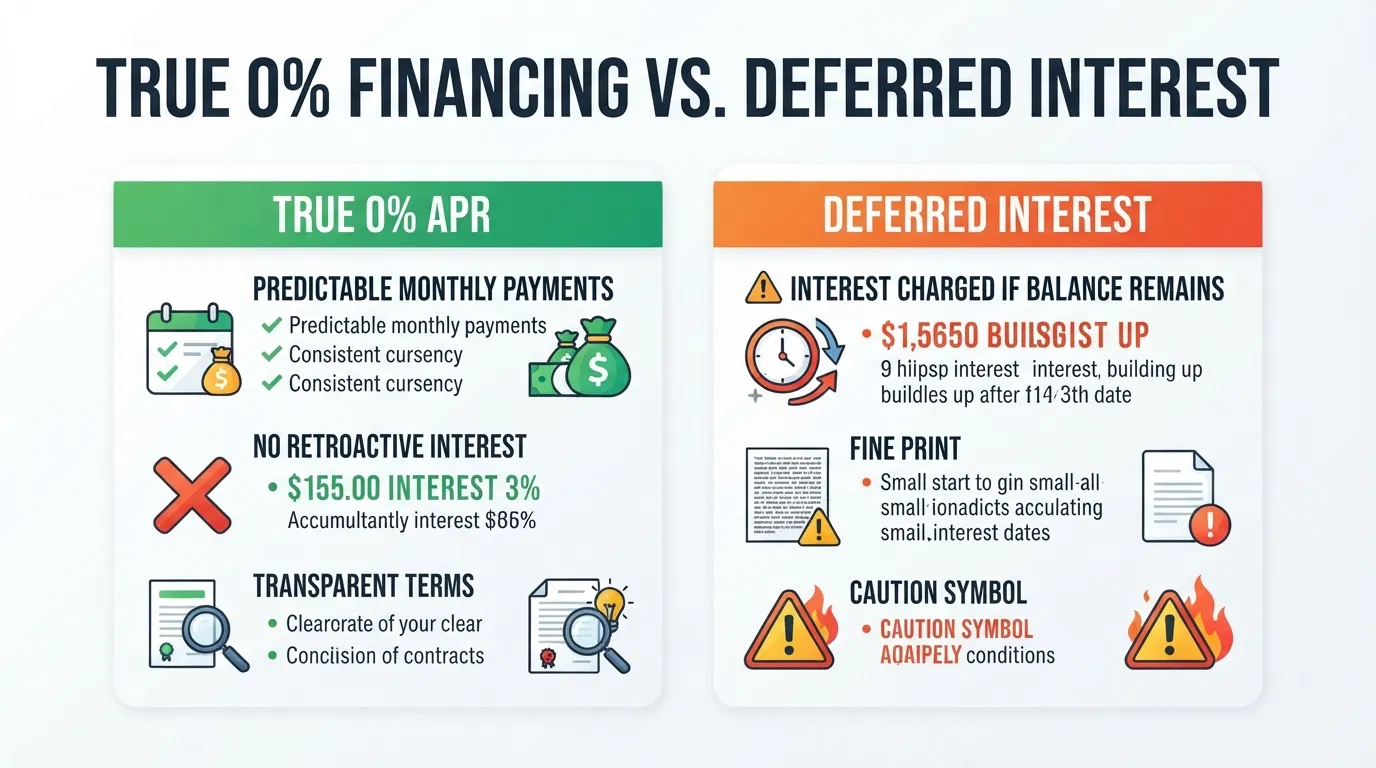
True 0% (equal payments): an $8,000 system over, say, 48 months at $166 and change. No interest ever, as long as you make the payments. The lender got paid via the dealer fee. Fine product, honestly priced money.
Deferred interest (“no interest if paid in full by…,” “same as cash”): interest starts accruing on day one at the card’s real rate, often 26% to 30%, but stays invisible. Pay the entire balance by the deadline and it vanishes. Miss it, even by $200, and the accrued interest on the whole original amount lands on your statement at once. On $8,000 over 18 months, that’s a surprise in the low thousands — for being one payment short.
The CFPB’s deferred-interest explainer is the neutral read on the mechanics. Our opinion is less neutral: deferred interest is a bet the lender usually wins, because it was engineered around how people actually behave with 18-month deadlines. If you take one anyway, set the payoff auto-draft two months early and treat the deadline like a rattlesnake.
The tell on paper: “equal monthly payments, 0% APR” is the real thing. “No interest if paid in full” is the trap wearing its cologne.
What it does to your credit
Prequalification runs a soft pull: no score impact, and worth asking for by name. The actual application is a hard inquiry, a few points, minor and temporary.
The quieter effect: many contractor programs are revolving accounts, essentially a store card the size of an AC. A fresh $10,000 line changes your utilization and average account age, which matters if a mortgage refinance is in your next year’s plans. Not a reason to skip financing; a reason to not apply at three companies in one afternoon “just to compare.” Compare quotes first, apply once.
Six questions to ask before you sign
Run these past any contractor, us included:
- Who’s the lender? You’re starting a years-long relationship with them, not with the person holding the tablet.
- True 0% or deferred interest? Ask in exactly those words, then find the answer in the paperwork too.
- What’s the cash price? The gap tells you the dealer fee, and whether “0%” was prepaid in your quote.
- What’s the rate after the promo? That’s the number you’ll live with if plans change.
- Any prepayment penalty? Paying it off early should cost nothing. Confirm.
- What’s the payment at the term I’d actually choose, and the total of all payments? A $148/month quote over 120 months is a five-figure system wearing a small hat.
A contractor who answers all six without flinching is telling you something good about the rest of their paperwork, too. It’s the same instinct as our written-quote-before-any-work policy: numbers in daylight.
When financing beats cash (and when it doesn’t)
Where it makes sense: a genuine replacement in brutal weather, when the alternative is gutting your storm fund. If your AC dies for good in a 100° Waco July with $9,000 of work on the table, a true-0% plan that keeps your savings intact is a reasonable tool, not a failure. Money for a fair rate while your buffer stays whole is exactly what credit is for. Run what a new system costs installed around Waco first so the number you’re financing is sane to begin with.
Where it doesn’t: repairs. Financing a $450 capacitor-and-service visit through a 26% revolving line turns a repair into a subscription. And never let a monthly payment answer the repair-or-replace question. “$160 a month” is designed to feel smaller than “$11,000,” but they’re the same money. Decide off the total, using the actual decision criteria in when to replace an AC unit, then pick how to pay. Same math applies on the heating side; we broke down furnace replacement costs separately.
The trade-off cuts the other way too, and it deserves saying: emptying savings to dodge a fair 0% loan leaves you one water heater away from a credit-card balance at 24%. Cash isn’t automatically the virtuous choice. Buffer beats interest-free pride.
Where we stand on AC financing in Texas
Ours is simple to state: flexible financing is available on new system installations, arranged through [CONFIRM: financing partner/terms], and we offer free estimates on new HVAC system installations only, so the number you’d be financing costs nothing to find out. Bring the six questions above to our kitchen table too; if any answer of ours doesn’t hold up in writing, that’s a replacement conversation you should walk away from. [CONFIRM: promo structures offered, terms, lender name before publish; no specifics beyond “flexible financing available” are claimed in this draft.]
Essential HVAC Financing FAQs for On Point Service Company
What credit score do you need for HVAC financing?
Is 0% HVAC financing really 0%?
Can you finance an AC repair?
Does HVAC financing hurt your credit?
The short version
HVAC financing is a fine tool with one booby trap: know your lender, demand the cash price, and make sure “0%” means equal payments — never “if paid in full.” Get the system decision right before the money decision, and get both in writing. When you’re ready to price it, get a straight answer and a written quote or call