



Appliance repair for a rental property runs on different math than repair in your own kitchen. Three rules cover most of it: durability beats features, speed beats price in July, and the repair-or-replace line sits lower than it does in a house you live in. Get those three straight and most decisions make themselves.
The rest of this page is the playbook we’d hand any landlord along the Waco corridor: what tenants actually mean when they text “the fridge is broken,” typical Central Texas repair costs against rental-grade replacements, and the clock that starts the moment that text lands.
On this page:
- The rental math is different
- What tenants report vs. what’s actually broken
- The 15-minute triage before you send anyone
- Rental property appliance repair costs: the table
- Repair or replace in a rental: durability beats features
- Landlord HVAC repair: July is a habitability clock
- Response times: what tenants and Texas expect
- The Baylor calendar problem
- Keeping units rentable through a Central Texas summer
- Set this up before anything breaks
- Landlord FAQ
The rental math is different
When your own dishwasher dies, you’re weighing convenience against money. When a rental’s dishwasher dies, you’re weighing money against money: the repair bill, the replacement cost, the vacancy risk if the unit starts feeling neglected, and your own hours spent coordinating all of it.
That last one is the number landlords forget. A $220 repair that takes one phone call is cheaper than a $150 repair that takes four, a missed meeting, and a tenant who’s now texting you nightly.
So the rental version of repair-or-replace adds two questions to the usual ones. First: how many more tenancies does this machine need to survive? Second: what does the fix cost me in coordination, entry notices, and tenant goodwill, on top of the invoice?
A machine in a rental also lives a harder life. Nobody descales a dishwasher they don’t own. Lint screens get cleaned when they get cleaned. So the same repair buys fewer years in a rental than it would in your own house, and your math should assume that. We wrote up how long appliances actually last — knock a year or two off those figures for a hard-used rental and you’re close.
What tenants report vs. what’s actually broken
Tenants report symptoms, not diagnoses, and the translation gap is where landlords waste the most money. A few patterns we see over and over on rental calls around Waco and Temple:
“The fridge is broken” usually means warm. Sometimes it means the ice maker quit, which is a different repair at a different price. Occasionally it means someone set the dial to off while cleaning. Ask for a photo of the inside with a thermometer if you can get one; ask what’s warm (fridge side, freezer side, both) if you can’t.
“The AC doesn’t work” splits three ways: no air at all, air but warm, or air that runs constantly and never catches up. The first is often electrical, the second is the classic capacitor-or-refrigerant fork, the third might be a filter so clogged it’s suffocating the system. Which one it is changes the urgency and the bill.
“The dishwasher floods“ is frequently a clogged filter or an air-gap backup, both of which cost nothing. An actual leak underneath is a real repair. The difference is whether water shows up during the cycle or under the machine.
“The outlet sparked and the dryer died” means stop and send someone today. Anything that smells hot, trips breakers repeatedly, or involves a gas odor skips triage entirely.
“Nothing in the kitchen works” is a tripped breaker more often than it’s four simultaneous appliance failures. It’s also occasionally a genuinely scary panel problem, which is why the triage script below asks about the breaker box by name.
None of this makes tenants unreliable narrators. They’re reporting what they see. The translation is your job, or the job of whoever answers your repair calls.
The 15-minute triage before you send anyone
The honest downside of hiring any repair company, ours included: repair visits carry a small service fee that covers travel and diagnostic time. That fee stings when the fix was a tripped breaker the tenant could’ve reset. So burn through the free checks first, by text, before anyone drives.
Here’s a script you can paste. It reads friendly and takes a tenant five minutes:
- Breaker box: “Any switches sitting in the middle or pointing the wrong way? Flip it fully off, then on, once.”
- Power: “Is the machine plugged in snug? Does the outlet work with a phone charger?”
- Thermostat (AC calls): “What’s it set to, what does the screen read, and does the screen have fresh batteries?”
- Filter (AC calls): “When did the air filter last get changed? Hold it up to a light — can you see through it?”
- Dishwasher/washer drains: “Pull the bottom filter and send me a photo of what’s in it.”
- Photos: “Send a picture of the model sticker inside the door or behind the kick plate.”
That model-sticker photo matters more than it looks. It tells a repair shop what parts the truck should carry, which is the difference between one visit and two. One visit, one fee.
If the checks come back clean, something real is broken and the service call stops being a gamble. We explained the fee’s whole anatomy in why the service call fee exists; the short version is that it buys a diagnosis and a written quote, and the quote is yours whether or not you approve the work.
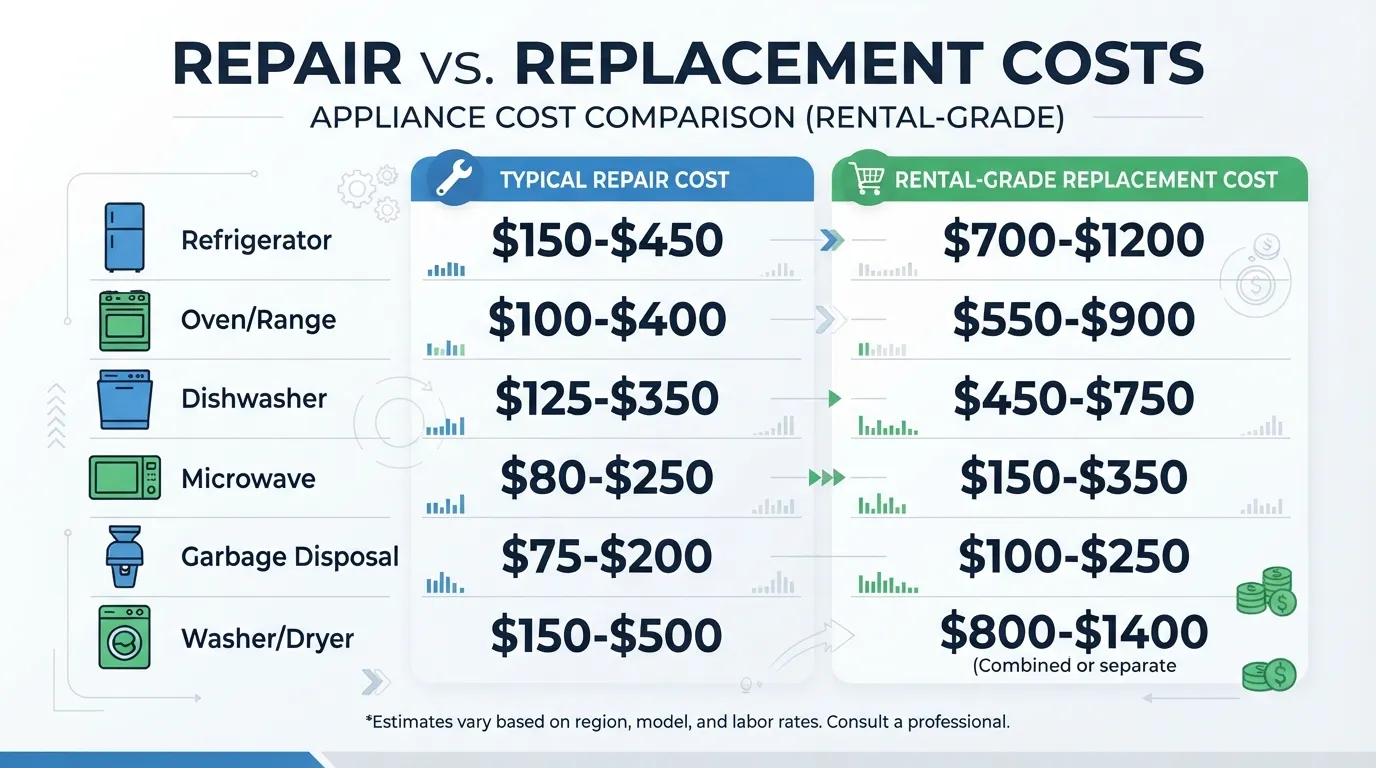
Rental property appliance repair costs: the table
The ranges below are industry-typical for Central Texas, parts and labor together. They’re not our price list — your written quote is the real number — but they bracket what normal looks like, so nobody can quote you fiction on a property you don’t live at.
| Appliance | Typical repair range | Rental-grade replacement | Lean |
|---|---|---|---|
| Refrigerator (top-freezer) | $150–$450 | $600–$900 | Repair under 8 years; sealed-system failure = replace |
| Dishwasher | $100–$350 | $450–$650 | Repair the mechanical stuff; dead board past year 8 = replace |
| Electric range | $100–$300 | $600–$850 | Repair — elements and switches stay cheap |
| Washer | $150–$400 | $600–$850 | Repair young machines; bearings past year 8 = replace |
| Dryer | $100–$300 | $550–$800 | Repair — elements, fuses, belts are routine |
| Garbage disposal | $80–$150 | $150–$300 installed | Replace; repairs rarely pencil out |
| Over-the-range microwave | $100–$250 | $250–$400 | Replace unless it’s nearly new |
Two things jump out of that table. Disposals and OTR microwaves are effectively consumables in a rental — budget them as replacements and stop thinking about them. And the refrigerator is the one appliance where the repair range and the replacement number genuinely fight each other, which is why we broke out typical refrigerator repair costs line by line. Same logic exists for the dishwasher repair-or-replace math if that’s this week’s problem.
Repair or replace in a rental: durability beats features
For an owner-occupied kitchen, the 50% rule does the work: if the repair costs more than half of what you’d spend on the machine you’d actually buy, replace. In a rental, run the same rule against a rental-grade replacement, and buy differently than you would for yourself.
Buy the plain top-freezer refrigerator. Ice makers are the single most repair-prone system in any fridge, and door dispensers double the failure points. A $650 top-freezer with no dispenser will outlast a $2,200 French-door in tenant service, and when it does need work, the parts are cheap and everywhere. The fancy fridge doesn’t raise the rent. The dead fancy fridge lowers it.
Same reasoning down the line: electric range over gas where the unit allows (fewer service calls, no igniter complaints), mechanical-dial washer if you can still find one, dishwasher one step above builder-grade because the true bottom shelf dies fast enough to erase the savings.
There’s a trade-off to owning this strategy, and it’s worth saying plainly: base-model appliances make a unit feel base-model. If you’re renting a renovated place in China Spring at the top of the market, mid-tier stainless may earn its keep in photos and showings. For a workhorse rental near campus, it won’t. Match the machine to the tenant you’re pricing for.
One more rental-specific rule: the second major repair on the same machine inside a year means stop. Machines that fail in clusters are telling you something, and a landlord’s version of listening is a replacement order, not a third invoice.
Landlord HVAC repair: July is a habitability clock
Everything above goes double for cooling. Landlord HVAC repair isn’t really a comfort category in Central Texas — in a 100°+ July week, a dead AC is the one breakdown that can make a unit genuinely unlivable, and Texas law treats it accordingly.
The plain-English version: the Texas Property Code requires a landlord to make a diligent effort to repair any condition that materially affects an ordinary tenant’s physical health or safety, once the tenant gives proper notice and is current on rent. You can read the statute itself, Chapter 92, and you should — we fix machines, we don’t give legal advice. But a house sitting at 92° inside during a heat dome is the textbook argument for a condition that materially affects health, and plenty of Texas attorneys will make it enthusiastically.
Practically, that means AC calls jump the queue. Acknowledge the same day. Get a diagnosis moving within a day or two, faster for at-risk tenants — and if your usual repair contact can’t get there, find one who can. Same-day AC repair in Waco is a real thing during most of the summer; the trick is calling early in the day before the route board fills.
While the fix is in motion, a $120 window unit from a big-box store buys you goodwill and cool air in one bedroom. Cheap insurance against both misery and a repair-and-deduct letter.
And know the fork you’re deciding at: a capacitor swap typically lands between $150 and $400 in Central Texas, while a full system replacement starts around five figures. Those two numbers should never get confused in the same phone call. When someone says “replace,” our air conditioner repair side would rather look first and put the answer in writing — that’s the whole pitch, and it’s the same pitch whether you own one rental or forty doors.
Response times: what tenants and Texas expect
The statute talks about a “reasonable time” and presumes seven days is reasonable in most cases. Treat that as the legal floor, not the customer-service target, because your actual deadline is set by the tenant’s patience and the season.
A workable internal standard for the Waco corridor looks like this: acknowledge every repair text the same day, even if the answer is “triage questions coming.” Dead AC in summer or no heat in a February freeze, eyes on it within 24 hours. Refrigerator warm, within a day or two — food spoilage turns into a reimbursement conversation fast. Dishwasher, dryer, disposal: inside the week is fine, and most tenants are content once a date exists.
The pattern under all of it: tenants don’t leave over breakdowns. They leave over silence. A landlord who answers in an hour with a plan keeps tenants through three appliance funerals; a landlord who goes quiet for four days loses one over a disposal.
Written records save you here too. Repairs requested by text, diagnoses and quotes in writing, invoices filed by unit. If a dispute ever reaches a courtroom or a deposit argument, the paper wins it. That’s one reason a written assessment and quote before any work is our standing policy — it was built for homeowners, but landlords are the ones who thank us for the paper trail.
The Baylor calendar problem
If you rent anywhere near campus, your repair calendar isn’t January to December. It’s August to August.
Move-in week stacks every failure at once: fridges loaded from empty to full in an afternoon and blamed for “not cooling,” washers meeting their first 2 a.m. overload, ACs asked to pull a shut-up house from 95° to 72° during the hottest week of the year. Whatever was marginal in July gets outed in the third week of August.
The move that separates experienced campus-area landlords from new ones: run the machines yourself during the turn, in July, while the unit’s empty. Full dishwasher cycle, dryer on high with a real load, AC pulled down 20 degrees while you watch it. A Waco appliance repair visit in mid-July books days out; the same visit in late August, when every property in a mile radius is calling at once, books longer. Finding the weak dryer before nine months of laundry finds it is the cheapest repair you’ll never make.
Game-day weekends add their own texture — guests, full fridges, disposals meeting brisket. Not much to do about that except own machines that can take it, which loops back to the durability rule.
Keeping units rentable through a Central Texas summer
A short prevention list beats a long repair list. The four that pay for themselves fastest around here:
- Filters on a schedule, not on trust. Deliver a stack of filters at move-in and put a reminder in your own phone. A choked filter is the root of half the summer AC complaints in older Waco stock with undersized returns.
- Condenser coils rinsed each spring. Cottonwood fluff and oak pollen mat the outdoor coil, and the system pays for it every hour of a heat dome.
- Fridge coils vacuumed at every turn. Ten minutes, and it’s the difference between a compressor that survives August and one that doesn’t.
- A hard-water plan for dishwashers. McLennan and Bell County water is hard, and scale is the quiet killer of heating elements and pump seals. A monthly citric-acid cycle, put in the lease’s care paragraph or handled at turns, adds years.
None of this is exotic. It’s the stuff that never happens without an owner making it happen, which is exactly why the appliances in rentals die young.
Set this up before anything breaks
The best time to pick a repair company is not from a hot driveway in July. Sort five things out in advance and every future breakdown becomes a text thread instead of a fire drill:
- A standing authorization number. “Fix anything under $250 without calling me” saves a day of phone tag per incident. Set it wherever your sleep-at-night line is.
- Quotes in writing, always. You’re approving spend on a property you’re not standing in. If a company resists paper, that’s your answer about them.
- Tenant-direct scheduling, owner-direct billing. The shop coordinates entry with the tenant; the invoice and the decision come to you. Ask for exactly that split.
- One shop for HVAC and appliances, if you can get it. Fewer vendors, one relationship, and no “that’s not our trade” dead ends when a breaker-trip mystery could be the AC or the dryer. It’s honestly why landlords find us and stay — HVAC and appliance repair under one roof is rare in this market. To be clear about what we’re not: we don’t manage properties, collect rent, or handle make-readies. We fix machines for the people who do.
- Records by unit. Model stickers photographed, invoices filed, repair dates logged. Your future self, your accountant, and any deposit dispute will all thank you.
For budgeting across a portfolio, ENERGY STAR’s appliance guidance is a useful, neutral reference for lifespans and operating costs when you’re deciding what to buy at replacement time — worth a bookmark next to the cost table above.
Rental Property Maintenance FAQ for On Point Service Company
Who pays for appliance repairs in a rental property?
How fast does a landlord have to fix an AC in Texas?
Is it worth fixing a 10-year-old refrigerator in a rental?
Should landlords buy new or used appliances for rentals?
Does a landlord have to provide a refrigerator in Texas?
Can my tenant hire a repair and deduct it from the rent?
Where to go from here
Put the triage script in your phone, set your authorization number, and line up your repair contact before the next 100° week does it for you. If you own doors anywhere around Waco, Temple, Belton, or McGregor, get a straight answer and a written quote from us at — rental property appliance repair and HVAC, one shop, paper on everything. 10% off repairs for seniors and military, always.
The On Point Team · On Point Service Company — family-owned HVAC & appliance repair, McGregor, TX · Serving Waco, Temple, Belton, and surrounding Central Texas towns · Licensed & insured, TDLR License TACLB00069239E ·