






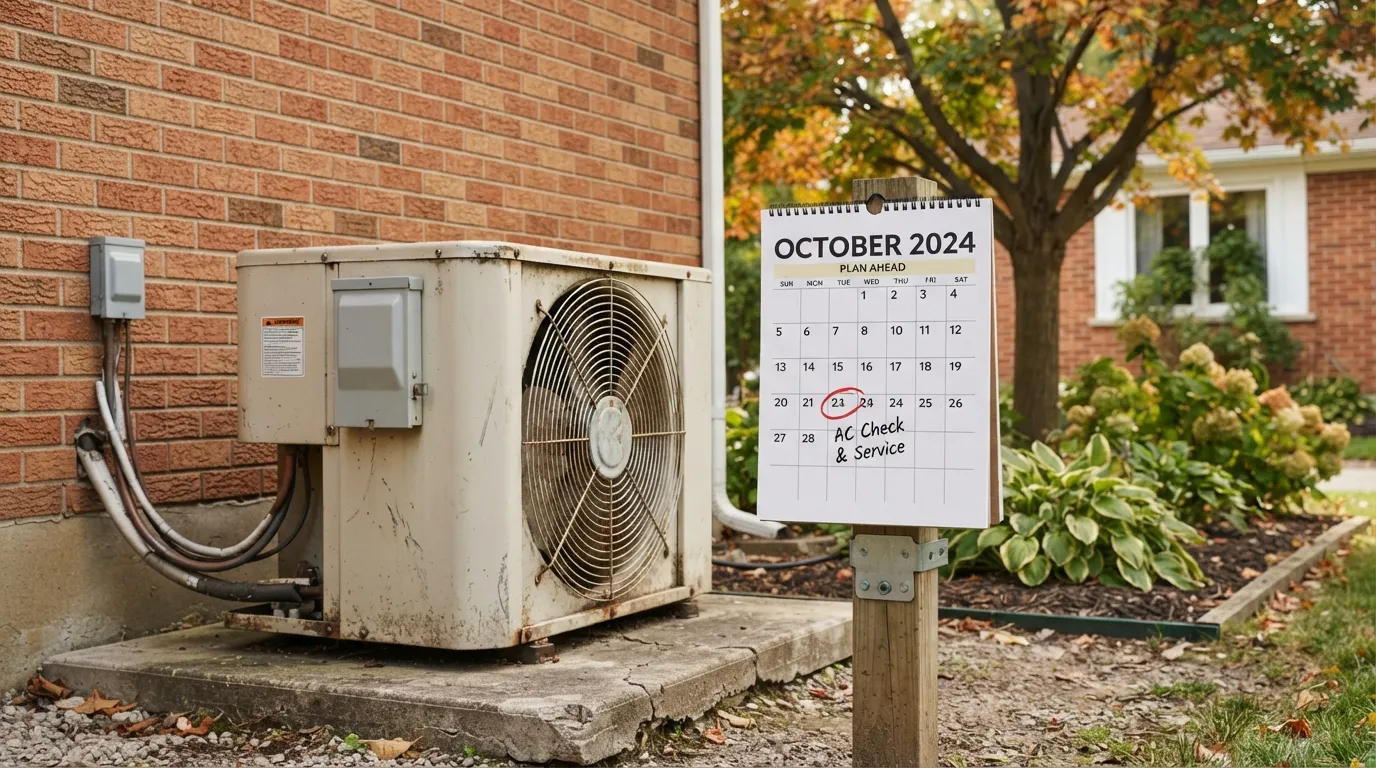
Replace your AC unit when it’s past 10 to 12 years old and repairs start stacking up, when a single repair quote crosses half the replacement price, or when it still runs on discontinued R-22 refrigerant. That’s the condition half of the answer. The other half is the calendar: if the machine gives you any say in the matter, replace it in fall or spring, never July.
Most guides stop at the first half. The second half is where the money and the misery actually live, so this post covers both.
The condition signs: how to know it’s time
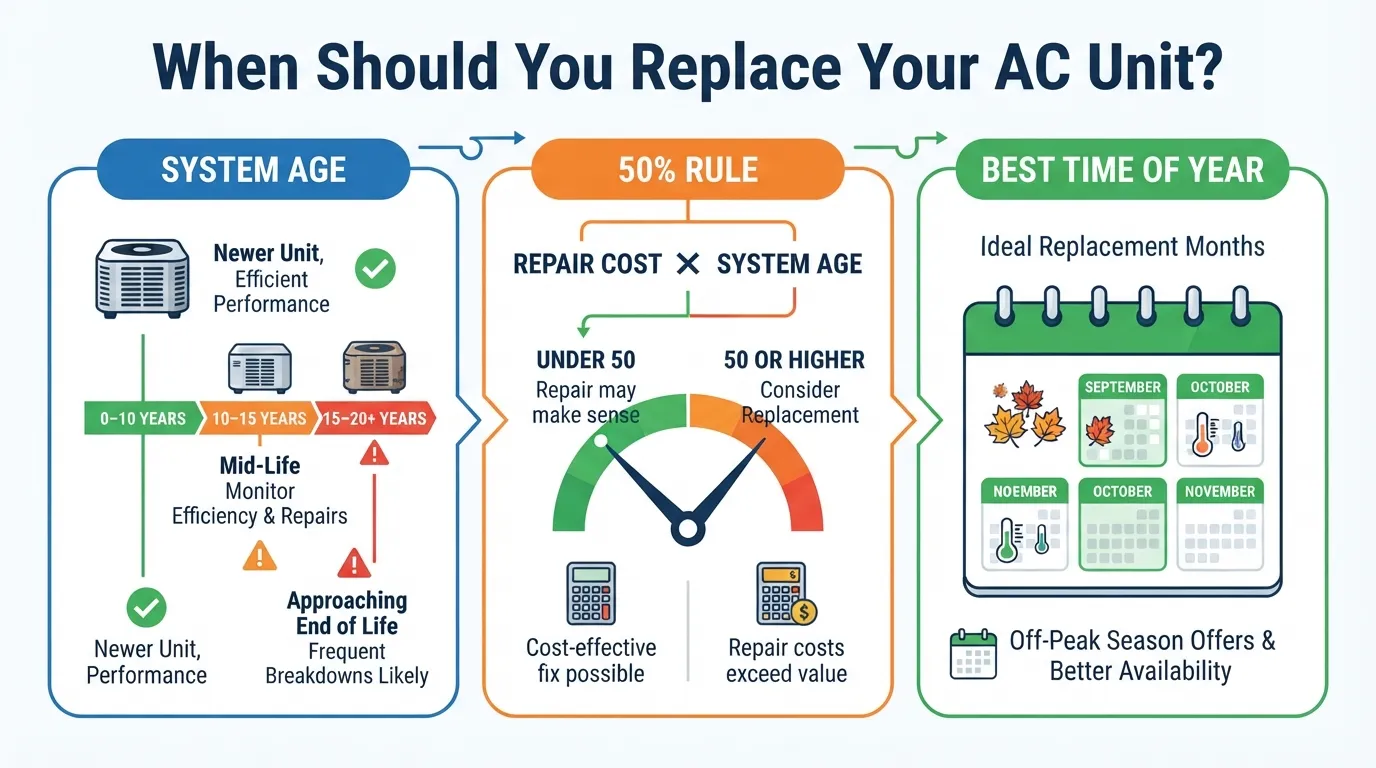
Age. Central Texas run hours are brutal, and 10 to 15 years is the realistic life here. ENERGY STAR’s replacement guidance says a 10-year-old unit is old enough to start weighing replacement, and our summers argue for the early end of every national range.
Repair frequency. One repair is a repair. The second major one inside 18 months is a pattern; machines fail in clusters at the end of their lives.
The R-22 question. If your system went in before roughly 2010, it may run R-22 refrigerant, which is no longer produced. Every leak repair on an R-22 system carries collector’s-item refrigerant pricing, and that fact alone tips the math toward replacement for a lot of older units. (Refrigerant is EPA-certified-tech territory in every case; this is a budget fact, not a project.)
Comfort and bills drifting. Rooms that never quite cool anymore, humidity that hangs around, electric bills creeping up each August with no rate change. Old compressors fade before they fail.
The repair math that decides
The 50% rule: take the repair quote, double it, and if that beats the installed price of a system you’d actually buy, repair it. Age breaks the ties — a $600 fix on a 6-year-old unit is easy, the same fix at year 13 is throwing good money after tired metal.
We built the full decision framework, brackets and all, in is a 10-year-old AC worth repairing, and you can sanity-check any quote against the typical ranges in what AC repair costs in Waco. If the math says repair, repair without guilt. If it says replace, keep reading, because the next question is when.
The best time to replace AC equipment: fall and spring, on purpose
Here’s the part nobody plays well. If your unit is limping rather than dead, the best time to replace AC equipment in Texas is the shoulder season: October through November, or February through April.
Three honest reasons.
Scheduling flips in your favor. In July, installer calendars across Waco, Temple, and Belton are triaged by desperation, and you take what’s available. In October, you pick the week, the crew isn’t racing sundown, and the job gets the unhurried version of everyone’s attention.
You have time to decide well. A shoulder-season replacement means multiple quotes, a real load calculation, and model numbers you actually compared. Manufacturers also cluster their promotions in the slow months, and crews have room to work with you on timing.
The house stays livable. A swap takes a day, sometimes two. In April that’s a mild inconvenience. In a 100-degree August week, it’s a hotel bill or a miserable house, on top of everything else.
What July panic-buying actually costs
Every “air conditioning replacement near me” search in July is somebody sweating, and the market knows it. Decisions made at 88 degrees indoors are fast decisions: the first available unit instead of the right-sized one, sizing shortcuts because everyone’s slammed, popular models backordered exactly when demand peaks.
Our opinion, from watching it happen every summer: the most expensive AC in Texas is the one bought during a heat wave. Same equipment, same street, worse price, worse install, and a week of no-AC days waiting for it.
If your 12-year-old unit barely survived last August, don’t give it the chance to die next July. Replace it on your calendar, not its.
Buying it right, whichever month you choose
A real replacement quote includes a load calculation (not a square-footage guess), exact model numbers, the code items, and a written total with no asterisks. That’s how our air conditioner replacement visits work, and we offer free estimates on new system installations, so comparing quotes costs you nothing.
For what the numbers should look like tier by tier, our AC installation cost in Waco guide breaks down typical installed ranges. Bring it to any quote conversation, including ours.
And when you search “ac replacement near me,” filter hard: TDLR license you can verify, written quotes before work, and somebody willing to show you the sizing math. The cheapest bid that skips those three usually costs the most by year five.
If you have to limp through one more summer
Sometimes the timing is wrong even when the math is right: the budget needs a season, or it’s already June. That’s a legitimate call, and here’s the honest bridge plan: keep the filter fresh, rinse the condenser coil gently with a garden hose (power off first), and don’t ask a fading unit for 68 degrees in August.
A modest repair to reach October is sometimes the smart play, and we’ll say so when it is. The trade-off is real, though: you’re spending repair money on borrowed time, so cap it. Anything over a few hundred dollars going into a 13-year-old unit deserves the 50% math first, and a free second opinion if the quote feels engineered to scare you.
Common questions about when to replace an AC unit
How do I know when my AC unit needs replacing?
What is the best month to replace an AC in Texas?
Should I replace my AC before it dies completely?
How long do AC units last in Texas?
Where to go from here
Two questions, in order: is it time (age plus the 50% math), and can you pick the month (then pick fall or spring). Answer the first with a written quote instead of a guess — get a straight answer or call , and if you’re weighing a replacement someone else proposed, a free second opinion has saved more than one Belton homeowner from buying a unit two sizes too big.
The On Point Team · On Point Service Company — family-owned HVAC & appliance repair, McGregor, TX · Serving Waco, Temple, Belton, and surrounding Central Texas towns · Licensed & insured, TDLR License TACLB00069239E ·