


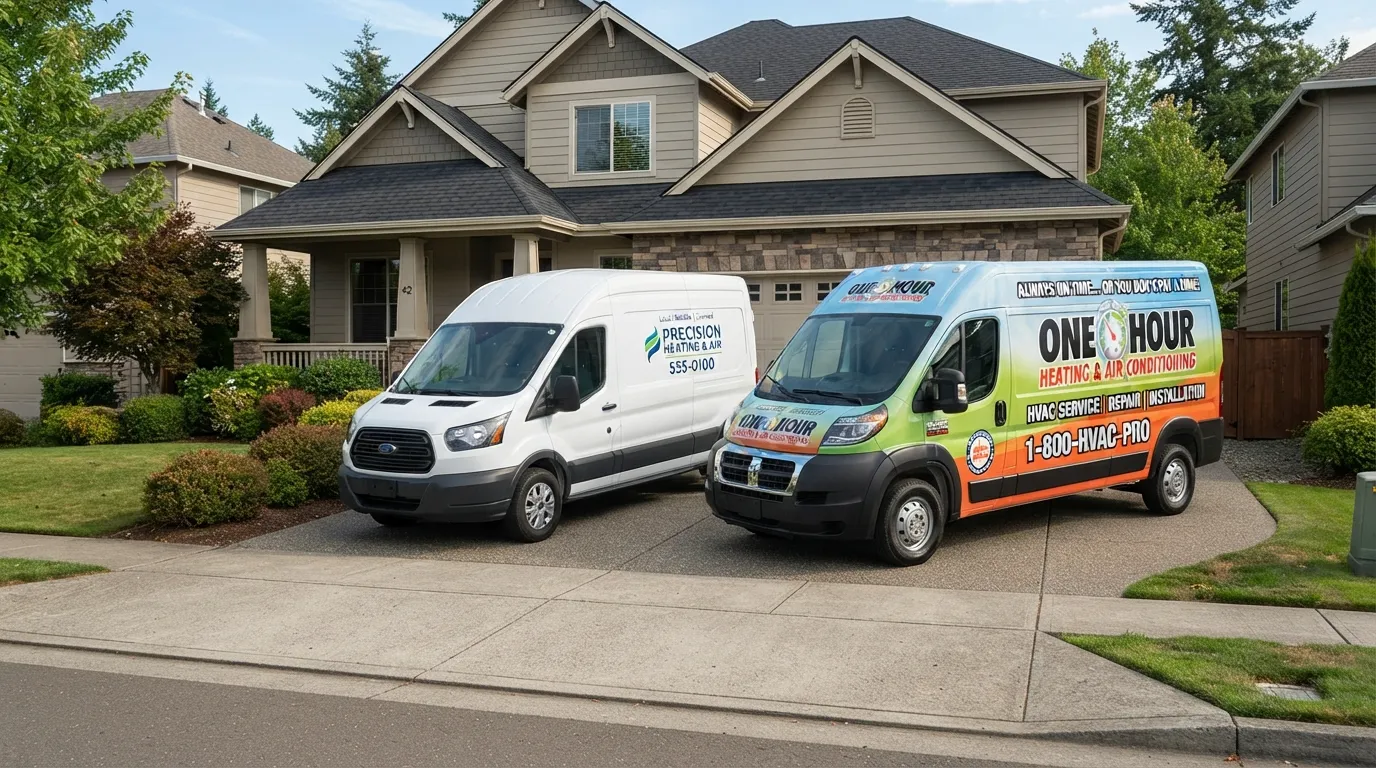
Strip away the ad budgets and the local vs franchise HVAC question comes down to three real differences: who sets the price, how far away the decisions get made, and how the person in your attic gets paid. Everything else (the trucks, the uniforms, the vans wrapped like billboards) is packaging.
Both models can fix your AC. We’re a local shop, so you know where we land, but the honest version of this comparison has trade-offs running in both directions. Here they are, stated as facts instead of mud.
Understanding HVAC Pricing Structures and On Point Service Company
At most franchise operations, pricing comes out of a book. Flat-rate pricing software, built or approved somewhere above the local operator, assigns a set price to each repair task. The tech opens a tablet, taps the task, and reads you the number. That number was designed to cover franchise royalties, national ad spend, call-center staffing, and fleet costs, plus the repair itself.
At a local shop, the owner sets the price, and the overhead it carries is a shop, some trucks, and insurance. Nobody in another state takes a percentage.
Neither model makes a company honest or crooked. Flat-rate books exist partly for consistency, and plenty of local outfits quote high. But it’s worth knowing what you’re comparing when two numbers land in front of you: one price was built to feed a system; the other was built by the person who’ll cash the check. Ask either one to put it in writing and you’ll learn most of what you need. We walked through what a service call costs and why the fee exists if you want the anatomy.
How far away the buck stops
Say the repair goes sideways. The part fails in a month, or the bill doesn’t match the quote.
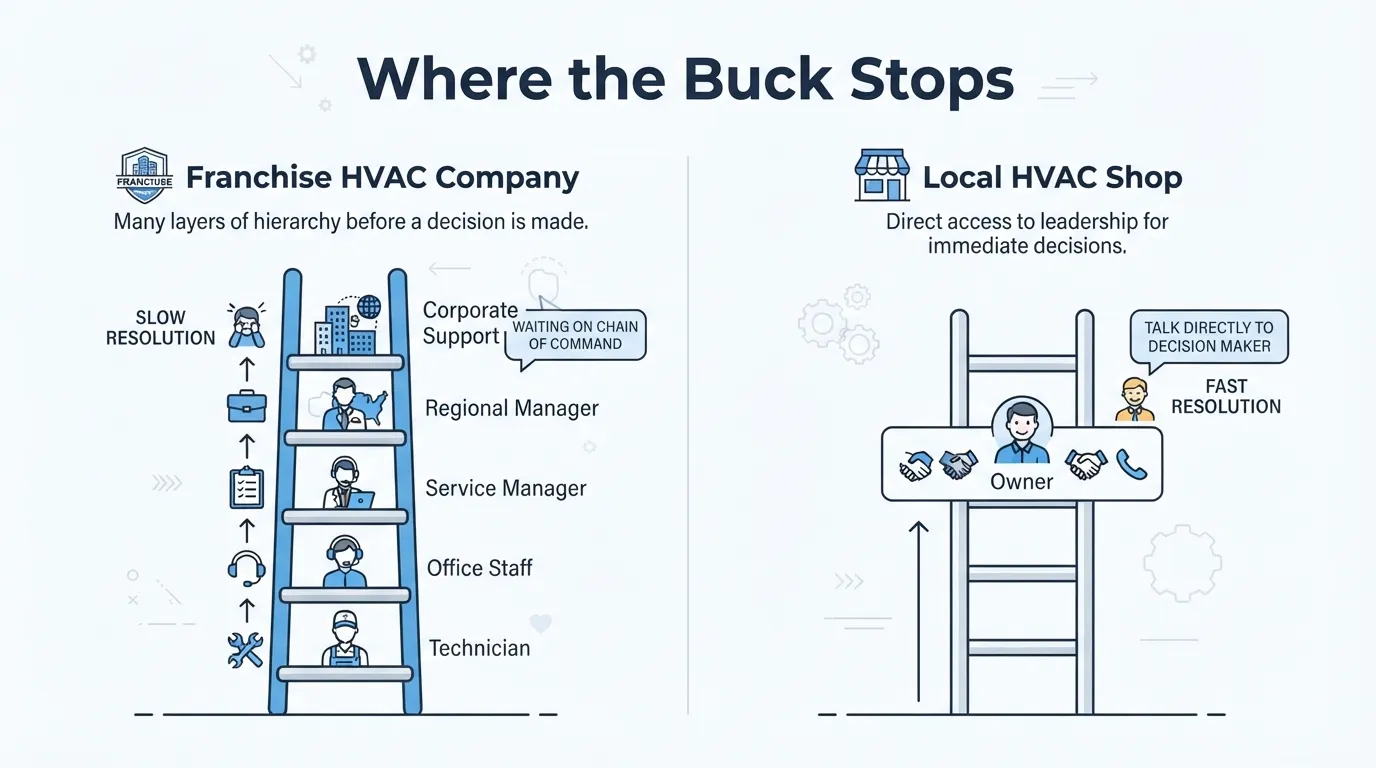
At a franchise, your complaint climbs a ladder: tech, dispatcher, service manager, maybe a regional office, maybe a corporate customer-care line reading from the same software the price came from. You can absolutely win that climb. It just has stairs.
At a family shop, the ladder is one rung. Here, if something’s wrong, you’re talking to Chris or Tara, the owners, whose names are on the license and whose kids go to school in McGregor. That’s not a virtue claim; it’s a structural fact. When the decision-maker answers the phone, the distance between “this isn’t right” and “we’ll make it right” is one conversation.
The flip side, stated fairly: a franchise’s ladder also means a written playbook, and playbooks protect customers from a bad local operator’s moods. Structure cuts both ways.
How the tech in your attic gets paid
This is the difference homeowners feel most and understand least. Across the industry, franchise and independent alike (a category fact, not a franchise accusation), many service techs earn commission or bonuses tied to what they sell: repairs, replacements, memberships, add-ons. Performance quotas and sold-per-ticket averages are documented, openly discussed realities of the trade; walk any HVAC forum and you’ll find techs comparing them.
A commissioned tech isn’t a dishonest tech. But incentives lean on people, and a pay structure that rewards finding more to sell will, across thousands of visits, find more to sell. Larger operations also see real technician turnover, which means the person diagnosing your system may be newer to the trade than the brand on the van suggests, and may never see your house twice.
The questions that cut through, for any company: “Is your diagnosis fee separate from your repair pricing? Can I see the readings? Will you put the options in writing?” A straight answer to those three beats any org chart. It’s also, frankly, why hiring a licensed HVAC company beats a handyman in the first place — the license makes the answers checkable.
What franchises genuinely do better
Here’s the trade-off section, because pretending there isn’t one would make this whole page ad copy.
Franchise networks run 24/7 call centers. When your AC dies at 2 a.m. on a Saturday, somebody answers, and that is a real advantage. We won’t pretend otherwise, and we won’t pretend to match it: our phones run Monday through Friday, 8 to 5, with real same-day availability inside that window. If you need a 2 a.m. dispatcher, a franchise has one and we don’t.
They also bring financing infrastructure (established lender programs with fast kitchen-table approvals), standardized training pipelines, and fleet depth: in a brutal July week, ten trucks clear a backlog faster than three. Those are genuine operational strengths that come from scale, and scale is the thing a family shop doesn’t have.
What scale can’t manufacture is the thing you’re actually buying in this trade: a person whose name rides on the outcome. Pick which advantage matters more for your situation. For a middle-of-the-night breakdown, their model wins the phone call. For a considered repair-or-replace decision with real money attached, we’d argue the owner-answerable model earns its keep.
How to compare HVAC companies near you
Searching “hvac companies near me” hands you a map pack and twenty tabs. Five checks sort them fast, local and franchise alike:
- License number displayed and verifiable. Every legitimate Texas HVAC contractor operates under a TDLR license you can look up in about a minute. No number, no call.
- Written quote before work, as policy. Not “we can do that if you ask.” Policy.
- A straight answer on the service fee. What it is, what it covers.
- Reviews that mention the same trait repeatedly. One theme across fifty reviews is a culture; five perfect reviews in a week is a campaign.
- Whether they’ll say “don’t spend the money.” Hard to test in advance, but a company whose content and reviews show it telling people not to buy is showing you its incentives.
Run that list and the local-vs-franchise label matters a lot less. Both kinds of companies pass and fail it every day, which is the fairest thing we can say about the whole debate — and if you want to see how we try to pass it, get a straight answer from us on your next repair and grade the paper we hand you.
Where we land, since you’ll ask
On Point is the local model: family-owned, run by Chris and Tara out of a shop on W 2nd Street in McGregor, serving Waco, Temple, Belton, and the towns between. Written assessment and quote before any work. A price-match policy because we’d rather match a fair number than argue about it. Free second opinions, because the second look is where upsells go to die. And 20+ years of combined experience across HVAC and appliances, which is the quiet advantage when a “breaker keeps tripping” call could be the condenser or the dryer.
That’s the pitch, all of it. No countdown timers.
FAQ
Are franchise HVAC companies more expensive?
Is a local HVAC company better than a franchise?
Why do HVAC techs push replacements so hard?
Does On Point offer 24-hour service?
The short version
Local vs franchise HVAC isn’t a morality tale. It’s a structure question: book pricing vs owner pricing, ladder vs one rung, scale vs skin in the game. Decide which structure you want standing behind your system, then make whoever you pick put the number in writing. If the local model suits you, request a visit or call , and read who you’re actually calling first if you want the specifics.
The On Point Team · On Point Service Company — family-owned HVAC & appliance repair, McGregor, TX · Serving Waco, Temple, Belton, and surrounding Central Texas towns · Licensed & insured, TDLR License TACLB00069239E ·