



Your AC kicks on, runs a few seconds, and the house goes quiet. You walk to the panel, flip the breaker, and it happens again. In a Waco July, that little switch controls your whole afternoon.
Here’s the short version: a breaker that keeps tripping is protecting you from a circuit pulling more current than the wiring can safely carry. The fix depends on what’s pulling too much — and in our service calls, it’s the AC most of the time, but not all of the time. Sometimes it’s the dryer. Sometimes it’s the breaker itself.
We repair both sides of that question under one roof, so this guide covers the whole thing, not just the half most HVAC companies write about.
Why your AC keeps tripping the breaker
An AC trips its breaker when the system draws more amps than the circuit is rated for. The usual causes, in the order we find them: dirty condenser coils making the unit strain, a weak capacitor, a refrigerant problem overworking the compressor, a compressor that’s failing, or a breaker that’s worn out. The breaker isn’t malfunctioning. It’s doing its job.
That last sentence matters more than it sounds. The dangerous breaker is the one that doesn’t trip while something in the wall cooks. So don’t fight the switch — figure out what it’s reacting to.
First question: is it actually the AC?
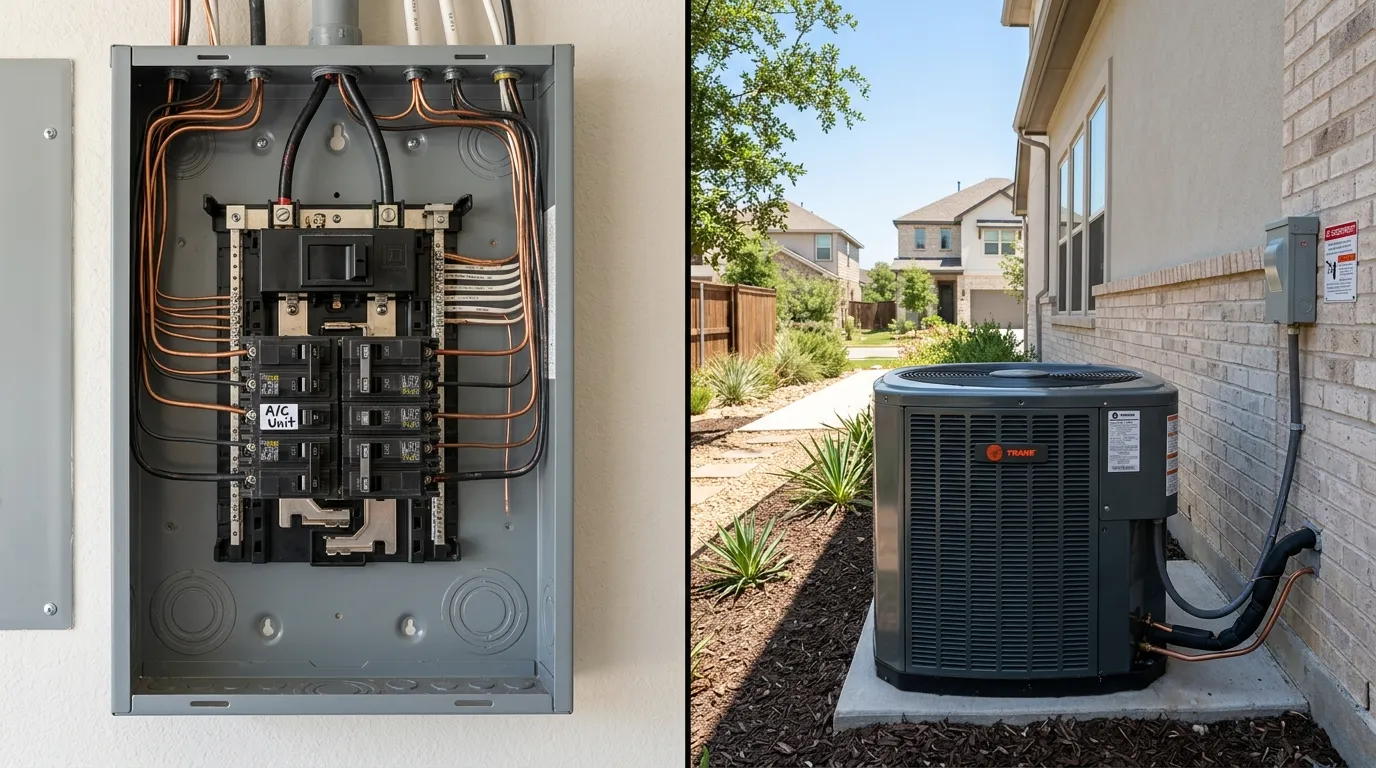
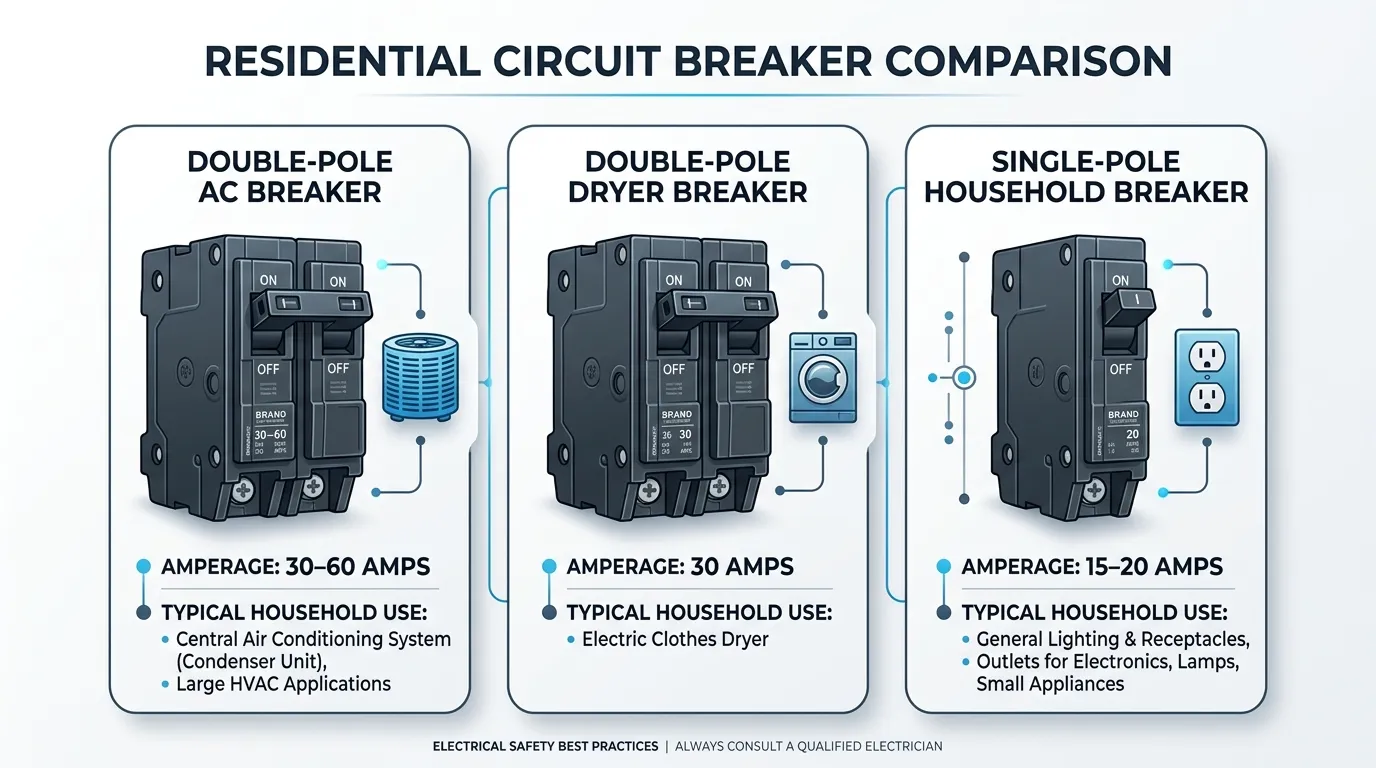
Before you blame the condenser, confirm which circuit is tripping. Open the panel and read the label. Three things we see in Waco-area homes every summer:
- The AC breaker trips. Usually a double-pole breaker (two switches joined), often labeled 30–60 amps. If this is your repeat offender, it’s an AC-side problem. Keep reading.
- The dryer breaker trips. Also double-pole, usually 30 amps. A dryer that trips mid-cycle points to a failing heating element or motor, not your AC. Different machine, different repair, same phone call if you use us, because we fix both.
- A general 15–20 amp breaker trips. Single switch, feeds outlets and lights. A window unit or a space-heater-grade appliance plugged into a crowded circuit will do this all day. That’s a load problem, and possibly an electrician problem, not an HVAC one.
Older houses in Waco proper complicate this. We’ve opened 1960s panels where the “AC” label was three owners out of date. If the labels don’t match reality, that’s worth fixing before anything else.
The checks you’re allowed to do yourself
You can do real diagnostic work here without opening anything sealed:
- Reset the breaker once. Push it fully OFF, then ON. Once. If it holds, watch it for a day. If it trips again, stop resetting — repeated resets into a real fault is how wiring gets damaged.
- Check the air filter. A packed filter makes the blower strain and the system run long and hot. If you can’t see light through it, swap it.
- Look at the outdoor unit. Cottonwood fluff, grass clippings, oak pollen mats. If the coil fins are furred over, the unit can’t shed heat and the amp draw climbs. Rinse gently with a hose from the outside, power off first.
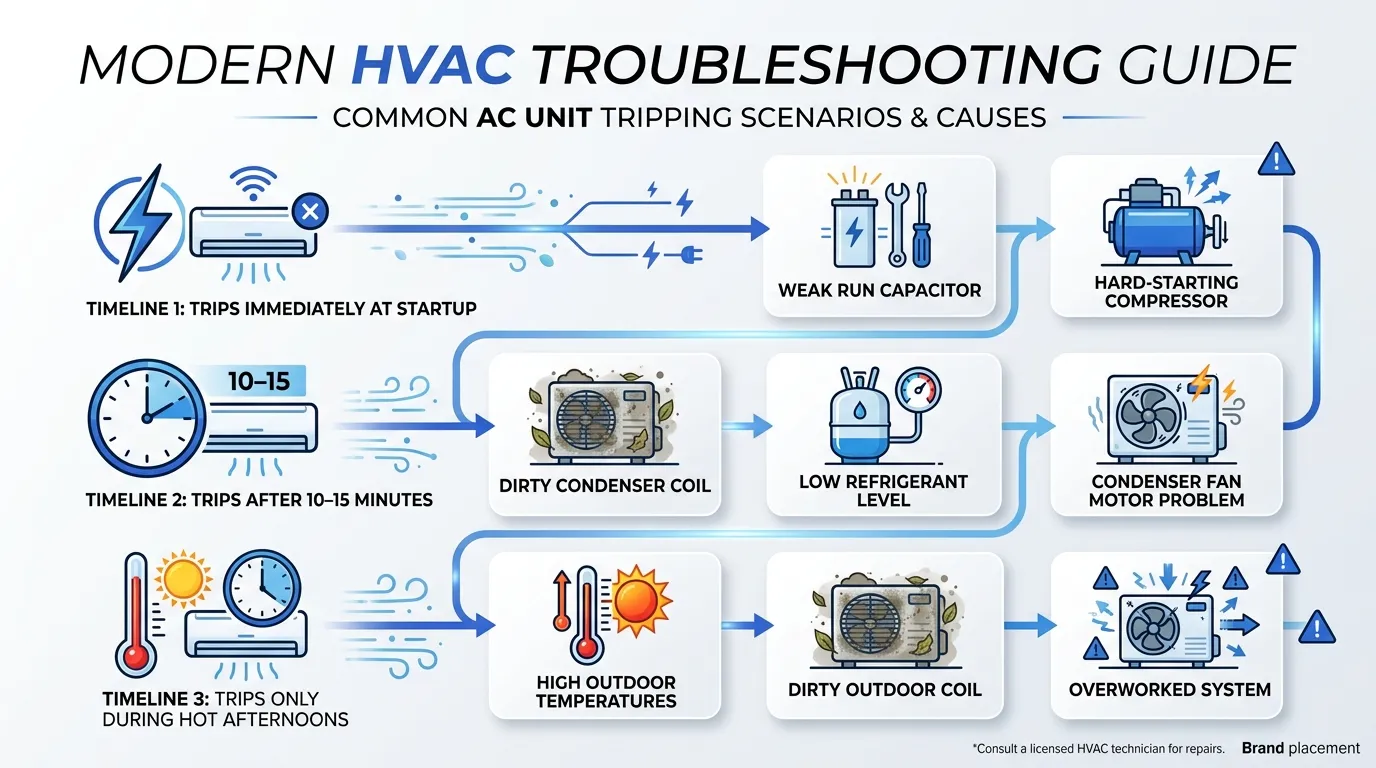
- Note the timing. Trips the instant the AC starts? Trips ten minutes in? Trips only on 100° afternoons? Write it down. That one detail tells a tech half the story before we open a panel.
That’s the whole list. No multimeters, no panel covers, no “just check the capacitor.” More on that below.
Why does the breaker trip when the AC starts?
An AC that trips the breaker at startup usually has a hard-starting compressor or a weak run capacitor. Compressors pull a big surge of current in the first second (inrush), and a tired capacitor makes that surge bigger and longer. Trips at startup are also the classic sign of a compressor near the end of its life.
Why does it trip after running a while?
Heat. Dirty coils, low refrigerant, or a struggling condenser fan let temperatures build until the amp draw crosses the line. This is the pattern we see most in July and August, and it’s why the problem “only happens in the afternoon.” The system isn’t possessed. It’s hot.
Where you stop and call a licensed tech
This is the hard line, and it exists because the two most tempting DIY steps here are the two most dangerous ones:
- Don’t open the disconnect or unit panels to test the capacitor. Capacitors store a charge after power is off. Discharging one safely is a trained-hands job, full stop.
- Don’t touch refrigerant. Diagnosing or topping off refrigerant requires EPA certification, and a “small top-off” on a leaking system is money poured into the grass anyway.
- Don’t replace the breaker to make the tripping stop. A new breaker on a faulted circuit just moves the protection out of the way. If the breaker itself is worn (it happens — they’re mechanical parts), let someone verify the load first.
- Don’t hold, tape, or oversize a breaker. Ever. The Electrical Safety Foundation files this under “how house fires start,” and so do we.
If the breaker trips a second time after one reset, that’s the signal. Something real is wrong, and finding it takes gauges and a meter. Our techs carry both, and you get a written quote before any work — if it’s a $200 capacitor, nobody’s going to sell you a condenser.
What the fix usually costs
Typical Central Texas ranges, not our prices: a run capacitor swap usually lands between $150–$400. A condenser coil cleaning, $100–$250. A failing compressor is the expensive branch — $1,500–$2,800 to replace, which is why on a 10-year-old system the honest conversation shifts to repair versus replace. A worn breaker swap by an electrician is often under $200.
The spread is wide, and that’s the point. Until someone measures what’s actually pulling the amps, any number is a guess. Full pricing context lives in our Waco AC repair cost guide.
One honest trade-off: if your AC trips the breaker and it’s blowing warm before it trips, you may have two symptoms of one refrigerant problem — start with our warm air walkthrough because the cheap causes overlap.
Common Questions About AC Breaker Issues – On Point Service Company
How do I stop my AC breaker from tripping?
How can I tell if the AC circuit breaker itself is bad?
You mostly can’t from the outside. Clues that point at the breaker: it trips at random loads, feels hot to the touch, won’t stay reset even with the AC disconnect pulled, or the panel is a known-recalled brand. A tech or electrician confirms it with a load test in minutes.
Is it safe to keep resetting a tripping breaker?
No. One reset is a test. Two trips is an answer. Each reset into a genuine fault pushes current through a problem that’s already announced itself, and that’s how insulation and panels get damaged.
Can the dryer and AC trip the same breaker?
Not normally. Each should have its own dedicated double-pole breaker. If running the dryer seems to knock out the AC, the panel may be mislabeled, overloaded, or wired in a way that needs an electrician’s eyes before summer does its worst.
Where to go from here
If the breaker held after one reset and a filter change, run it and watch. If it tripped twice, the system is telling you it needs a diagnosis, not another reset. Request service and we’ll put a meter on it, tell you which machine is at fault, and hand you a straight answer in writing. Senior or military? 10% off the repair.
The On Point Team — On Point Service Company, McGregor, TX. Family-owned, 20+ years of combined experience fixing HVAC systems and household appliances across Waco, Temple, Belton, and Central Texas. Licensed & insured — TDLR License TACLB00069239E. Call for same-day availability.