




Major appliance repair means two things at once: repairs to the big machines (refrigerator, washer, dryer, range, dishwasher) and, more usefully, the repairs that earn the word (sealed refrigeration systems, compressors, drum bearings, transmissions, control boards). That second meaning is the one that decides whether you spend $300 or $1,300, so that’s the one this guide is about.
Short version up front: a major repair replaces a core system instead of a wear part, usually costs $250 and up in Central Texas, and is sometimes still the best money you can spend on a machine. Sometimes. Here’s how to tell.
What is considered a major repair to an appliance?
A major repair replaces a core system rather than a wear part: the sealed refrigeration circuit or compressor, a washer’s drum bearings or transmission, a control board, or a drive motor. Expect disassembly, specialty tools, and a bill over $250 — the territory where repair-or-replace math starts.
Everything below that line is minor, even when it feels dramatic. A fridge door gasket, a dishwasher latch, an oven element, a dryer belt: those are wear parts, they’re priced like wear parts, and no machine should be replaced over one. The distinction matters because “major” is where honest shops slow down and pushy ones speed up.
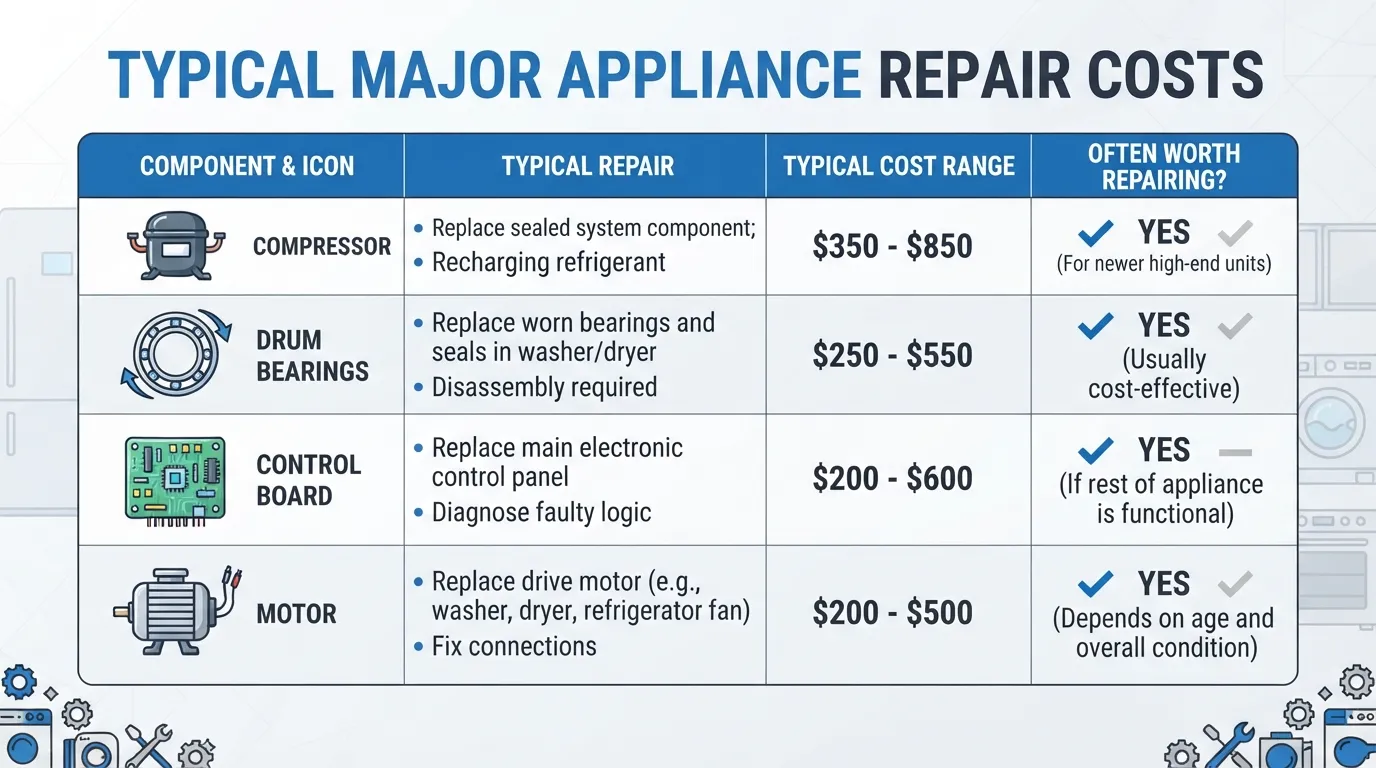
The big four majors, with typical Central Texas ranges
| Repair | Where it shows up | Typical range* | Usual call |
|---|---|---|---|
| Sealed system / compressor | Refrigerator, freezer | $600–$1,200 | Often replace |
| Drum bearings / transmission | Washer | $250–$500 | Depends on age |
| Control board | Any appliance | $250–$600 | Age decides |
| Drive motor / pump | Washer, dryer, dishwasher | $200–$450 | Often repair |
*Industry-typical for the Waco area, parts and labor together. These bracket what normal looks like; your written quote is the real number.
The pattern to notice: the top row is a different animal from the rest. Sealed-system work means recovering and recharging refrigerant, which is why it costs the most, takes the longest, and legally can’t be done by just anyone. The bottom three rows are mechanical and electronic surgery: significant, but routine for a shop that does them weekly.
How a pro actually triages a major repair
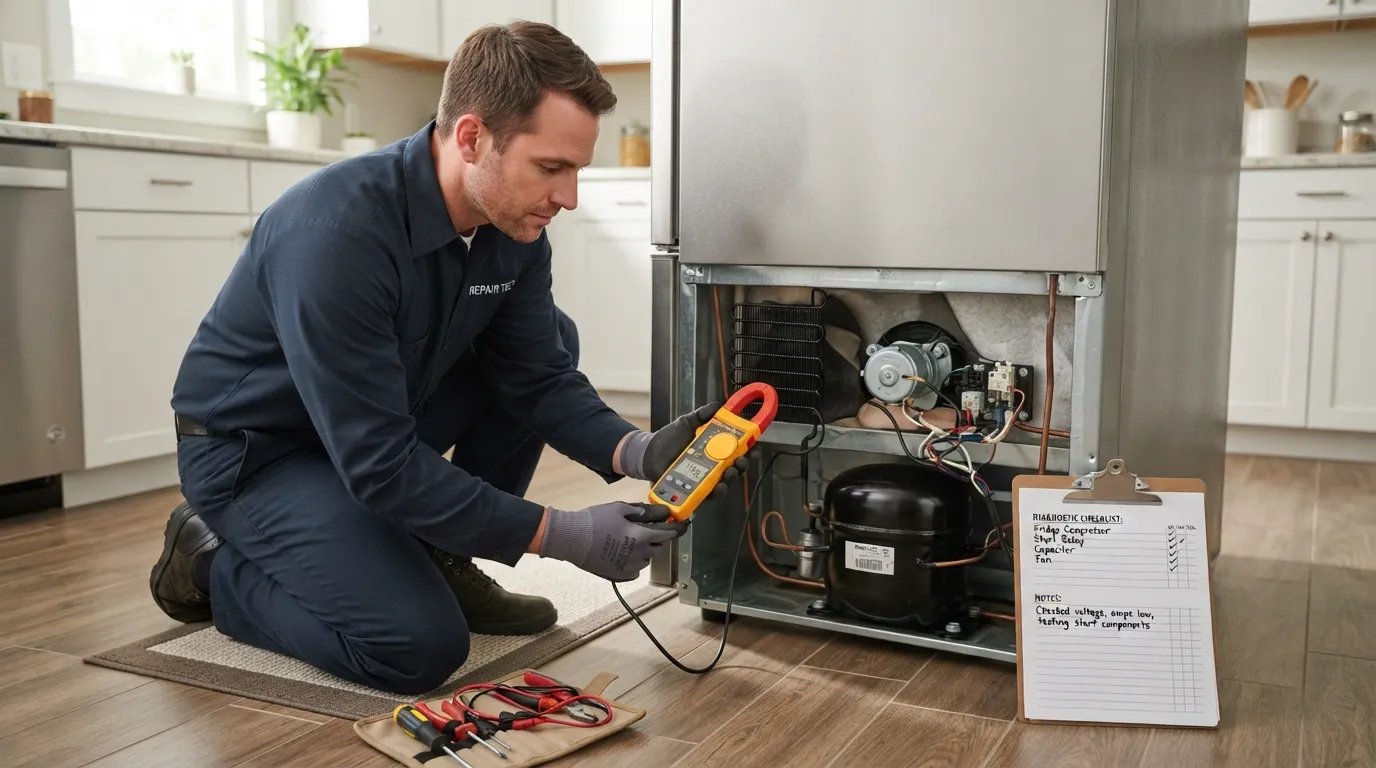
When a fridge in Temple stops cooling or a washer in Robinson starts sounding like a jet, this is the order we run. It’s worth knowing, because it’s also how you spot a tech who’s skipping steps.
- Reproduce the symptom. Not the description of it. The thing itself. Warm fridge, screaming spin cycle, dead panel.
- Rule out the cheap stuff first. Clogged condenser coils imitate a dying compressor. A worn belt imitates a dying motor. Half of “major” calls end here, minor.
- Isolate the core system. Amp draws, temperature splits, resistance readings. This is the part the service fee actually pays for.
- Price the part and check availability. A $280 board in stock is one conversation; a discontinued board on backorder is a different one.
- Run the age math, then quote in writing. The repair gets weighed against the machine’s remaining life, and you see the number before any work starts.
Here’s an opinion we’ll stand behind: any shop that quotes a compressor over the phone, sight unseen, is guessing, and you shouldn’t pay four figures on a guess. The diagnostic visit exists so the big quote is built on readings, and it’s why we put every one in writing with a free second opinion if you want to check someone else’s.
When a major repair still beats replacement
The internet’s rule of thumb says big repair = buy new. Real life is less tidy, and there are four cases where major work wins clearly.
Built-ins and counter-depth units. A wall oven, a downdraft range, or a built-in refrigerator isn’t a $700 replacement; it’s often $3,000-plus and sometimes carpentry. Against that, an $800 sealed-system job can be the bargain. Our refrigerator repair team runs this exact math with owners every month.
Young machines. A five-year-old washer with bad bearings has half its life left. Fix it.
High-end machines. A $2,500 fridge with a $600 problem is still a $1,900 win. Quality buys repair headroom, the same logic we walked through in what dishwasher repairs cost, scaled up.
When replacement means waiting. Some models still run six-week delivery windows. A family can’t stage groceries in coolers for six weeks. A repaired compressor cools tonight.
The general framework (the 50% rule, the age brackets) lives in our guide to deciding between appliance repair and replacement if you want the whole decision tree.
When “major” is money down the drain
The honest counterweight, because it’s half the picture: a major repair puts a new core into a machine whose every other part is the same age as the one that failed. That’s the trade-off, and it’s why age caps the math.
Past the repair-cutoff age (roughly 8 years for a mid-tier fridge or washer, later for ranges), big-ticket work rarely pays. Neither does the second major repair in a year; machines that fail in clusters are announcing the ending. And rust-through, a cracked tub, a failing sealed system on a builder-grade unit? Done. We keep the cutoff ages for every machine in our appliance lifespan chart, and we’d rather point at that chart than collect for a repair the math doesn’t support.
The parts of “major” nobody should DIY
Some of this work is gated for reasons beyond skill. Refrigerant is the big one: recovering and recharging a sealed system legally requires EPA Section 608 certification, full stop. Gas valves and connections on ranges and dryers are licensed work. Capacitors inside washers and HVAC gear hold a charge after unplugging, and control boards live behind panels that carry line voltage.
You can check coils, filters, belts (visually), breakers, and settings. The moment a repair means opening a sealed system, touching gas, or reaching past an access panel into live components, stop and call. That line isn’t about protecting our invoices; it’s about which mistakes can’t be undone.
Common questions about major appliance repair
What is the most expensive appliance repair?
Is it worth replacing a refrigerator compressor?
What counts as a major appliance?
Do appliance repair techs need a license in Texas?
Get the number in writing first
If someone’s told you your repair is “major,” make them show their work: what failed, what was ruled out, what the part costs, and what the machine’s age does to the math. That’s a written quote, it’s how we operate on every job, and with 20+ years of combined experience across HVAC and appliances, we’ve seen which majors pay off and which don’t. Request a straight answer or call — and if the honest call is “don’t fix it,” that’s the call you’ll get.
The On Point Team · On Point Service Company — family-owned HVAC & appliance repair, McGregor, TX · Serving Waco, Temple, Belton, and surrounding Central Texas towns · Licensed & insured, TDLR License TACLB00069239E ·