



Most AC repairs in Waco land between $150 and $650. That covers the parts that actually fail in Texas heat: capacitors, contactors, fan motors, clogged drain lines. The expensive stuff — compressors, coils, refrigerant leaks — runs $1,200 to $3,000, and that’s where the repair-or-replace math starts.
Here’s the longer version, because the details decide whether you pay $200 or $2,000 for the same dead air conditioner.
Typical AC Repair Costs in Waco (2026 Table)
AC repair cost in Waco typically runs $75–$150 for the diagnostic visit, $150–$650 for common part replacements like capacitors and contactors, and $1,200–$3,000 for major work such as compressors or coil replacement. Full system replacement in Central Texas usually starts around $6,000.
These are industry-typical ranges for Central Texas in 2026 — not any one company’s price list. Every unit, attic, and failure is different, which is why a written quote beats a phone estimate every time.
| Repair | Typical range (Central TX) | Worth knowing |
|---|---|---|
| Service call / diagnostic | $75–$150 | Often credited toward the repair |
| Capacitor replacement | $150–$400 | The most common summer failure |
| Contactor replacement | $150–$350 | Sticks and pits after years of cycling |
| Condenser fan motor | $300–$700 | Heat kills these in July |
| Blower motor | $450–$1,500 | Variable-speed (ECM) sits at the high end |
| Thermostat replacement | $150–$500 installed | Smart models push the top of range |
| Drain line clearing | $75–$250 | Cheapest fix with the scariest symptom |
| Refrigerant leak repair + recharge | $400–$1,500+ | Depends on leak location and refrigerant type |
| Circuit board | $200–$650 | Often misdiagnosed — ask what failed |
| Evaporator coil | $900–$2,400 | Repair-or-replace territory |
| Compressor | $1,200–$3,000 | The decision point for most 10-year-old units |
Save the table. When a quote comes in far outside these lanes, you’re allowed to ask why — and a company doing honest work will have an answer that names the part, not the weather.
Why There’s a Fee Just to Look at It
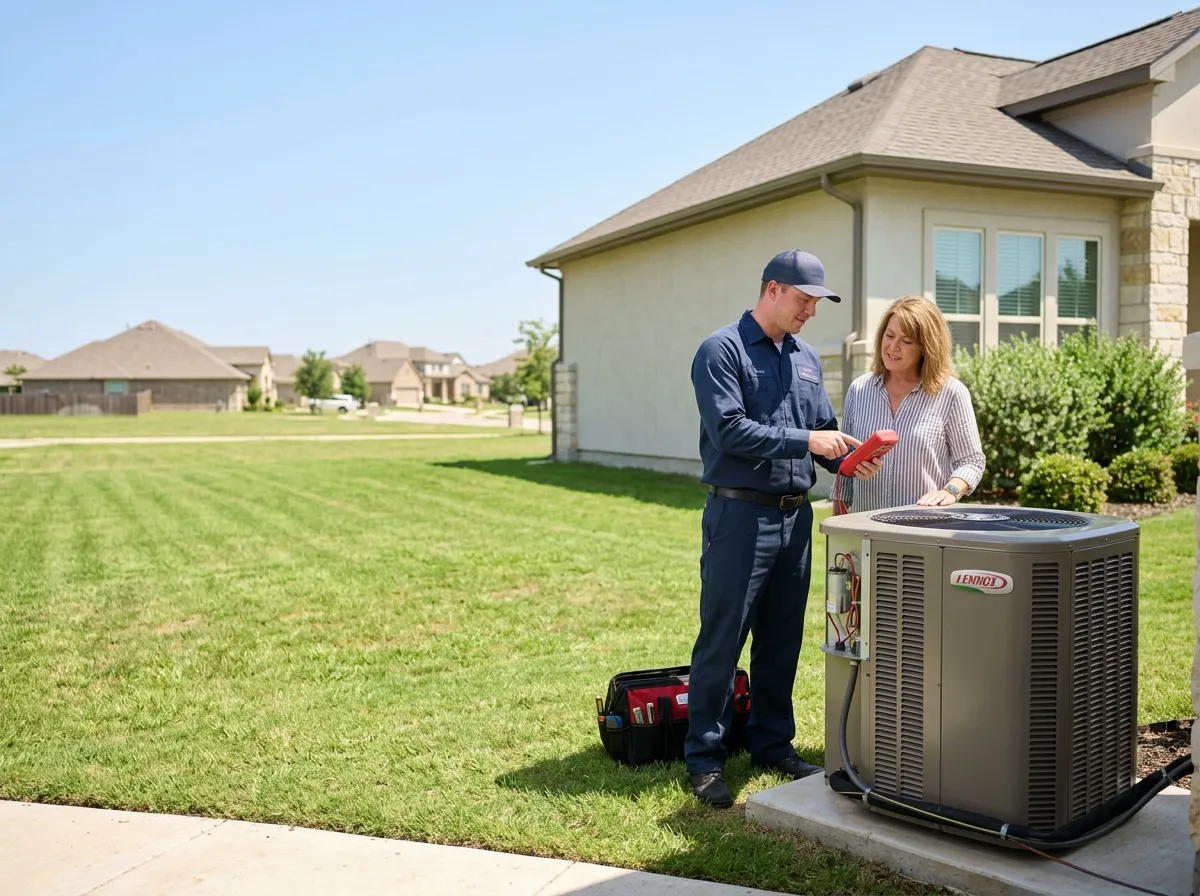
Nobody loves paying someone to tell them what’s wrong. Fair. But a diagnostic visit is 30–90 minutes of a licensed tech’s time plus the truck that got them there, and in Waco that honest cost sits around $75–$150 across the industry.
Here’s how we handle the objection at On Point: you get a written assessment and quote before any work happens, so the fee buys you a real answer — not a shrug and a sales pitch. No surprises on the final bill, because the number was on paper before the toolbox opened.
One thing to know: “free estimates” in HVAC advertising almost always means estimates on new system installations, not repairs. That’s true for us too — free estimates apply to new HVAC system installs, while repair visits carry the service fee that covers travel and diagnostic time. Any company offering truly free repair diagnostics is recovering that cost somewhere, usually inside the repair price.
The Repairs Waco Homeowners Actually Pay For
Skip the encyclopedia. Five failures cover most of the AC repair work in McLennan County, and they cluster hard between June and September.
Capacitor: $150–$400
The little cylinder that gives your compressor and fan motors their starting kick. Texas heat cooks capacitors — attic temperatures over 130° shorten their life, and we see the failures spike during the first real 100° week every year. Symptoms: the outdoor unit hums but the fan won’t spin, or the AC trips the breaker at startup.
It’s a 20-minute swap for a licensed tech. It is not a $1,500 problem, and it’s not a reason to replace the condenser. More on that below, because this part matters.
Contactor: $150–$350
A relay that clicks your outdoor unit on and off. After a few thousand Texas cooling cycles the contacts pit and stick. Stuck closed, the outdoor unit runs even when the thermostat is satisfied — you’ll notice it humming at 2 a.m. Stuck open, nothing runs at all.
Fan motors: $300–$1,500
The condenser fan motor (outside) usually goes first; it lives in direct sun and pulls hot air across a coil all day. Blower motors (inside) cost more, especially the variable-speed ECM motors in systems from the last decade. If your blower motor dies and the quote includes a new module rather than the whole motor, that’s a good sign — modules alone can save you several hundred dollars.
Refrigerant leaks: $400–$1,500+
The range is wide because the work is. A leak at a service valve is an easy fix. A leak inside the evaporator coil means coil replacement money. Either way, the refrigerant itself has become a real line item — see the 2026 refrigerant section below, because this is where older systems quietly become money pits.
Say your AC is blowing warm air on a Saturday in July. Low refrigerant is one possible cause — but so is a $5 clogged filter or a tripped float switch. Check those two yourself before assuming the worst.
Drain line problems: $75–$250
Central Texas humidity means your AC pulls gallons of water out of the air every day, and all of it leaves through one PVC pipe. Algae clogs it, the float switch trips, and the whole system shuts down. It’s the cheapest “my AC is dead” fix on this list. You can even prevent it yourself — a cup of vinegar down the drain line every month or two during cooling season keeps the algae down.
Refrigerant in 2026: The Type in Your System Changes the Bill
Three generations of refrigerant are running in Waco backyards right now, and the label on your unit swings the repair math more than any other single factor.
R-22 (systems from before ~2010). Production ended in 2020. What’s left is reclaimed supply, and prices reflect it — recharging an R-22 system can cost more than a month’s mortgage. Our honest take: putting refrigerant into a leaking R-22 system in 2026 is spending good money on borrowed time. That’s a system telling you it’s done.
R-410A (roughly 2010–2024 installs). Still the majority of units we service, and still fully serviceable. Prices per pound have climbed since the EPA’s HFC phasedown started tightening supply, but a 410A repair is still a rational purchase. If your system is under 10 years old, repair usually wins.
A2L refrigerants (2025+ installs). New systems now ship with lower-impact refrigerants like R-454B and R-32. Cleaner rulebook, but the equipment costs more, and early-supply hiccups on parts are real. If you’re quoted on a brand-new system, this transition is part of why replacement prices moved up over the last two years.
None of this is DIY territory. Refrigerant handling legally requires EPA Section 608 certification — it’s not a YouTube job, and a “topped it off myself” story usually ends with a dead compressor.
The Capacitor Test: How to Spot an Honest Quote
Here’s the scenario we hear about most, told to us by homeowners getting a second opinion. The AC quits during a 102° week. A company comes out, looks at the outdoor unit, and opens with: “Your condenser’s shot. These units don’t last in this heat. We can have a new system in by Thursday — $9,000.”
Sometimes that’s true. Often the actual failure is a $20 capacitor.
So use the capacitor test. When the quote for a not-cooling AC starts at “replace the system,” ask one question: “What specific part failed, and can I see the reading?” A tech who diagnosed a bad capacitor can show you the microfarad reading against the rating printed on the part. A tech who diagnosed “it’s old” has given you a sales pitch, not a diagnosis.
This is exactly why we put every AC repair finding in writing before work starts — the part, the reading, the price. It’s also why we give free second opinions. If someone in Waco, Robinson, or China Spring quoted you a full system and you’re not sure, get a straight answer before you sign anything. Worst case, we confirm the first company was right, and you buy with confidence. That happens too, and we’ll say so.
One of our customers put it better than we can: “professional… no BS… worked with me on the bill.” That’s the standard a written quote should hold any company to — ours included.
When Repair Stops Making Sense
We repair for a living, so believe us when we say: some units shouldn’t be repaired. Here’s how to decide without emotion.
The $5,000 rule. Multiply the unit’s age by the repair quote. Over $5,000, lean replace; under, lean repair. A $400 fan motor on an 8-year-old unit: $3,200 — repair it. A $1,800 compressor on a 12-year-old unit: $21,600 — that money belongs in a new system.
The three-strikes pattern. Two significant repairs in two summers, and now a third? The unit is failing systemically. Stop feeding it.
The R-22 override. Pre-2010 system with a refrigerant leak: replace. The math almost never works anymore, whatever the other numbers say.
The efficiency quiet part. A 15-year-old unit hitting maybe 8 SEER in practice against a modern 15+ SEER system can trim a summer electric bill by $50–$100 a month in a Central Texas cooling season. Real, but it rarely justifies replacement on its own — treat it as a tiebreaker, not a reason.
The honest trade-off cuts both ways: repair-first has a gamble in it. You can put $500 into a fan motor and lose the compressor the following August — nobody can promise otherwise, and you should side-eye anyone who does. What tilts the odds is a tech telling you which gamble you’re taking. When the numbers point to a new system, air conditioner replacement quotes and estimates are free on new HVAC system installations, and financing is available — so getting the replacement number to compare costs you nothing.
What Pushes a Waco Repair Bill Higher
Same part, different bill. Four local reasons:
The July–August crunch. When the heat dome parks over Central Texas and half of Waco loses cooling the same week, demand outruns supply. Companies don’t have to inflate prices for your bill to grow — failing parts get bigger the longer you wait in a queue. The capacitor that limped along Monday takes the fan motor with it by Friday.
Older homes, harder access. A lot of housing near downtown Waco and Baylor predates modern duct design. Cramped attics, handmade returns, equipment squeezed into closets — labor time goes up, and labor is most of any repair bill. New builds out toward China Spring and Temple are usually faster jobs.
Spring pollen, dirty coils. That yellow-green oak pollen film that coats every windshield in March? It mats onto condenser coils too. A unit that ran dirty all spring works harder all summer, and heat-stressed parts fail sooner. A $100–$200 coil cleaning in April is the cheapest insurance on this page.
Hail. Central Texas hail flattens condenser fins. Bent fins choke airflow; the unit runs hotter and dies younger. After a serious storm, have the fins combed out — and check your homeowners policy, because hail damage to the condenser is often covered.
How to Keep the Next Bill Smaller
You can’t prevent every failure. You can stack the deck:
- Change the filter monthly, June through September. A $10 filter protects a $1,000 blower motor. Most airflow complaints we see in summer trace back to a filter that should’ve been changed in May.
- Pour vinegar down the condensate line every month or two in cooling season. One cup. Prevents the most common August shutdown.
- Keep two feet clear around the condenser. Trim the shrubs. The unit needs to breathe to shed heat.
- Hose off the condenser coil each spring — gently, water only, power off at the disconnect. Gets the pollen off before the heat arrives.
- Book a tune-up in the shoulder season. A spring inspection catches weak capacitors and low charge before the first 100° week finds them for you. Here’s what a real AC tune-up includes and how often a Central Texas system actually needs service.
And one early-warning habit: know the warning signs an AC gives before it quits. Units almost never die silently — they announce it, and the announcement is cheaper than the funeral.
Where You Stop and Call a Licensed Tech
Safe for you to check, no tools needed:
- The breaker panel. If the AC breaker tripped once, reset it once.
- The filter. Clogged solid? Swap it and give the system an hour.
- Thermostat batteries and settings. Dead batteries and a bumped mode switch cause a surprising share of “broken” ACs.
- The drain line and float switch. Standing water in the drain pan means the float switch did its job.
Stop there. These are the hard lines:
- Refrigerant — federal law requires EPA certification to handle it. No exceptions for careful homeowners.
- Capacitors — they hold a charge after power is cut and can put you on the ground. Even techs discharge them with a tool, never a screwdriver and hope.
- Anything behind a sealed electrical panel — 240 volts lives there.
- A breaker that trips twice — that’s not a reset problem, that’s a short circuit hunting for a fire. Leave it off and make the call.
A licensed company carries the certification, the insurance, and the meter readings to do this safely. That’s what you’re paying for in that service fee — and it’s cheaper than the ER.
FAQ: What Waco Homeowners Ask About AC Repair Costs
What does an HVAC service call cost in Waco?
Typically $75–$150 in Central Texas, covering the trip and the diagnostic. Many companies, ours included, put the findings in a written quote before any repair work begins — so you know the full number before you commit to anything.
Why is my AC blowing warm air?
In rough order of likelihood: dirty filter, tripped float switch on the drain line, iced-over evaporator coil, failed capacitor, low refrigerant from a leak. The first two you can check yourself in five minutes. The last two need a licensed tech with gauges.
Is it worth repairing a 10-year-old AC?
Run the $5,000 rule: age times repair cost. A 10-year-old unit facing a $300 capacitor (that’s $3,000 — repair it) is a different animal from one facing a $2,000 compressor ($20,000 — replace it). Refrigerant type matters too; R-22 units usually aren’t worth major repairs in 2026.
Why does my breaker trip when the AC starts?
Often a weak capacitor making the compressor draw extra amps at startup. Can also be a failing compressor or a genuine electrical fault. Reset it once. If it trips again, leave it off and call — repeat tripping is a safety mechanism doing its job, not an inconvenience to work around.
How fast can someone actually come out in Waco? In peak season, same-day availability exists but goes early — call in the morning. We offer same-day service when the schedule allows, and we’ll tell you honestly on the phone if it doesn’t. Be wary of anyone who guarantees instant arrival during a July heat wave; physics and traffic apply to every truck in town.
Does a maintenance plan actually save money? A tune-up usually pays for itself by catching weak parts early — a $150 spring visit that spots a drifting capacitor beats a $400 emergency swap in August, plus the days of waiting. Where plans go wrong is when they’re used as a foot in the door for upsells. Judge the company, not the plan.
Get the Number in Writing
Whatever you do about a struggling AC, do it with a written number in hand. It’s the single best defense against overpaying in this industry — better than reviews, better than gut feel.
If your AC is acting up anywhere in the Waco area — Waco, McGregor, China Spring, Robinson, Lorena, Temple, Belton, Moody, Crawford, or Troy — call for a straight answer and a written quote: . Seniors and military get 10% off repairs. And if you already have a quote in hand that doesn’t smell right, the second opinion is free.
On Point Service Company is a family-owned HVAC and appliance repair company in McGregor, TX, serving the greater Waco area with 20+ years of combined experience. Licensed & insured · TDLR License TACLB00069239E ·