



By The On Point Team · Updated July 2026
Often, yes. A 10-year-old AC with a failed capacitor, contactor, or fan motor is usually worth repairing. Those fixes typically run $150–$650 in Central Texas and buy years of remaining life. It stops being worth it when the quote crosses roughly half the cost of replacement, or when the failed part is the compressor or coil.
That’s the answer. The rest of this guide is how to run that math on your unit, in your driveway, before anyone standing in it has a chance to run it for you.
The Math That Actually Decides It
Two rules do most of the work.
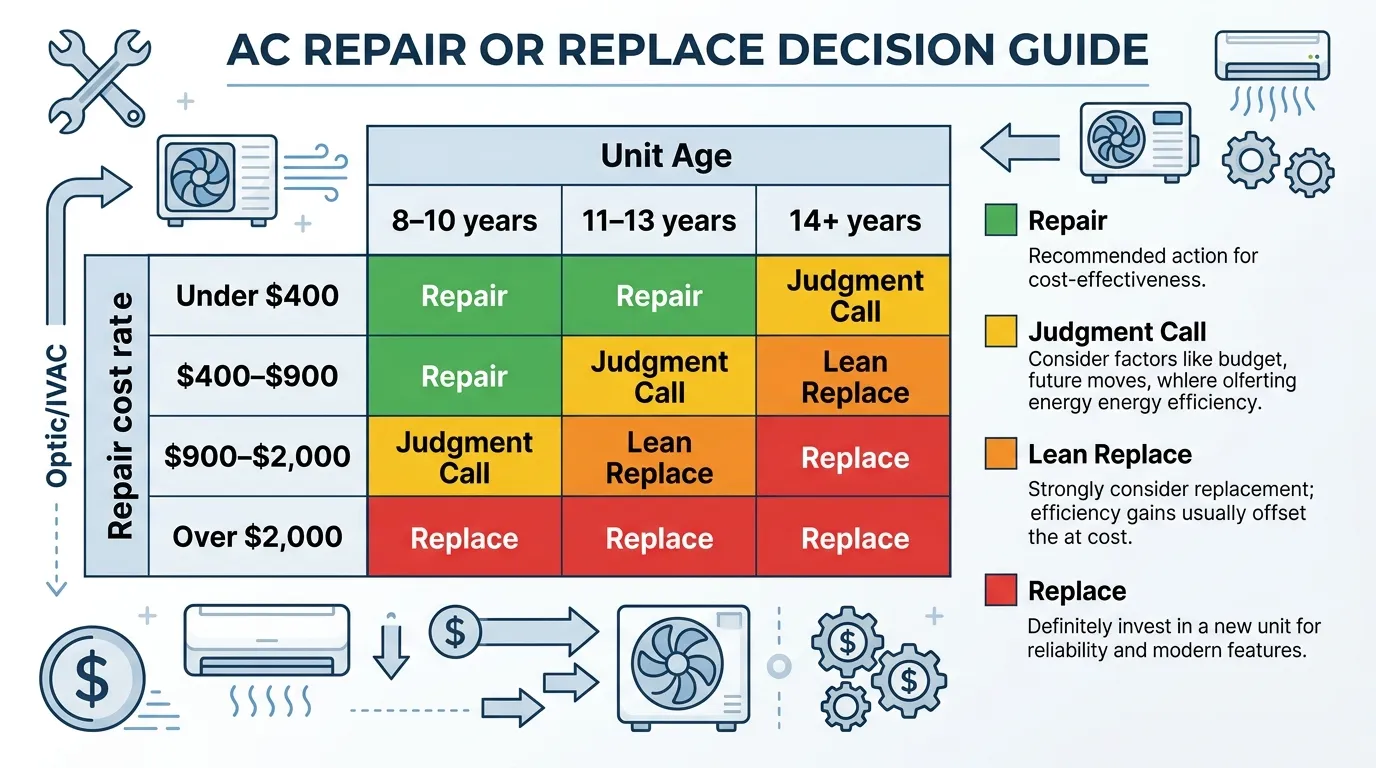
The 50% rule. If the repair quote is more than half the cost of a comparable new system, replace. A typical Central Texas system replacement lands somewhere in the $6,000–$12,500 range depending on size and efficiency, so a quote north of $3,000 on an old unit needs a very good story.
The multiply-by-age rule. Multiply the repair cost by the unit’s age. Over 5,000, lean replace; under, lean repair. It’s a rough industry heuristic, not physics, but it catches the right cases. A $300 repair on a 10-year-old unit scores 3,000: fix it. A $900 repair on the same unit scores 9,000: start asking harder questions.
Here’s how that plays out across the quotes we actually see:
| Repair quote | Unit age 8–10 | Unit age 11–13 | Unit age 14+ |
|---|---|---|---|
| Under $400 | Repair | Repair | Repair, usually |
| $400–$900 | Repair | Judgment call | Lean replace |
| $900–$2,000 | Judgment call | Lean replace | Replace |
| Over $2,000 | Lean replace | Replace | Replace |
Three things tilt the judgment calls. Repair history: a unit on its third summer breakdown is telling you something. Cooling performance: if it never held 74° through August even when it ran, sinking money into it preserves a problem. And the electric bill: a 10 SEER relic from 2014 costs meaningfully more per month to run than a modern 15.2 SEER2 system, so an aging unit can lose the math even while it technically works.
One warning about the table: it only works with an honest diagnosis in hand. A “failing condenser” that’s actually a $40 capacitor breaks every rule above. More on that in a minute.
The Refrigerant Problem Nobody Mentions on the Phone
Your 10-year-old system almost certainly runs on R-410A. In 2025, federal rules under the EPA’s HFC phasedown pushed new residential systems to newer low-GWP refrigerants like R-454B and R-32, and started squeezing R-410A production down year by year.
What that means for your repair decision, practically:
- R-410A is still legal to buy and use for servicing existing systems. Nobody is forcing you to replace a working unit. Anyone who tells you otherwise is selling.
- But refrigerant-related repairs on R-410A systems are getting more expensive, because a shrinking supply of the stuff meets every aging system in Texas at once. A leak repair plus recharge that was a moderate bill five years ago now stings.
- The gap matters most on borderline calls. A $350 fan motor doesn’t care what refrigerant you run. A leaking evaporator coil does: you’d be paying a premium to top up a system the industry is actively walking away from.
So add one question to your decision: does this repair touch the refrigerant circuit? If no, the age rules above stand as written. If yes, shade one column toward replace. (The EPA’s HFC phasedown page has the regulatory detail, if you want the source rather than a contractor’s version of it.)
Repairs Worth Making on a 10-Year-Old Unit
The parts that fail most in Texas heat are, conveniently, the cheap ones.
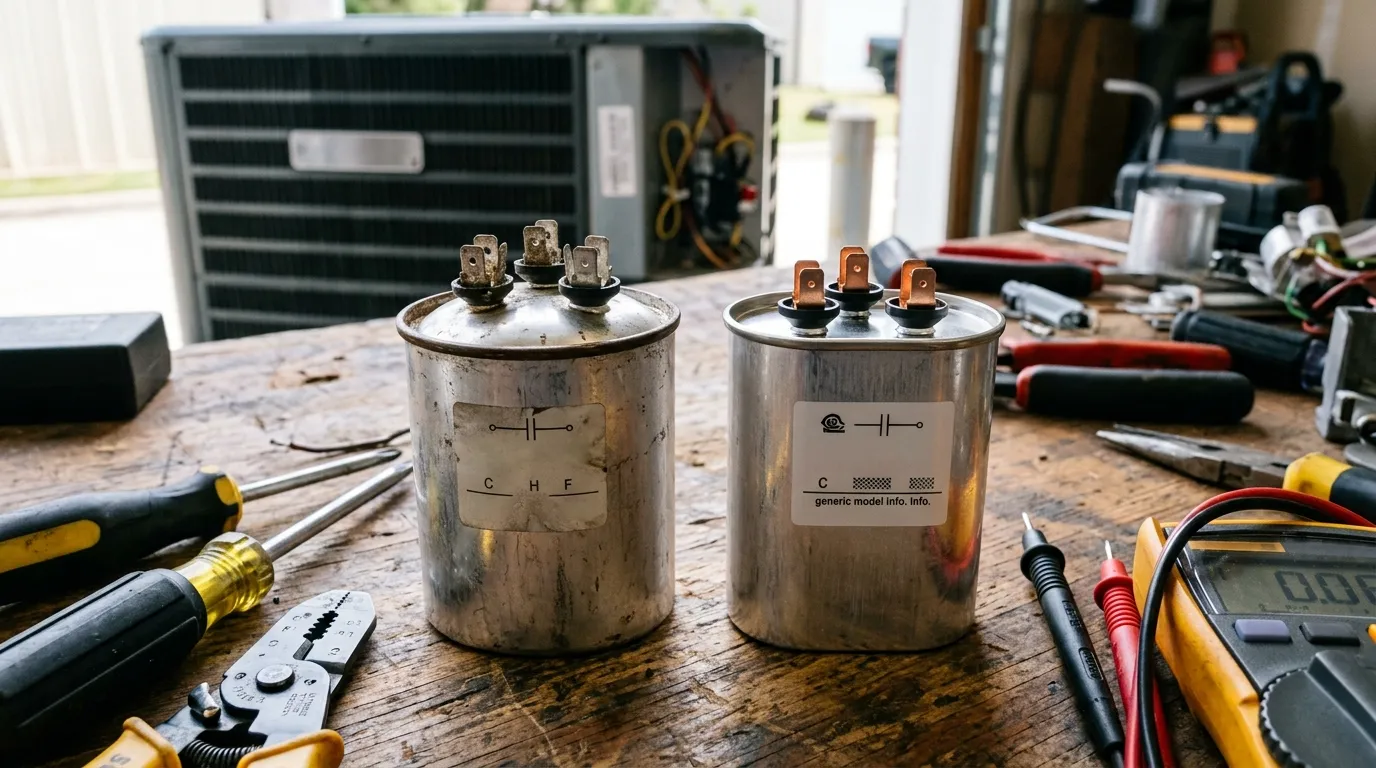
Capacitors: $150–$400 typical. The number-one summer failure, full stop. Heat kills them, 100° weeks kill them faster, and the fix takes a tech under an hour. A 10-year-old unit that needs a capacitor is not dying. It had a very normal Tuesday.
Contactors: $150–$350 typical. The relay that clicks the outdoor unit on. Pitted contacts, unit won’t start or won’t stop. Routine.
Fan motors: $300–$650 typical. Condenser fan or blower motor. Worth doing on almost any unit that’s otherwise healthy.
Drain line clogs: $75–$250 typical. The Texas classic: algae plugs the condensate line, the float switch kills the system, and someone panics about a “dead AC” that needs a $150 clearing. We covered the full symptom list in our warm-air troubleshooting rundown, cost by part, no drama.
Notice the pattern: none of these touch the refrigerant circuit, none require matching new components to old ones, and all of them leave the unit’s core (compressor and coils) untouched. This is exactly why the honest move on an older unit is fixing the small stuff and riding the compressor as long as it’ll go.
Our opinion, plainly: never replace a system over a capacitor, a contactor, or a clogged drain. You’d be surprised how often that sentence needs saying.
Repairs That Usually Aren’t
Compressors: $1,200–$3,000 typical. The heart of the system. On a unit past ten years, this quote almost always fails both math rules, and a compressor dying often signals broader wear rather than one bad part. There are exceptions (a unit with a documented easy life, a failure with a known external cause), but they’re exceptions.
Evaporator or condenser coils: $1,500–$3,500 typical. Big labor, big refrigerant handling, and on an R-410A unit you’re paying the premium described above to extend a system on borrowed time.
Repeat refrigerant leaks. One leak, found and fixed, fine. A unit that needs “a couple pounds” every spring is leaking money into the atmosphere, literally, and each recharge costs more than the last. Chasing pinhole leaks through an aging coil is a losing game, and we’ll say so rather than book the annual appointment.
Control board failures on discontinued platforms. When the part is backordered-forever and the workaround is creative wiring, the system is telling you where this ends.
If your quote lives in this section, don’t take our word or anyone else’s as the final answer from one visit. Get the second opinion. Ours are free, on purpose, precisely because these are the calls where a second set of eyes changes four-figure outcomes.
How Texas Heat Bends the Lifespan Math
The national line is that ACs last 15–20 years. Around Waco, plan on 12–15, and here’s what moves a unit inside that range.
Runtime is everything. A Central Texas system runs a longer cooling season, at higher loads, than the same unit in Ohio. Heat-dome summers (and we keep having them) are the equivalent of highway miles, all of it towing.
Sun exposure ages condensers. A unit on the west side of the house in full afternoon sun runs hotter and eats capacitors faster than one shaded on the north side. Out on open rural lots toward Moody and Crawford, there’s often no shade to be had; we wrote about what that does to equipment in our Moody AC guide.
Spring oak pollen mats coils. That yellow-green film every April isn’t only a car-wash problem. A coil that can’t shed heat makes the compressor work harder all summer. A spring rinse and tune-up is the cheapest lifespan extension on the menu.
Hail bends fins. After a good Central Texas hailstorm, walk around your condenser. Flattened fins choke airflow, and a $100 fin-comb visit beats the slow cook the unit takes otherwise.
The takeaway for the repair-or-replace call: judge your unit by its life, not its birthday. A pampered, shaded, tuned-up 12-year-old can be a better repair bet than a sunbaked, never-serviced 8-year-old.
What “Well-Maintained” Buys You at Decision Time
Maintenance history is the tiebreaker the decision table can’t see, so pull it into the judgment calls deliberately.
Say your unit is 11 years old and the quote is $700 — squarely in the table’s gray zone. If that unit has had its coils cleaned and its refrigerant charge, capacitor readings, and amp draws checked most springs, the $700 is buying time on equipment with a known history. Reasonable bet. If it’s never seen a tech and the condenser looks like a lint trap with a fan, that same $700 is a down payment on whatever fails next, because neglect rarely breaks just one part.
There’s a paper angle too. Tune-up records document that a failure came out of nowhere rather than out of neglect, which matters for manufacturer warranty claims on units young enough to have coverage left. And a unit with a maintenance file is easier to sell with the house, for the same reason a car with service records is.
None of this means maintenance makes a 15-year-old immortal. It means the question “worth repairing?” is really “worth repairing this particular unit” — and the service history is the closest thing to an honest answer about what you actually own.
Protecting Yourself From the Replacement Pitch
Some honesty about our industry. Replacements pay contractors far more than repairs, commissioned salespeople exist, and July is when homeowners are most scared and least able to wait. None of that makes every replacement recommendation wrong. It does mean the incentive to round up is built in, and you should handle the conversation accordingly.
Four habits protect you:
- Ask what failed, specifically. A real diagnosis names a part: “the run capacitor reads 3 microfarads, should be 45.” Fog like “it’s shot” or “the whole system’s failing” is not a diagnosis.
- Ask to see it. Swollen capacitor, pitted contactor, oil stain at a coil joint. Techs who found something real are usually happy to show you.
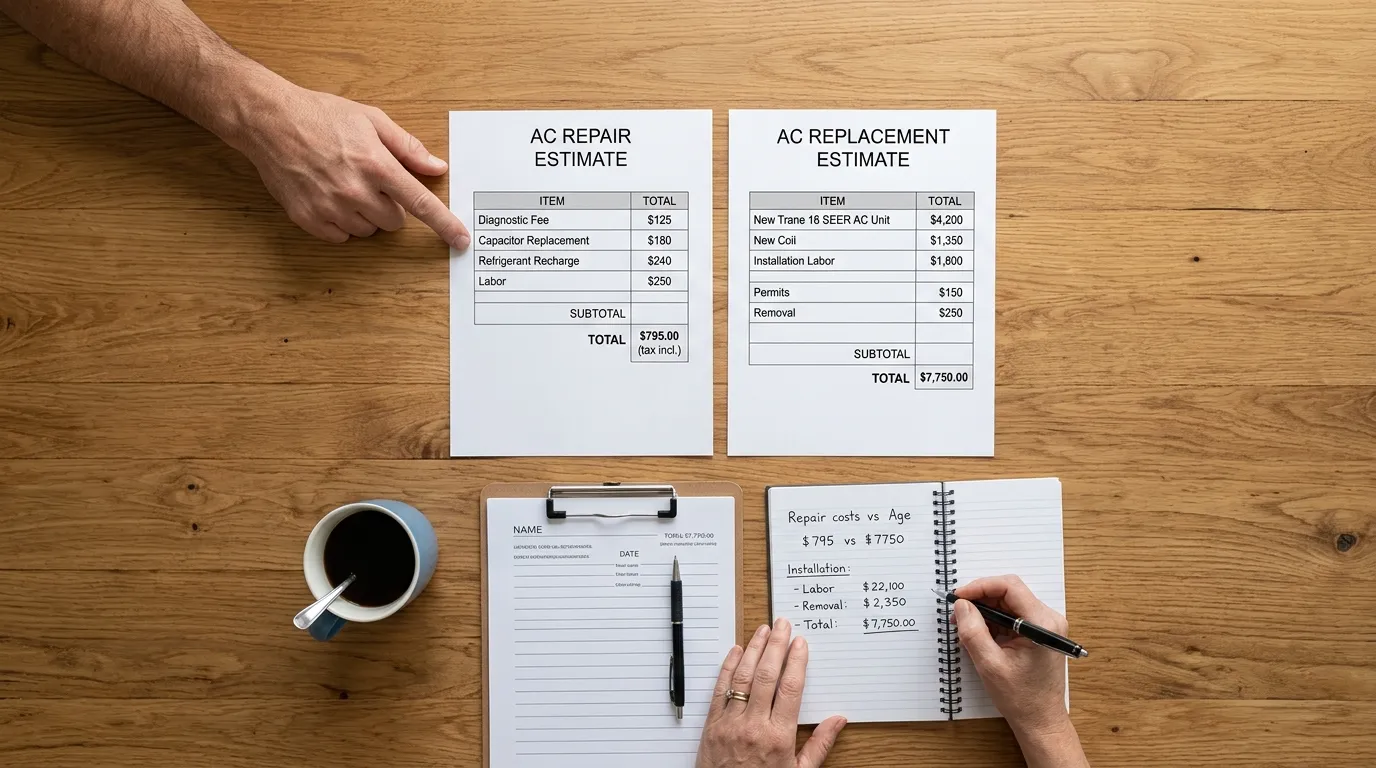
- Get both numbers in writing. Repair quote and replacement quote, side by side. We do this as standard policy — written assessment before any work, price before wrench.
- On any four-figure quote, get a second opinion. Every summer, second opinions turn some “failing condensers” back into capacitors. Not most — most techs are honest — but enough that a free hour of your time has the best ROI in home services.
A note on urgency: even mid-heatwave, you nearly always have 24–48 hours to decide. A same-day repair visit can usually get a limping unit through the week cheaply while you make the replacement call at kitchen-table speed instead of driveway speed.
If the Math Says Replace
Then it says so with real numbers, and the decision gets easier, not harder.
What to expect from the process: a load calculation (not a guess off the old unit’s label; houses change, and plenty of Waco-area systems were oversized on day one), a written proposal with equipment options at more than one price point, and a conversation about efficiency that pays attention to your actual electric bill rather than a brochure. New systems run modern refrigerants, so you step off the R-410A treadmill entirely.
On cost: free estimates apply to new HVAC system installations, financing is available, and the air conditioner replacement page covers how we approach sizing and quotes. We’ll publish a full Waco-specific installation cost guide shortly; the short version is that “what a new AC costs” depends mostly on tonnage, efficiency tier, and what your ductwork needs. Anyone quoting a single number without looking at all three is guessing.
Timing deserves one more sentence, because it’s the lever most people don’t realize they hold. A unit that fails the repair math in July doesn’t have to be replaced in July: a modest repair can often carry it through the season, letting you schedule the install in October when calendars open up and you can compare three bids like a person instead of a hostage. Paying $300 to buy yourself a calm, competitive five-figure decision is some of the best money in home ownership.
FAQ: Repairing an Older AC
How long should an AC last in Central Texas?
Is it worth replacing an AC before it dies?
Can I still get parts and refrigerant for my R-410A system?
My AC is 10 years old and needs a $250 repair. Replace it?
Does a new AC lower electric bills?
Who should I trust for the repair-or-replace call?
Run Your Own Numbers First
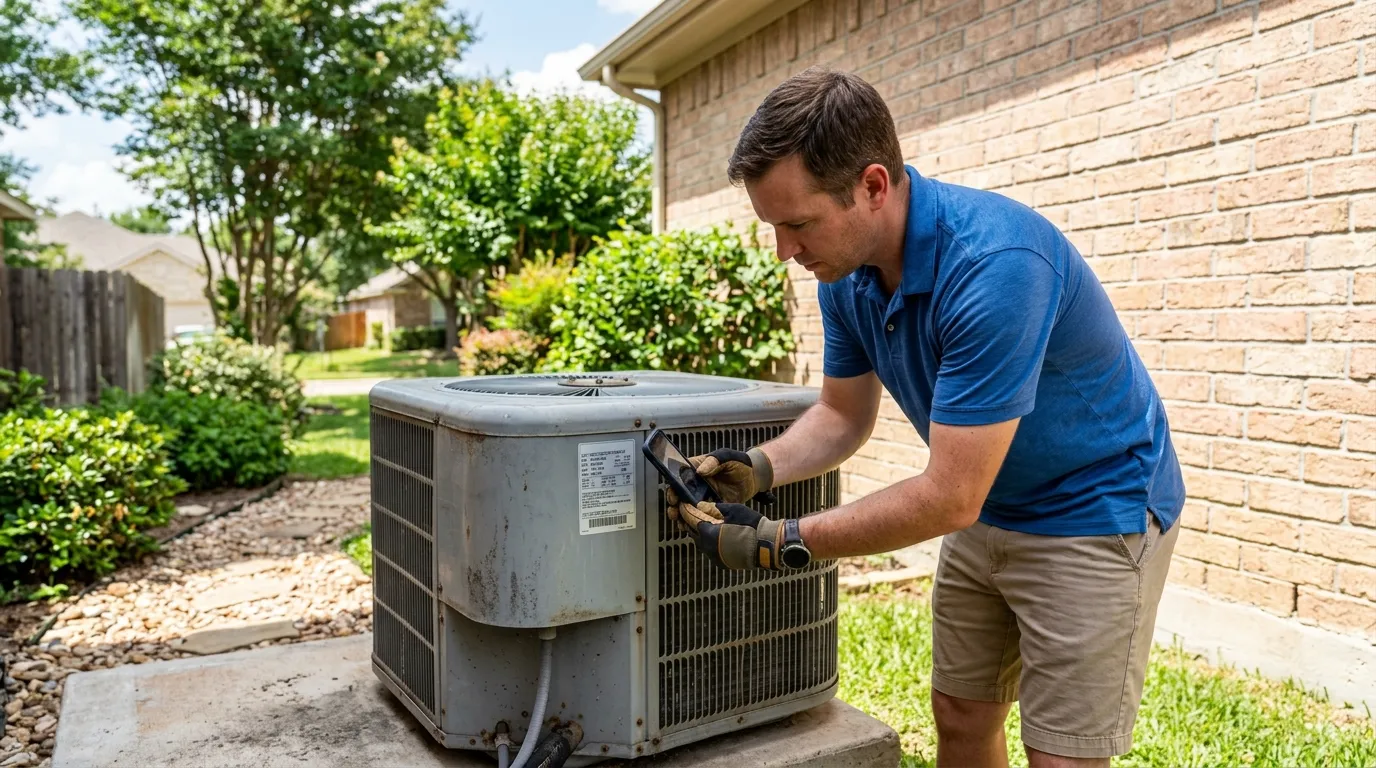
Before anyone stands in your driveway: note your unit’s age off the serial sticker, know that $6,000–$12,500 is the typical replacement neighborhood, and hold every quote against the 50% rule and the age math. If the repair passes, fix it without guilt. If it fails twice — this year and last — start planning the replacement on your terms.
And if a quote doesn’t smell right, get a free second opinion before you sign anything. Seniors and military get 10% off repairs. The written quote comes before the work, every time.
On Point Service Company is a family-owned HVAC and appliance repair company in McGregor, TX, serving Waco, Temple, Belton, and the surrounding area with 20+ years of combined experience. Licensed & insured · TDLR License TACLB00069239E