



A walk-in cooler that quits on a Friday night doesn’t hand you a repair bill first. It hands you a product bill: the weekend meat order, the dairy, two days of prep. The repair might be a $250 fan motor. The failure you didn’t see coming can cost ten times that.
Walk-in cooler maintenance comes down to six habits: check the door gasket and sweep monthly, clean the condenser coil every one to three months, keep the drain line clear, log temperatures twice a day, learn what a normal defrost cycle looks like, and treat any new noise from the evaporator fan as an appointment. None of it takes special tools. All of it is cheaper than a warm box.
Here’s each habit, with the Central Texas details the national guides skip.
The gasket math: a $200 part guarding thousands in product
Start with the boring part, because it has the best return in your kitchen. A worn door gasket lets warm, humid air pour into the box on every shift. The compressor runs longer, the evaporator coil ices up, and product creeps toward the danger zone while everything still sounds fine.
Replacing a walk-in door gasket typically lands between $100 and $300 around here, parts and labor. Set that against what the box holds: for a small restaurant, a few thousand dollars of inventory in an ordinary week, more heading into a Baylor home-game weekend. One lost load of protein pays for a decade of gaskets.
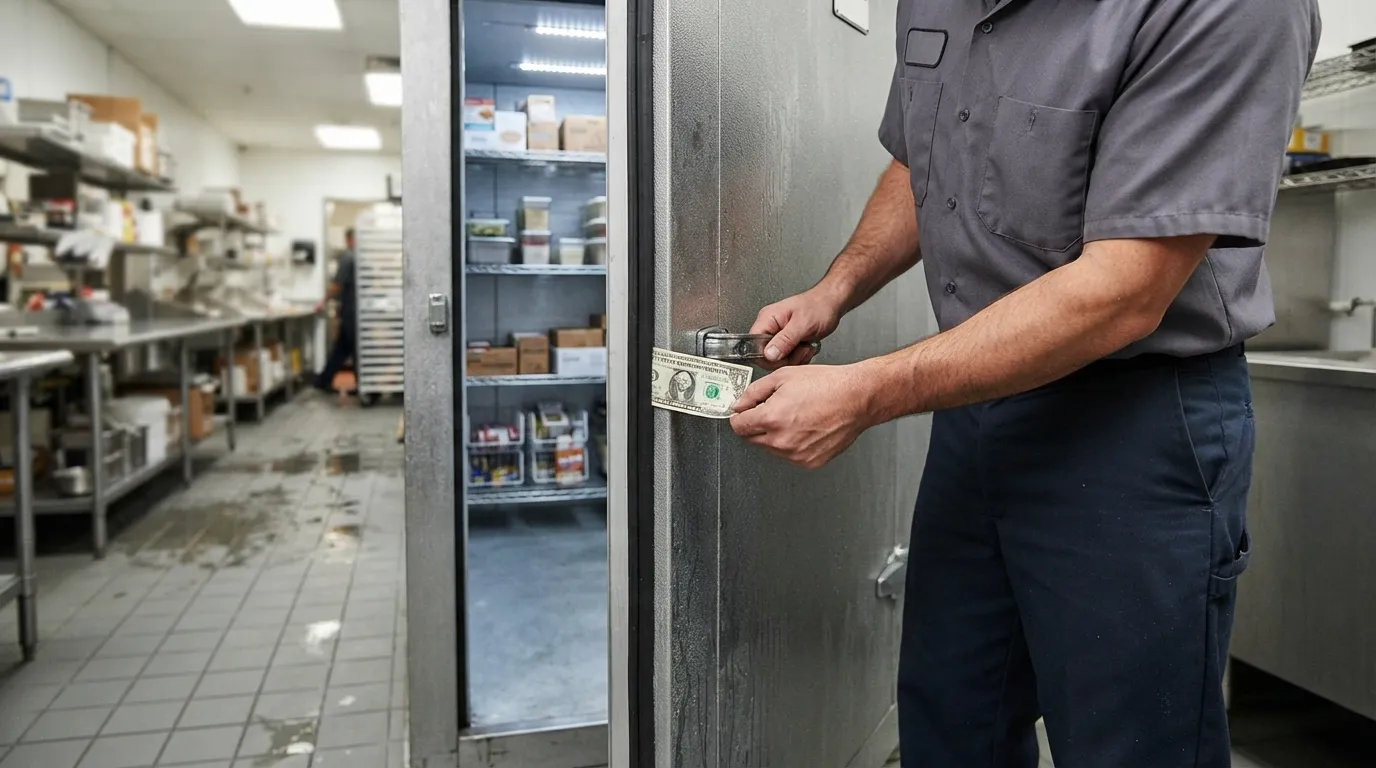
The monthly test costs nothing. Shut the door on a dollar bill. If it slides out with no drag, the gasket is done sealing. Check the sweep at the floor the same way; daylight under a closed door means warm air moving in around the clock.
First opinion of the post, and we’ll stand on it: the gasket is the highest-return part in the building.
Coil cleaning: every one to three months, no skipping spring
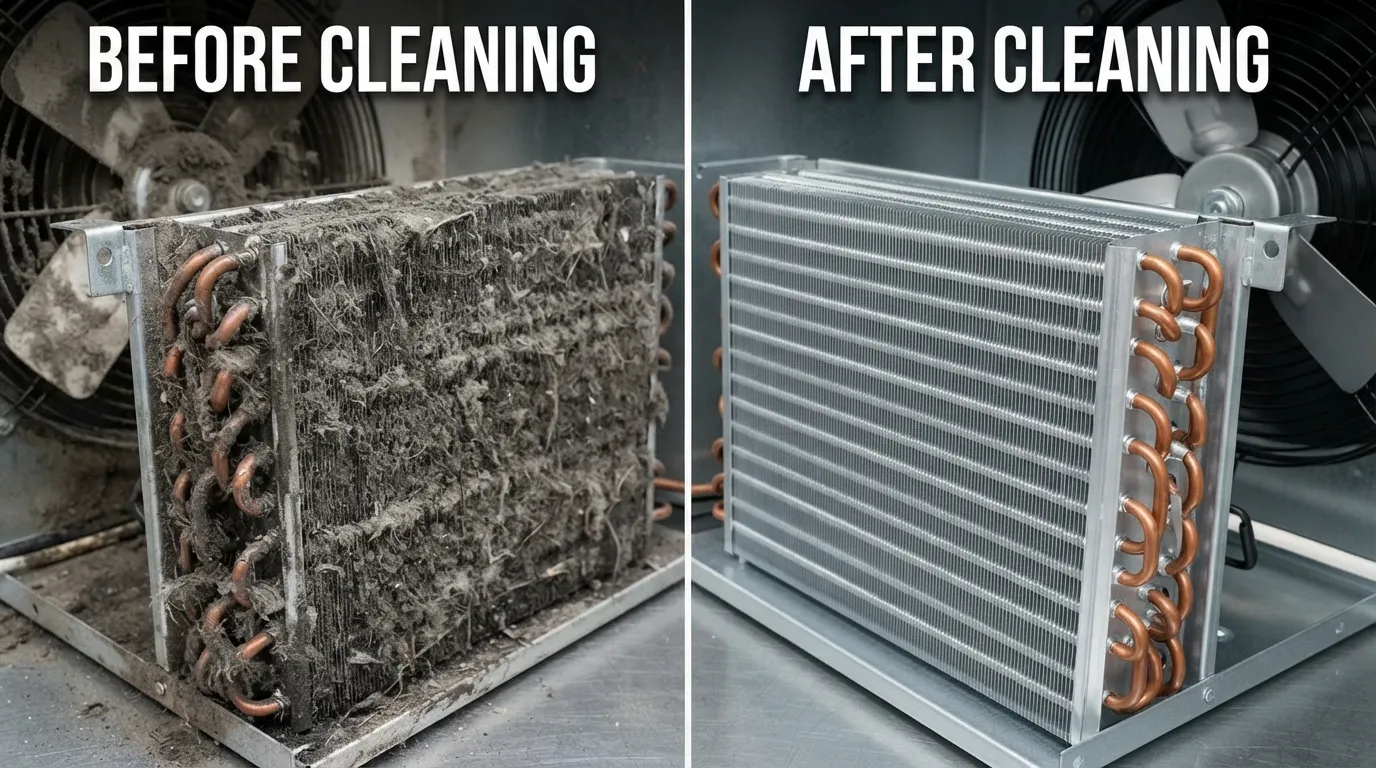
A walk-in has two coils. The condenser coil (up top or on a remote rack) throws heat out, and kitchens are brutal on it: flour dust, fryer haze, and lint mat the fins faster than any spec sheet assumes.
Kill the power, then brush and vacuum the condenser coil. Monthly if it lives near a fry line or a gravel lot, quarterly if it sits somewhere clean. Brush along the fins, never across them.
Timing matters here. A half-clogged coil that limps through April won’t survive the first 100° week in June; heat rejection gets hardest exactly when door traffic peaks. Book the deep clean every spring and the box enters summer at full capacity instead of 70%.
The evaporator coil inside needs less from you: airflow and a working defrost.
Drain lines: Texas humidity turns a dribble into a floor problem
Cooling makes water, and in Central Texas humidity it makes a lot. All of it leaves through one modest drain line that grows algae in warm months, clogs, and sends the overflow to your floor: puddles under the evaporator, an ice sheet in a freezer, a slip hazard your inspector will note before the handshake.
Your job here is eyes, monthly. Water where it shouldn’t be, ice below the coil, a drip trail down an inside wall: any of those means the line needs clearing. Have the drain flushed at every professional visit, and in a freezer, get the drain-line heater tested; a dead heater is an ice plug waiting.
Hard water plays a smaller part inside a walk-in than elsewhere in your kitchen (dust and humidity are the villains here), though on well water out toward Crawford or Moody, mineral crust shows up in drain pans too. Water-fed equipment has it far worse; we broke down what the local water does in our hard water guide. The ice machine fails almost entirely because of scale, so that one got its own triage guide.
The temp log: two minutes, twice a day
Tape a paper log to the door and write the box temperature twice a day, opening and mid-afternoon. Target 35°F to 38°F air temperature so food holds at 41°F or below, the cold-holding line in the FDA Food Code. Your inspector works from that number.
The log matters for a quieter reason than inspections. Walk-ins rarely die suddenly. They drift: 37° this week, 39° next, 41° the week after. That drift is a failing gasket, an icing coil, or a tired fan announcing itself weeks early, and memory won’t catch a two-degree slide. Paper catches it every time.
Use paper, honestly; wireless sensors are great until the subscription lapses and nobody opens the app. The thinking behind the log is the sequence we run on home refrigerators every week — airflow, seals, coils, and fans before anything sealed. A walk-in is that checklist with a door you can step through.
Defrost cycles and the fan: know what normal looks and sounds like
Your cooler defrosts on a schedule, a few short cycles a day where the fans pause and the coil sheds frost. Learn your box’s rhythm (how many cycles, how long), because trouble announces itself as change. A coil growing a frost beard, icicles at the fan housing, water refreezing on the floor: the defrost is losing, and the box is next.
Never chip ice off a coil; bent fins choke airflow, and one slip can puncture a line and turn a timer problem into a sealed-system problem. If ice returns after a manual thaw, the defrost clock, heater, or drain needs a tech.
The evaporator fan tells you even more, if you listen:
- A chirp or squeal at start-up: bearings drying out. Weeks of warning, usually.
- Grinding: bearings past warning. Days, maybe.
- Tick-tick-tick: blades clipping ice, which means a defrost problem too.
- Silence while the compressor runs: the fan is done, and the box loses the fight within hours.
Fan motors are among the most common walk-in failures and the cheaper ones, typically $200 to $500 replaced at commercial rates. Caught at the chirp, that’s a scheduled part swap. Caught at silence on a hot Saturday, it’s a product bill with a repair bill stapled to it.
The monthly owner checklist, and the hard line at refrigerant
Everything here is owner-safe and takes twenty minutes a month:
- Dollar-bill test the door gasket and the floor sweep.
- Brush and vacuum the condenser coil with the power off.
- Look under the evaporator for drips, puddles, or ice.
- Read the week’s log for drift, not only today’s number.
- Listen to the fan for chirps, grinding, or ticking.
- Time one defrost against your normal.
- Audit door habits: strip curtains down, closer working, nothing propping the door during deliveries.
The hard line is the refrigerant circuit, and it’s legal, not a skill judgment: gauges, charging, leak repair, and anything sealed require an EPA-certified tech under federal law. Contactors and control panels ride the same rule. Once a repair means opening an electrical box, it stopped being a checklist item.
[CONFIRM: commercial service scope — if OPSC’s commercial refrigeration work is confirmed, a direct service offer replaces this note.] Until that’s settled in print: shops differ on whether walk-ins are in their lane, and the honest ones say so on the phone in two minutes. Ours will. Call and ask whether your equipment is work our techs take on; a no costs nothing and comes with a pointer where we have one. And if somebody already quoted you a compressor, a second opinion on that math is free.
Pricing a new box instead? Read this first
If the quote says the compressor is dying on a 15-year-old box, walk in cooler installation might genuinely beat another repair. That’s a different conversation entirely: a refrigeration contractor, an electrician, sometimes a concrete pad and permits, with industry-typical installed costs starting around $8,000 for a small box and climbing fast.
Which is the strongest argument for everything above this paragraph. Maintenance money is small money against a five-figure box and a week of lost service.
One trade-off worth admitting: these habits cost discipline and a couple of professional visits a year that might find nothing wrong. Some years that feels like paying for reassurance. The year the log catches a three-degree drift in August, it’s the best money the kitchen spent.
FAQ: walk-in cooler maintenance
How often should a walk-in cooler be serviced?
What temperature should a walk-in cooler hold?
Why is my walk-in cooler not holding temperature?
Is a maintenance contract worth it for a single walk-in?
Where this leaves your Friday
If you only adopt one habit, make it the log. It’s the smoke detector for everything else on this list. Add the gasket test and a spring coil cleaning and you’ve headed off the failures that empty most walk-ins.
For the one question this checklist can’t answer, whose lane your box is in: ask us directly or call . A straight answer costs nothing. [CONFIRM: commercial service scope — swap in the confirmed CTA when settled.]
The On Point Team · On Point Service Company — family-owned HVAC & appliance repair, McGregor, TX · Serving Waco, Temple, Belton, and surrounding Central Texas towns · Licensed & insured, TDLR License TACLB00069239E ·