



Ice machine repair around Waco starts with an unfair fact: Central Texas water is hard enough to kill these machines young, and the machine helps it happen. Before you book anyone, run the free moves. Confirm power and water, change the filter, and run a full clean cycle with nickel-safe cleaner. A scaled machine acts exactly like a broken one, and cleaning is the only test that tells them apart.
That’s the short version. Below: the symptom decoder (thin ice, cloudy ice, no ice, slime), what a clean cycle genuinely fixes, and the honest point where a machine is scaled past saving.
Hard water is the villain: the scale story
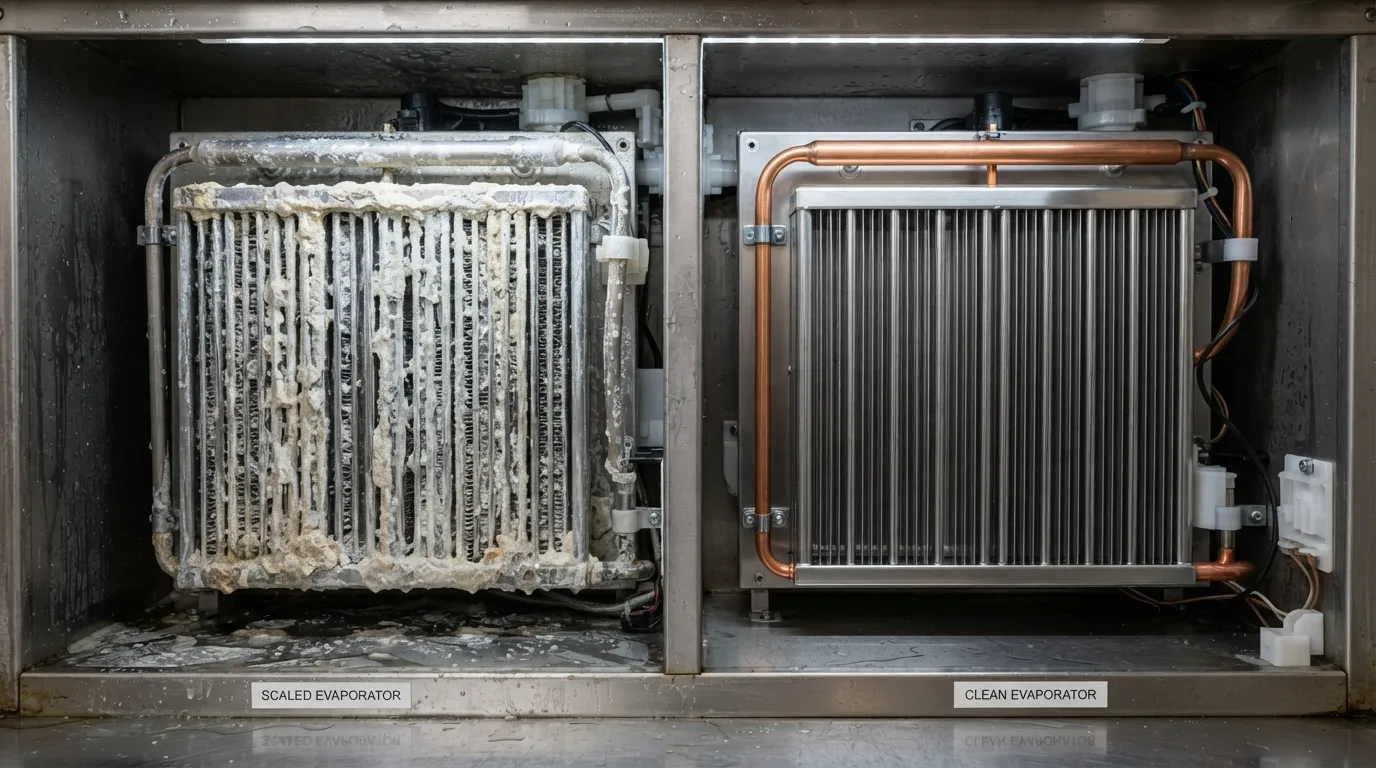
An ice machine concentrates minerals by design. Every cycle freezes nearly pure water out of the batch, which leaves the water still in the sump carrying a heavier mineral load, and that concentrate is exactly what limescale is made from. Our limestone-fed water across McLennan and Bell counties arrives hard before the machine makes it harder.
So scale shows up everywhere it hurts. It coats the evaporator plate, so cubes freeze slowly, come out thin, and release late. It plugs the inlet valve screen, seizes float sensors, gums the pump, and gives slime a surface to grab. We wrote up what this water does to every appliance that drinks it in our hard water guide; the ice machine is the worst victim on the list because concentrating minerals is its job description.
Here’s the opinion that follows from all that: an inline water filter is not optional equipment in this county, whatever the installer said, and it needs changing every six months, not whenever someone remembers. It’s the cheapest part on the machine and the only one that defends all the others.
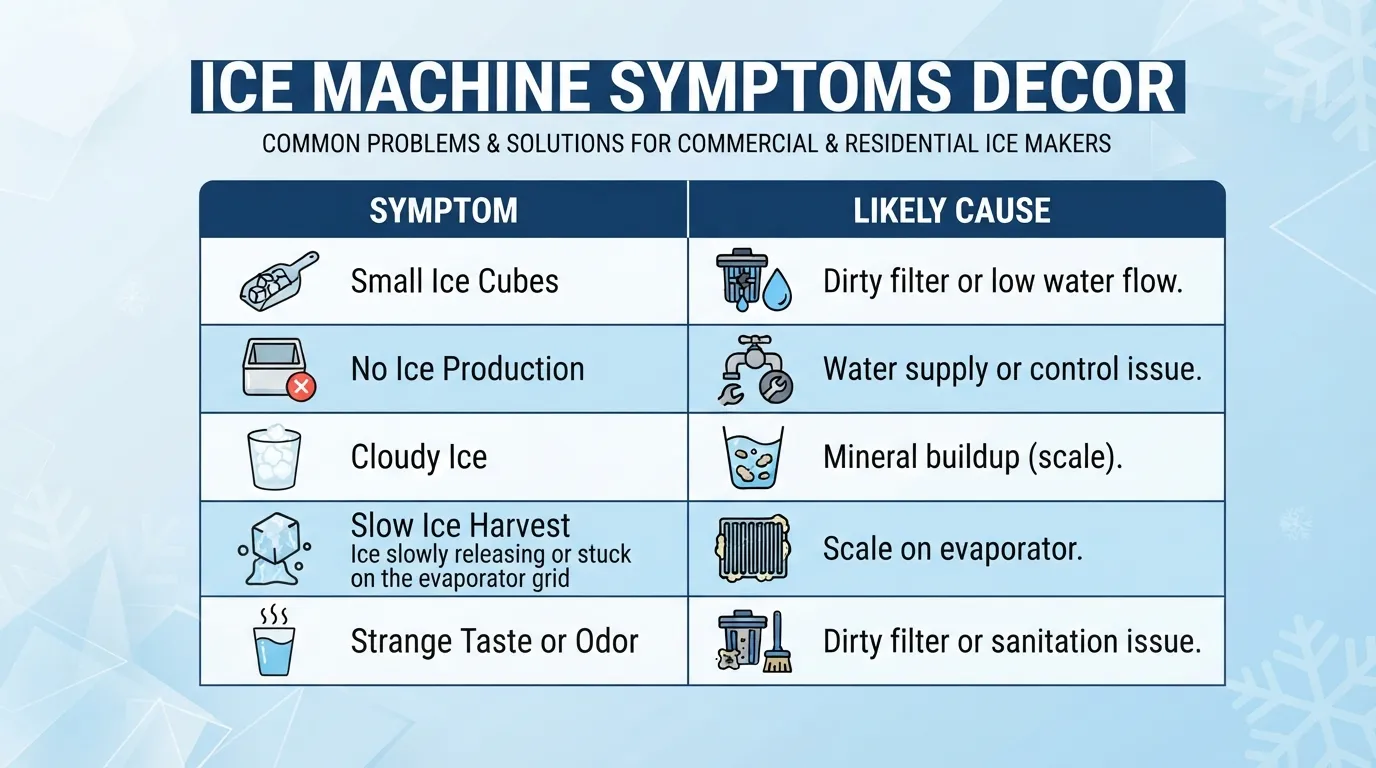
The symptom decoder: thin ice, cloudy ice, no ice, slime
Match your symptom, then make the cheapest move first.
| Symptom | Likely cause | First move |
|---|---|---|
| Thin, hollow, or incomplete cubes | Scale on the evaporator plate, weak water flow | Clean cycle, new filter, check water pressure |
| Cloudy or bad-tasting ice | Mineral-heavy water, spent filter | Change the filter before blaming the machine |
| No ice at all | Power, water supply, or a failed component | Breaker once, water valve open, then a clean cycle |
| Slow production in summer | Dirty condenser coil, hot ambient air | Brush the coil, clear airflow around the machine |
| Slime, odor, or gray flecks | Cleaning and sanitizing overdue | Full clean and sanitize, then tighten the cadence |
| Runs but never drops ice | Scale gluing up the freeze or release | Clean first; if it repeats, it’s a service call |
Two notes on that table. Summer slowdowns are usually the room, not the machine: a condenser gasping in a 95° closet can’t reject heat, so production falls exactly when the dining room wants ice most. Give the machine air before you give anyone money.
And the no-ice row deserves its own honesty: one breaker reset is diagnostic, two is a warning of a real electrical fault, and that’s where you stop.
Clean first, then judge: what a clean cycle fixes
Roughly half the “broken” machines in hard-water country are dirty, scaled, or both. That’s why every manufacturer builds in a clean cycle, and why Manitowoc and Hoshizaki care guidance calls for cleaning and sanitizing at least every six months. On our water, make it quarterly. Twice-yearly is a minimum written for places with softer water than ours.
Cleaning is two jobs, and they’re different. Descaling (the nickel-safe cleaner) dissolves the mineral crust off the evaporator and water path. Sanitizing kills the slime and biofilm. Do both, in that order, per your machine’s manual. Skipping the sanitize half isn’t a shortcut, because the FDA Food Code treats ice as food. Your inspector does too.
The trade-off, stated plainly: a proper clean-and-sanitize takes the machine down for several hours and you dump the bin at the end, so it costs an afternoon of ice. Schedule it for your slowest day and bridge with bagged ice. Skipping costs more, but pretending the downtime is zero would be a lie.
If a full clean cycle and a fresh filter don’t move the symptom, now you’re allowed to suspect parts.
What an ice machine mechanic checks before touching parts
A good ice machine mechanic doesn’t start with a parts catalog. The first twenty minutes look like this: water pressure at the machine, the inlet valve screen, the float or level sensor, condenser condition, and then one full freeze-and-release cycle watched end to end, because where the cycle stalls names the suspect.
You can copy the last part for free. Watch a complete cycle before you call anyone. Note where it hangs (filling, freezing, releasing, or between batches), write down the model and serial, and photograph any error lights. A call that opens with “Manitowoc undercounter, hangs at release, error light blinking twice” gets you a smarter answer and a shorter, cheaper visit than “it’s making weird ice.”
Typical repair money, industry-wide for Central Texas: inlet valves, pumps, and sensors usually land between $150 and $700 installed. Anything touching the refrigeration circuit runs $500 to $1,500 and up.
Scaled past saving: when repair stops making sense
Commercial ice machines give you 8 to 10 years of honest work, and hard water shortens that. Here’s the decision math when yours starts failing.
Run the 50% rule against a real replacement number: undercounter machines typically run $1,500 to $3,000 new, and a modular head for a restaurant $3,000 to $6,000, industry-typical. A $400 valve on a 4-year-old machine is easy money. A $1,200 refrigeration repair on a 9-year-old machine fails the math twice, on price and on age.
Scale history breaks the ties. Years of skipped descaling pit the evaporator plate’s finish, and once that plating is damaged, scale grabs the rough surface faster after every cleaning. A machine that needs descaling every few weeks just to limp along isn’t asking for another repair. It’s done, and the honest move is putting the money toward the next machine and a filter schedule that protects it.
One more piece of honesty: bagged ice buys thinking time. A weekend on bagged ice is cheaper than a panic-purchased machine and far cheaper than a repair approved under pressure. If a quote feels big, a free second opinion on the math costs you nothing, and we’ll say so straight if the numbers point to replace.
Where you stop, and whose lane this is
Owner-doable, all of it safe: clean cycles, sanitizing, filter changes, brushing the condenser coil, checking water pressure, and bin hygiene. That list prevents most failures and solves a good share of the active ones.
Past that sits the stop-line. Refrigerant, the compressor, hot-gas and harvest components, and anything sealed belong to an EPA-certified tech under federal law, and opening electrical panels rides the same rule. No exceptions for confident YouTube afternoons.
[CONFIRM: commercial service scope — if OPSC’s commercial ice machine work is confirmed, a direct service offer replaces this paragraph.] Until then, the honest routing: warranty machines go to the manufacturer’s authorized network first, because unauthorized work can void coverage. Out of warranty, call whoever you trust and ask one direct question: is this machine work your techs take on? Ask us that question and you’ll have a straight yes or no in two minutes, plus a pointer if it’s a no. The walk-in humming next to your ice machine plays by different rules entirely, and we built that checklist here.
Fridge ice maker or home-bar machine instead?
If the dead ice is in your kitchen refrigerator’s door, that’s a different machine and a different guide: ice maker not working walks the household version, and home fridge ice makers are squarely in our residential lane, a call we run all week.
Countertop and undercounter nugget machines (the home-bar favorites) die of the same scale as their commercial cousins, only faster, because their water passages are tiny. Run the cleaning cycle weekly with hard water, and be honest about the economics: a $150 countertop unit is rarely worth any service visit, while a built-in undercounter machine might be. Ask before assuming either way.
FAQ: ice machine repair
How often should an ice machine be cleaned?
Why is my ice machine making thin or hollow ice?
Is it worth repairing a 10-year-old ice machine?
Who repairs ice machines near Waco?
Ice Machine Maintenance and Repair Guide: On Point Service Company
Filter every six months, clean quarterly, watch one full cycle before calling anyone, and let the 50% rule and the scale history make the repair-or-replace call. If you want a second set of eyes on a quote or a straight answer about whose lane your machine is in, get in touch or call .
The On Point Team · On Point Service Company — family-owned HVAC & appliance repair, McGregor, TX · Serving Waco, Temple, Belton, and surrounding Central Texas towns · Licensed & insured, TDLR License TACLB00069239E ·