


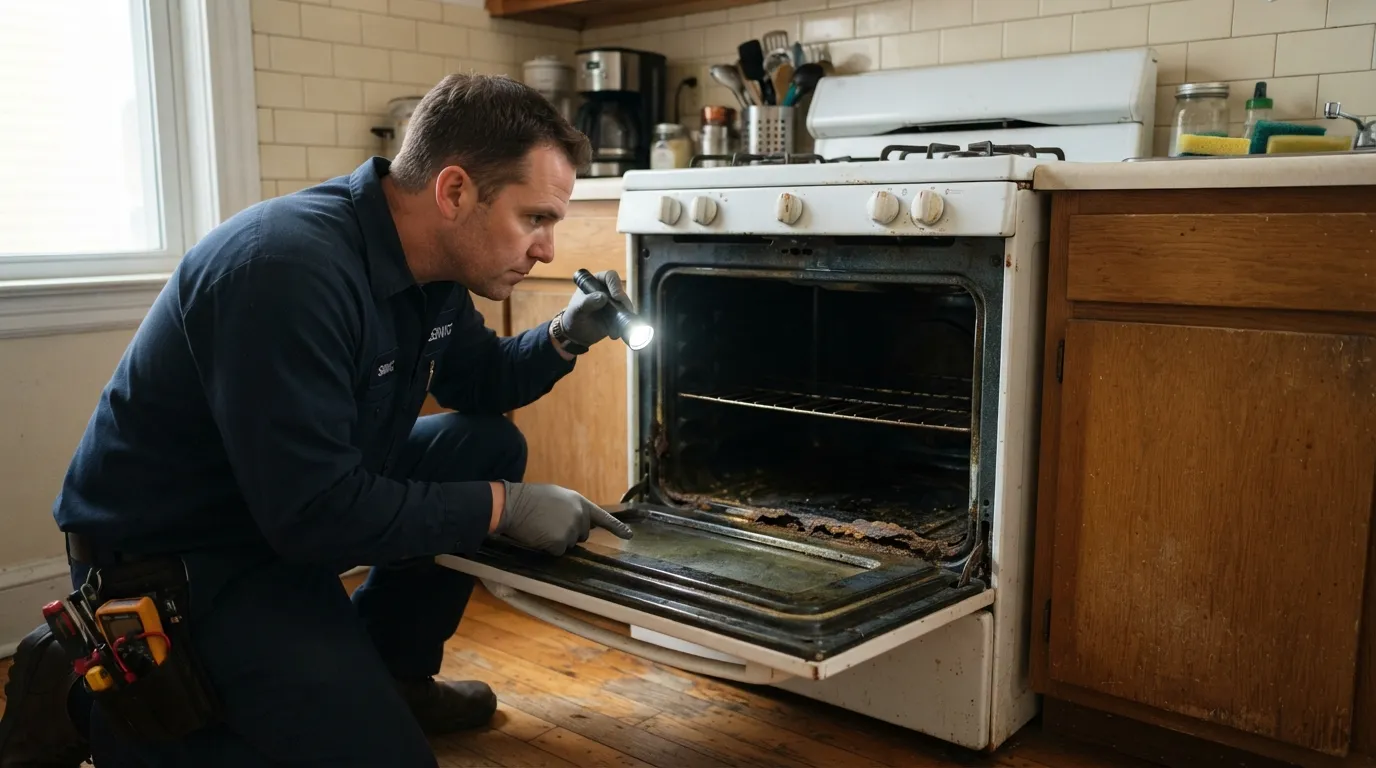
The honest signs you should replace your stove: failures arriving in clusters, a cracked glass cooktop, rust-through, a control panel dying on an older range, a warped door that can’t seal, age past 15, and discontinued parts. Any two together, and replacement usually wins.
But read the counterweight before you shop, because it’s the part the retailer listicles leave out: a single failure on a stove is almost always a repair, and usually a modest one. We fix stoves for a living and we’d still rather talk you out of a $900 range you don’t need.
The 7 signs at a glance
- Failures are clustering. A burner in March, the bake element in June, a sensor by fall.
- The glass cooktop is cracked. Replacement glass costs half a new stove.
- Rust has gone through. Structural rust, not surface specks.
- The control panel is failing on a range past its cutoff age.
- The door won’t seal because the frame or hinges warped, not the gasket.
- It’s 15 or older. Past typical lifespan for electric, at the edge for gas.
- Parts are discontinued. Every future repair becomes a scavenger hunt.
Now the detail, grouped the way the decisions actually get made.
Failures that stack up (signs 1, 4, and 5)
One dead burner is a part. A dead burner six months after a dead element is a pattern, and patterns are how stoves announce the ending: the components are all the same age, and they retire in waves. If this is your year of small failures, stop patching and start pricing.
Control failures raise the stakes because the part is expensive: a board typically runs $250–$600 in Central Texas. On a 6-year-old range, fix it. On a 13-year-old builder-grade unit, that board is most of the way to a new stove, and we’ll say so in the written quote.
The door deserves a closer look before it scares you. A torn or flattened gasket leaks heat and fakes a dying oven, and that’s a cheap fix. A warped door frame or sagging hinge assembly on an old range is the replace-level version; the door will never seal again no matter how many gaskets it eats. One dead burner, by the way, has its own decision tree; start with our guide to an electric stove burner not working before assuming the worst.
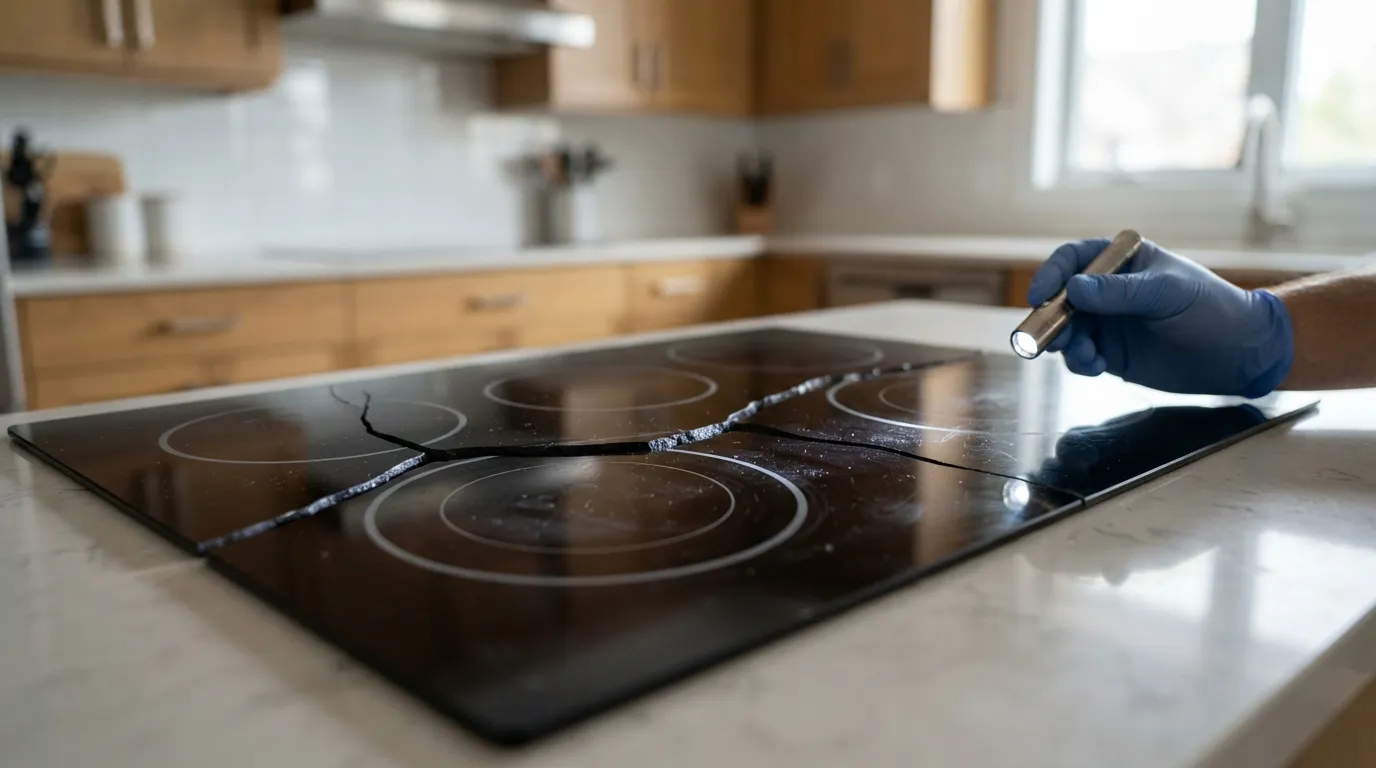
Damage with no sane fix (signs 2 and 3)
A cracked glass cooktop totals most stoves, and we want that stance on the record. Replacement glass plus labor typically lands at $400–$700, on a range you can replace new for $600–$900 at any Waco big-box store. Chasing the glass only pencils out on high-end ranges — and even then, get the number in writing first.
Rust-through is simpler: when rust penetrates the oven cavity or the frame (not the cosmetic freckles on a burner bowl), there’s no part to order. Moisture found the steel years ago and won. This shows up most in older houses around Waco proper, where a range may be on its third decade in a kitchen that’s seen a few steamy summers.
The calendar signs (signs 6 and 7)
Electric ranges typically last 13–15 years; gas ranges often run longer; they’re the longest-lived appliance in the kitchen. The NAHB’s life-expectancy research has said roughly the same for years. Past 15, every repair is a bet against the calendar, and only the cheap bets make sense.
Discontinued parts are the quieter deadline. Manufacturers stop making boards and elements for old models, and once that happens, repairs mean salvage parts with no warranty and long waits. If a tech tells you your model’s parts are drying up, believe the calendar over your attachment to the stove. It’s a real trade-off, though — replacing early means paying up front for certainty, and a simple gas range with available parts can honestly cook for 20 years.
The counterweight: most single failures are just repairs
Here’s the list the buy-a-new-stove articles skip. These are repairs, not replacement triggers:
- A dead burner or element: often a $30-class part on coil-tops
- A weak gas igniter: typically $150–$300
- A drifted temperature sensor: typically $100–$250
- A torn door gasket, a broken knob, an oven light, a latch
Elements and igniters run $150–$350 installed, and an electric oven that won’t heat is usually exactly that repair. Before you type “stove repair near me” and brace for a sales pitch, know the math we use: under 10 years old and the fix is under half of replacement, repair it. That rule, plus a written quote for stove repair before any work, is the whole defense against buying an appliance you didn’t need. Repairs carry our 10% senior and military discount, too.
If you do replace: five minutes of buying notes
Measure first: most freestanding ranges are 30 inches, but slide-ins and some older Temple and Belton kitchens play by their own rules. Match your fuel unless you’re ready to pay for new gas or 240-volt work, because switching costs real money. Skip features you won’t use; every extra board is a future failure point, and the simplest model in a good line is usually the reliability pick. And schedule haul-away, because a dead range in the garage helps no one.
One thing we ask people to check before any of that: make sure the stove is actually the problem. A range that half-works can be a house-side power issue, and our oven troubleshooting hub walks the checks that have saved more than one working stove from the curb.
Common questions about replacing a stove
How long do stoves last?
When should I replace my stove?
Is it worth fixing a 15-year-old stove?
Can a cracked glass cooktop be repaired?
Where this leaves you
Count the signs. Zero or one: repair it and move on. Two or more: start shopping, on your schedule instead of the stove’s. If you’re not sure which side of the line you’re on, ask us for a straight answer or call — a free second opinion has saved plenty of Central Texas ranges, and retired a few, and we’re fine with either ending.
The On Point Team · On Point Service Company — family-owned HVAC & appliance repair, McGregor, TX · Serving Waco, Temple, Belton, and surrounding Central Texas towns · Licensed & insured, TDLR License TACLB00069239E ·