


An oven not working with dinner already planned sets a hard deadline. The good news: most common oven and stove problems come down to nine causes, and the first three cost nothing to check — breaker, power or gas supply, and control settings. Work through them in order before you price parts or shop for a new range. It’s the same order we run on service calls across the Waco area.
Before you touch a screwdriver or a phone, run these. Roughly a third of the “broken oven” calls we take in McLennan County end here, and we’d rather tell you that now than charge you a service fee to flip a switch.
- Check the breaker. Electric ranges run on a double 240-volt breaker. Find it in the panel and flip it fully OFF, then ON. A breaker can trip halfway and still look fine.
- Check the plug. Ranges get shoved back against the wall. A cord seated at an angle can kill half the appliance.
- Check for a lockout. Most modern ranges have a control-lock feature, usually cleared by holding one button for 3 seconds. The manual (or the model number plus “control lock” in a search) tells you which.
- Check the clock and timer. A delayed-start or Sabbath mode setting will block the bake function on many models. If the display shows anything unusual, reset it.
- Check the door. Ovens with a self-clean latch won’t heat if the latch didn’t fully retract. Open and firmly close the door once.
- For gas: check other burners. If nothing on the stove lights and the igniters aren’t clicking, the problem may be the gas supply or the outlet the range plugs into (gas ranges still need 120 volts for ignition).
- Power-cycle the whole range. Breaker off, wait 60 seconds, breaker on. Control boards lock up like routers do, and this clears more faults than anyone likes to admit.
If the range still won’t cooperate, keep reading. The rest of this guide sorts the nine common problems by symptom, with what each typically costs to fix in Central Texas.
The 9 common oven and stove problems at a glance
| # | Symptom | Usual culprit | Typical Central Texas range* | Safe to DIY? |
|---|---|---|---|---|
| 1 | Oven dead, stove top works | Thermal fuse or control board | $150–$400 | Checks only |
| 2 | Electric oven won’t heat | Bake element or igniter relay | $150–$350 | Visual check only |
| 3 | Gas oven won’t light | Weak hot-surface igniter | $150–$300 | No — gas |
| 4 | Electric burner not working | Burner, receptacle, or infinite switch | $100–$250 | Swap-test only |
| 5 | Gas burner clicks, won’t light | Clogged ports or wet igniter | $0–$150 | Yes — cleaning |
| 6 | Temperature off / uneven baking | Sensor or calibration | $100–$250 | Calibration yes |
| 7 | Door locked shut | Self-clean latch assembly | $150–$350 | Power-cycle only |
| 8 | Error code on display | Sensor or control board | $100–$600 | Look up code |
| 9 | Sparks, buzzing, burning smell | Shorted element or wiring | Stop using it | No |
*Industry-typical ranges for the Waco area, parts and labor. Every job gets a written quote from us before any work starts — these are context, not our price sheet.
Oven problems: dead, not heating, or baking unevenly
The oven is dead but the stove top works
This one confuses people, and it’s all over the Waco Nextdoor threads every November. The stove top and the oven run on separate circuits inside the range, so one can die while the other cooks fine.
On electric models, the usual suspect is a blown thermal fuse (a one-time safety device that pops when the oven overheats, very often during a self-clean cycle) or a failed bake circuit on the control board. On gas models, it’s usually the igniter. Either way, if the stove top works, you’ve at least ruled out the breaker and the cord.
Electric oven won’t heat, or only half-heats
Set the oven to bake at 350°F and watch the lower element through the window. Within a few minutes it should glow evenly orange, end to end. Dark patches, one glowing half, or visible blistering means the element is done. That’s problem number one on electric ovens, and it’s the single most common oven repair we do between October and January, when holiday baking finds every weak element in the county.
An element that doesn’t glow at all could still be the element, but it could also be the relay that feeds it. That distinction matters because one part costs a fraction of the other, and it’s exactly the kind of thing a diagnostic visit settles before you buy anything. We cover the electric side in more depth in our electric oven troubleshooting post.
Gas oven won’t light
Gas ovens don’t use a pilot light anymore. They use a hot-surface igniter that has to glow, draw enough current to open the gas valve, and then light the burner, usually within 90 seconds. Igniters weaken with age. A weak one still glows, which fools people into replacing other parts, but it never pulls enough current to open the valve.
If your gas oven hums, glows faintly, or clicks without lighting, the igniter is the odds-on favorite. It is not a part we’d have you test yourself, because testing means working next to a live gas valve. More on where the line sits below.
The temperature is off or everything bakes unevenly
If cookies come out raw at the setting that worked for years, the oven temperature sensor has probably drifted. You can verify with a $10 standalone oven thermometer from any hardware store in Waco: set 350°F, wait 20 minutes, compare. A reading 25°F or more off is worth fixing.
Two honest notes before you pay anyone. First, most ovens can be recalibrated from the control panel (the manual shows how) and that adjustment is free. Second, uneven baking is sometimes just a bad rack habit: one tray dead-center beats two trays crowding the walls.
Stove top problems: burners that won’t light or won’t heat
Electric stove burner not working
On a coil-top stove, do the swap test: unplug the dead burner, plug a same-size working one into its spot. If the borrowed burner works, the original coil is bad — about a $30 part you can genuinely replace yourself, since the coils just plug in. If the borrowed burner also stays cold, the receptacle underneath or the infinite switch behind the knob has failed, and that repair goes into sealed-electrical territory.
Glass-top stoves don’t give you the swap test. A radiant element or its control failing under glass shows the same symptom, and getting to it means opening the cooktop. That one’s a service call.
Gas burner clicks and clicks but won’t light
Usually dirt, not damage. Boil-overs clog the tiny flame ports around the burner head, and in our hard-water part of Texas, the residue cakes on faster. With the burner cool: lift off the grate and cap, brush the burner head with a dry toothbrush, clear each port with a straightened paper clip (not a toothpick — it snaps off), dry everything completely, and reseat the cap dead level.
A crooked burner cap is the most anticlimactic fix in the appliance business. It’s also one we’ve driven to Robinson for.
If every burner clicks but none light, stop cleaning. That pattern points at the gas supply or regulator, and that’s not yours to chase.
Door locks, error codes, and the self-clean trap
Here’s an opinion you won’t find on a manufacturer’s blog: skip the self-clean cycle the week before a holiday. Self-clean takes the oven to roughly 880°F, which is exactly the stress test that pops thermal fuses and warps door latches. Every year we meet a Temple or Belton oven that locked itself shut two days before Thanksgiving because someone wanted it spotless for guests. Clean it in January, when nobody’s coming over and parts have time to arrive.
If the door is locked right now: run the 60-second power cycle from the top of this guide and give the latch motor a few minutes to reset. No movement after that means the latch assembly needs a tech.
Error codes (F1, F3, E2, and the rest) are the range tattling on a specific circuit. Search your exact model number plus the code before assuming the worst. An F3 is typically the temperature sensor, a $100–$250 fix. Codes pointing at the control board run $250–$600, which starts the repair-or-replace conversation on an older range.
Sparks, gas smells, and other stop-everything signs
Some symptoms aren’t troubleshooting projects. They’re stop signs:
- Sparking or arcing from an element or outlet: shut the breaker off and leave it off.
- A burning-plastic smell that isn’t food: same.
- Gas smell while the range is off: don’t flip switches, don’t relight anything. Get people out, then call your gas provider’s line from outside. The CPSC’s gas-safety guidance is blunt about this, and so are we.
- An oven that heats with the door open or won’t shut off: unplug it or kill the breaker.
None of these are “keep using it gently until the part arrives” situations. A range pulling 40-plus amps or sitting on a gas line deserves respect.
Here’s where you stop and call a licensed tech
You can safely check: breakers, plugs, control settings, burner caps and ports, the swap test on plug-in coils, and oven temperature with a thermometer. That covers every no-cost fix in this guide.
You stop at:
- Anything gas-side beyond surface cleaning. Igniters, valves, regulators, and connectors are licensed-tech work, full stop.
- Sealed electrical components. Control boards, infinite switches, receptacles, and internal wiring stay closed. A range circuit carries enough current to hurt you even when things look off.
- Anything requiring the range pulled out and opened up. The back panel is where the 240-volt terminal block lives.
We’d rather you call and describe the symptom than meet you after a DIY repair went sideways. A phone description costs you nothing, and half the time we can tell you whether it’s worth a visit before anyone drives anywhere.
When it’s the house, not the range
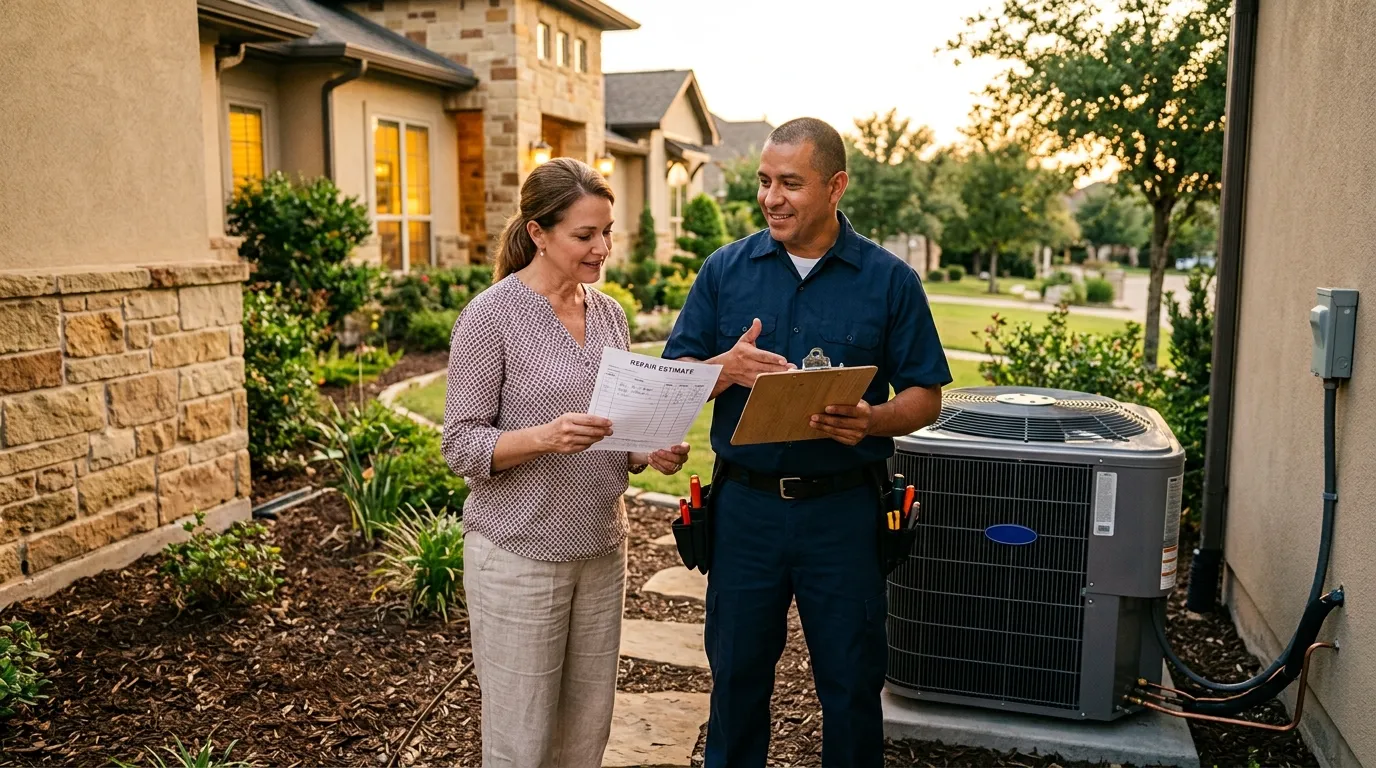
Every so often the range is innocent. Electric ranges run on a 240-volt circuit made of two 120-volt legs, and if one leg fails (a half-tripped breaker, a worn breaker, or a loose panel connection), you get strange half-symptoms: clock works but elements don’t, or burners heat weakly on low.
The quick test: run the breaker fully off and on. If symptoms persist and the range checks out, the problem is upstream in the panel — an electrician’s job, not an appliance tech’s, and we’ll tell you that instead of selling you parts. Breakers that trip repeatedly are their own subject; our post on what it means when a breaker keeps tripping covers the AC version of the same story, and the logic transfers.
Older homes around Waco proper, with panels that predate the newer builds out in China Spring, see this more than anyone wants. It’s worth ruling out before you replace a working appliance.
Repair or replace: the honest math
A basic electric range at a Waco big-box store runs $600–$900 new, installed closer to $1,000. That number should anchor every repair decision.
Our rule of thumb: if the range is under 10 years old and the fix is under half the replacement cost, repair it. Elements, igniters, sensors, and switches all clear that bar easily. A $500 control board on a 14-year-old builder-grade range does not, and we’ll say so in the written quote.
The trade-off runs the other way too: repair keeps your exact range, but if you’re fighting rust, a second failing component, or discontinued parts, you’re paying to extend a countdown. We walk through the general framework in our guide to deciding between appliance repair and replacement, and the same $150-style logic we applied to microwave repair-or-replace decisions scales up to ranges.
Ranges are the longest-lived appliance in the kitchen — 13–15 years typical for electric, often more for gas. A mid-life repair usually earns its money back in years of service.
What a service visit actually looks like
You call, we ask what the range is doing, and we’re honest if it sounds like a five-minute fix you can do yourself. If it needs eyes on it, the diagnostic visit carries a small service fee that covers the drive and the testing time, and you get a written quote for the oven or stove repair before any part goes in. No work starts until you’ve seen the number. Seniors and military get 10% off repairs.
We’re an HVAC and appliance shop in one, with 20+ years of combined experience, which matters here more than it sounds: when the symptom is electrical-ish (half-dead range, tripping breaker), you’re not stuck guessing which trade to call. Same-day availability is real when the schedule allows, and July schedules allow more oven work than you’d think — nobody’s baking, everybody’s AC is dying.
Common questions about oven and stove problems
Why is my oven not working but the stove top is?
Why is my electric oven not heating up?
Nine times out of ten: the bake element (visibly damaged or not glowing evenly) or the temperature sensor. Less often it’s the relay board. Run a bake cycle and watch the element — an even orange glow rules it out, dark patches rule it in.
How much does oven repair cost in the Waco area?
Typical Central Texas ranges: elements and igniters $150–$350, sensors and switches $100–$250, control boards $250–$600. The symptom narrows it fast, which is why we quote in writing after diagnosis instead of guessing over the phone.
Is it worth repairing a 15-year-old oven?
Usually only for cheap, simple parts — an element or a sensor, if parts are still available. Board-level failures on a range that old rarely justify the spend. Under 10 years old, repair wins most of the time.
Can I replace an oven heating element myself?
The plug-in coil burners on a stove top, yes. The oven’s internal bake element sits behind live 240-volt terminals, and we put it past the DIY line along with everything else that requires opening the appliance. Check it visually, then let a tech swap it.
What does it mean when my gas oven clicks but never lights?
The igniter is firing but the gas isn’t lighting, which points at a weak igniter, a blocked port, or a supply problem. Clean what’s reachable with the burner cool. Beyond that, it’s licensed-tech territory — gas work always is.
Get a straight answer before you buy parts
Work the 60-second checks, watch the element, try the swap test. If the oven’s still not working after that, tell us what it’s doing and we’ll tell you what it likely costs before anyone drives to your kitchen. Request a written quote or call — and if the honest answer is “don’t fix it,” that’s the answer you’ll get.
The On Point Team · On Point Service Company — family-owned HVAC & appliance repair, McGregor, TX · Serving Waco, Temple, Belton, China Spring, Robinson, and the surrounding area · Licensed & insured, TDLR License TACLB00069239E