


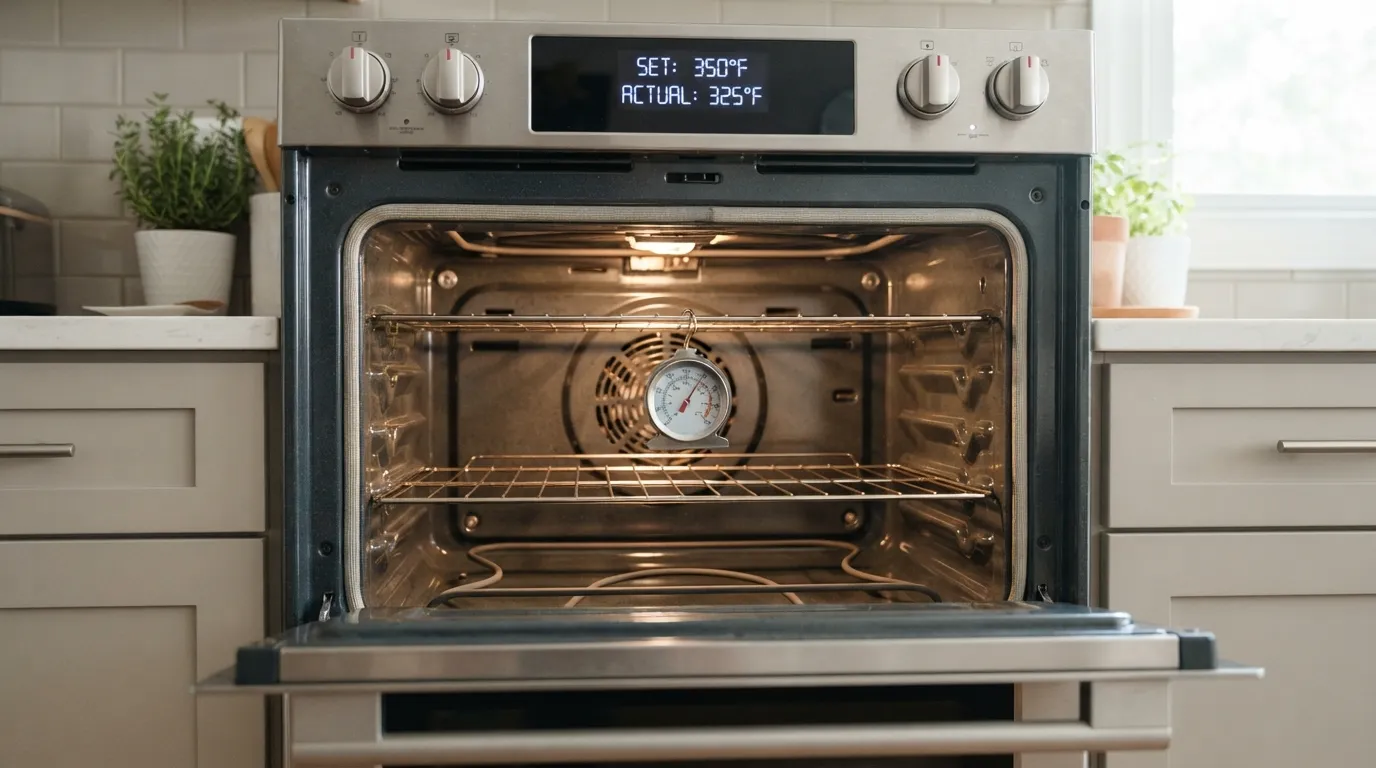
An oven not cooking evenly has three possible stories: the temperature is wrong everywhere (a calibration or sensor problem), the heat is uneven inside the box (element, fan, or airflow), or the oven’s fine and the rack habits aren’t. A $7 dial thermometer sorts all three in one afternoon, and two of the three fixes cost nothing.
Here’s the test, in the order a tech would run it.
The $7 thermometer test
Every kitchen should own a dial oven thermometer, and we’ll die on that hill: it’s the cheapest diagnostic tool in the appliance world, and it settles arguments the oven’s own display can’t be trusted to referee. Any hardware store or grocery in Waco has one for about $7.
- Hang it dead center on the middle rack.
- Set the oven to 350°F and let it preheat fully.
- Wait 20 minutes past the beep, then read it through the glass. Within 25° of the dial: your overall temperature is fine, skip to the hot-spot section. More than 25° off: calibration territory, two sections down.
- Now map the corners. Move the thermometer front-left, give it 10 minutes, read. Repeat back-right. More than 25–30° of spread between positions means real hot spots, and now you know where they live.
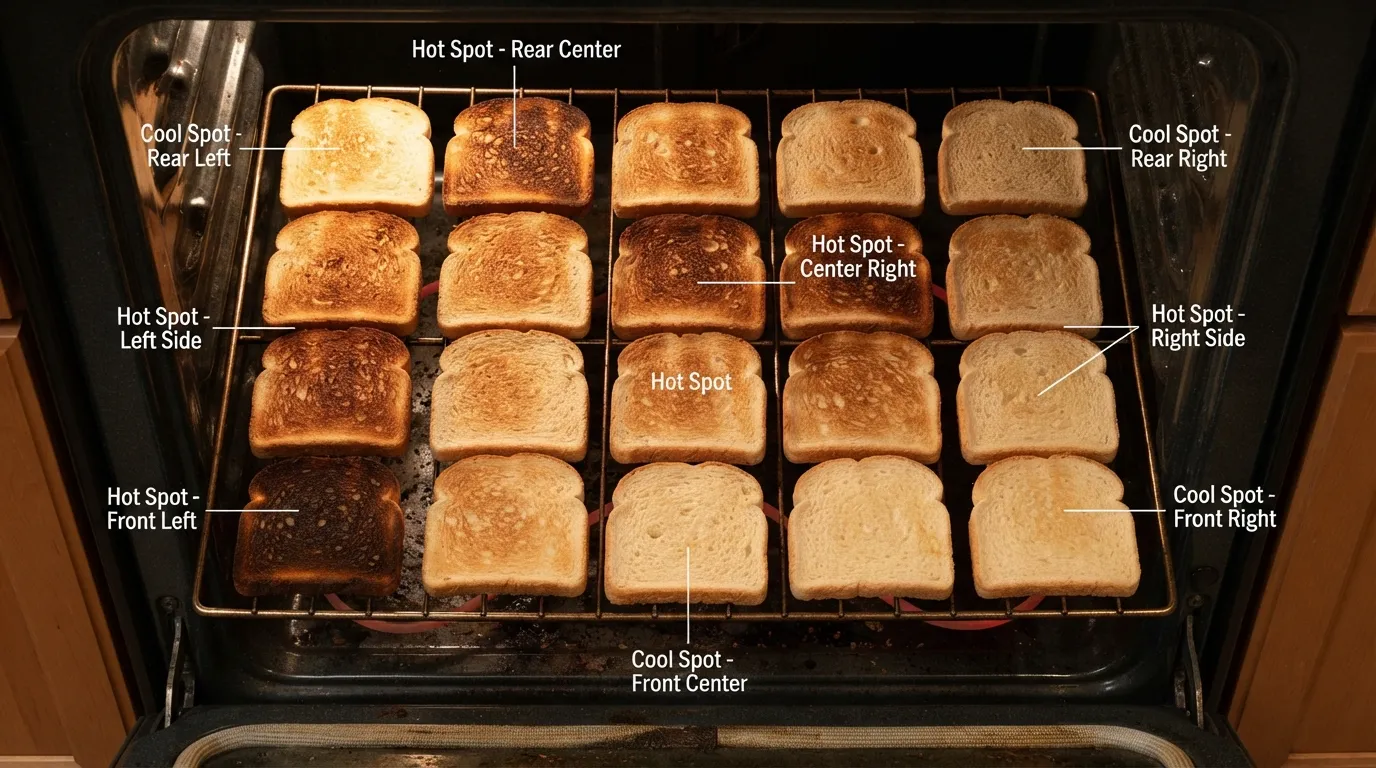
Prefer breakfast to data collection? Run the toast map instead: cover a rack edge to edge with bread slices, bake at 350° until they color, and pull the rack. The browning pattern is a heat map of your oven — pale corner, cold corner. It’s the oldest trick in the trade because it works.
Why is my oven not heating evenly?
Uneven baking usually comes from crowded racks blocking airflow, a bake element weakening at one end, a convection fan that’s stopped spinning, foil covering vents, or a leaking door gasket. Genuine temperature error (the sensor or calibration drifting) is the least common cause, which is why testing beats guessing.
That order matters, because the internet’s favorite answer (the sensor) is the last thing we’d replace, and the most common answer (the way the oven’s loaded) is free to fix. We’ll take them in order of likelihood.
If the temperature is wrong everywhere: calibrate it
When the thermometer reads 320° against a 350° dial in every position, your oven temperature is wrong. Uniformly wrong, which is oddly good news. Nearly every oven made in the last 20 years lets you adjust the temperature offset from the control panel, usually ±35°F. The sequence is in your manual, or search your model number plus “calibration.” Two buttons, five minutes.
And it’s free. That’s the part the parts-sellers skip: an oven that runs 25° cold doesn’t need a $200 visit, it needs its offset nudged. We’d rather you do this yourself than pay anyone, us included.
One honest caveat, since calibration gets oversold in the other direction too: the offset fixes a stable error. If your oven needed +15° in March and +30° by August, the sensor is drifting, calibration is a bandage on a slow leak, and the next section is yours.
Hot spots: elements, fans, and foil
If the center reads true but the corners disagree, work these in order.
Watch the bake element. Run a bake cycle and watch it through the window. It should glow evenly orange, end to end. One glowing half or visible dark patches means the element is failing unevenly — the full walkthrough lives in our electric oven not heating guide, and the repair typically runs $150–$350.
Listen for the convection fan. On convection models, a fan that’s quit turns “even bake” into “one hot wall.” No hum when convect is on is your answer.
Check for foil. A sheet of foil on the oven floor or draped over a rack blocks the vents that move heat. It’s the most common self-inflicted hot spot in Central Texas kitchens, usually installed the week before a holiday to catch drips.
Test the door gasket. Close the door on a dollar bill; if it slides out with no resistance, the gasket’s flattened there, and the front of the oven runs cold. Gaskets are one of the cheap fixes.
When it’s the sensor, and where you stop
The temperature sensor is that thin probe poking out of the oven’s back wall. When it drifts, the oven believes its own bad data: real 320° reads as 350°, and dinner takes an extra half hour forever. Drifting readings, error codes, or an offset that won’t hold all point here.
Testing a sensor means resistance readings, and replacing one means the back panel and live wiring behind it — that’s the stop-and-call line, same as every sealed component on a 240-volt appliance. The repair typically lands at $100–$250 in the Waco area, quoted in writing before any work, through our oven and stove repair service. If the oven has bigger symptoms than uneven cake (dead displays, no heat at all), start with the full oven troubleshooting guide instead, because sensors get blamed for a lot they didn’t do.
The free fixes most ovens actually need
Half the “broken” ovens we test in Belton and Temple bake unevenly for reasons no part will fix:
- One pan, center rack beats two pans hugging the walls. Air has to move around the food.
- Rotate halfway. Even great ovens have a warm side; bakers rotate in every professional kitchen on earth. King Arthur Baking’s oven guidance treats this as standard practice, not a workaround.
- Ignore the preheat beep. Most ovens announce readiness early, while the walls are still cold; the thermometer will show another 10–15 minutes to honest temperature. The beep is marketing. The dial is data.
Try those for a week before spending a dime. If results still swing, the thermometer test above will say why — and if Thanksgiving is on your calendar, run the whole pre-holiday oven check while you’re at it.
Common questions about uneven ovens
Why is my oven temperature not accurate?
How do I recalibrate my oven?
Why does my oven burn everything on one side?
Do I need a new oven if it bakes unevenly?
Where to go from here
Buy the thermometer, run the map, nudge the calibration if the error’s uniform. That solves most of it for the price of a burger. If the readings drift or the element’s showing dark patches, send us the numbers you measured or call — a tech who arrives already knowing your oven runs 30° cold in the back-left corner works faster, and you get a written quote before anything gets touched.
The On Point Team · On Point Service Company — family-owned HVAC & appliance repair, McGregor, TX · Serving Waco, Temple, Belton, and surrounding Central Texas towns · Licensed & insured, TDLR License TACLB00069239E ·