



The week before Thanksgiving is the busiest oven-repair week of our year, every year. Oven maintenance before Thanksgiving comes down to one 20-minute test: put a $7 thermometer in the oven, bake-test it at 350°, watch the element or listen to the igniter, and check the door seal. Run it in early November, while parts and appointments still exist. And whatever you do, skip the self-clean cycle until January.
Here’s the test, the reasons behind it, and the one habit that kills more Thanksgiving ovens than age does.
Why ovens die the week before Thanksgiving
We call it the November 20th call, because that’s about when the phone starts. Same story every time: the oven worked fine last week, and now, with a thawing turkey in the fridge and family driving in from Temple, it won’t heat.
Ovens don’t pick that week out of cruelty. They fail then because of what came before it. A Central Texas oven barely works from May through September — that’s grill season, and nobody bakes in a 100° kitchen. Then November arrives and the oven goes from two light uses a week to four-hour sessions at 375°. That first long, heavy bake is a stress test, and it finds every weak element, tired igniter, and drifting sensor in McLennan County at roughly the same time.
The result is a scheduling pile-up. The same failure that gets a same-day visit on a random Tuesday in July waits in a long line on November 24th. You can’t change that math. You can beat it by three weeks.
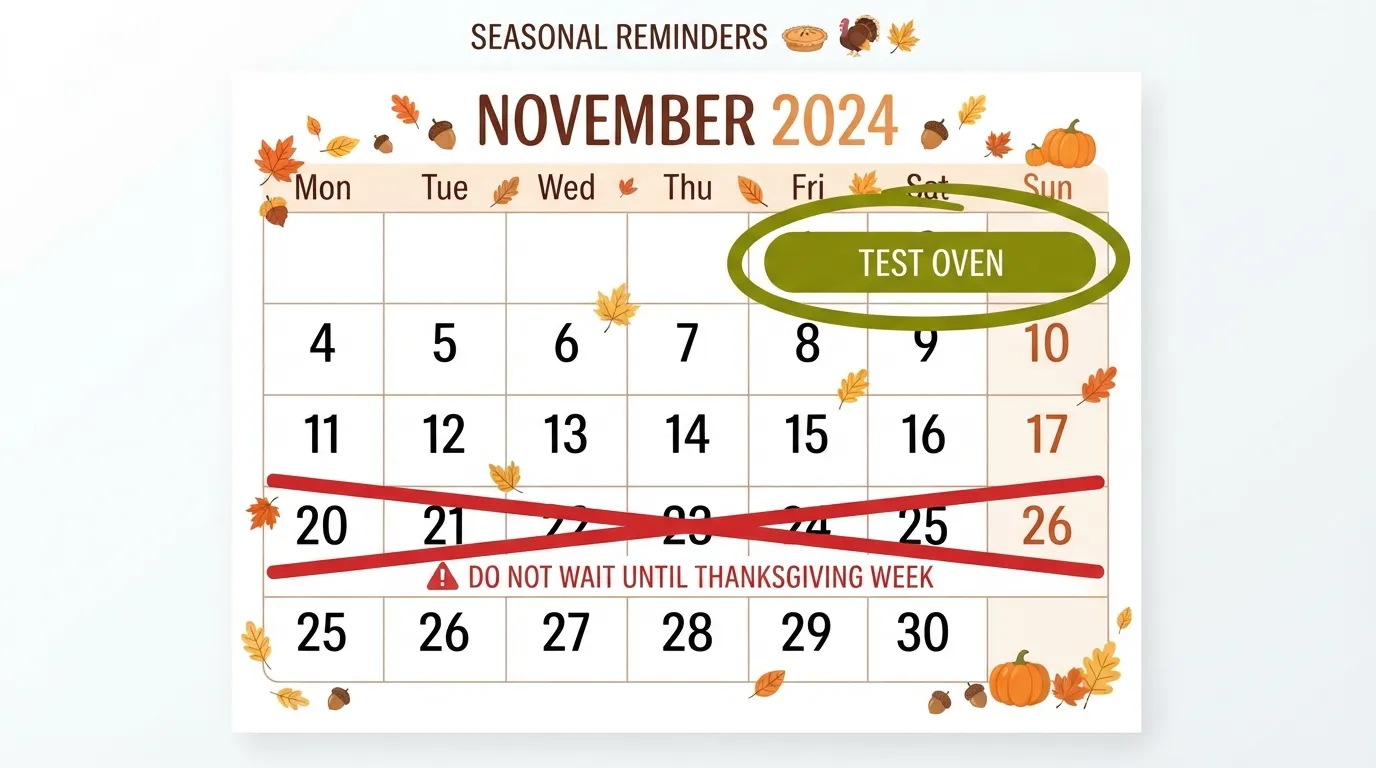
Oven maintenance before Thanksgiving, in one 20-minute test
Run this the first weekend of November. Total cost: about $7.
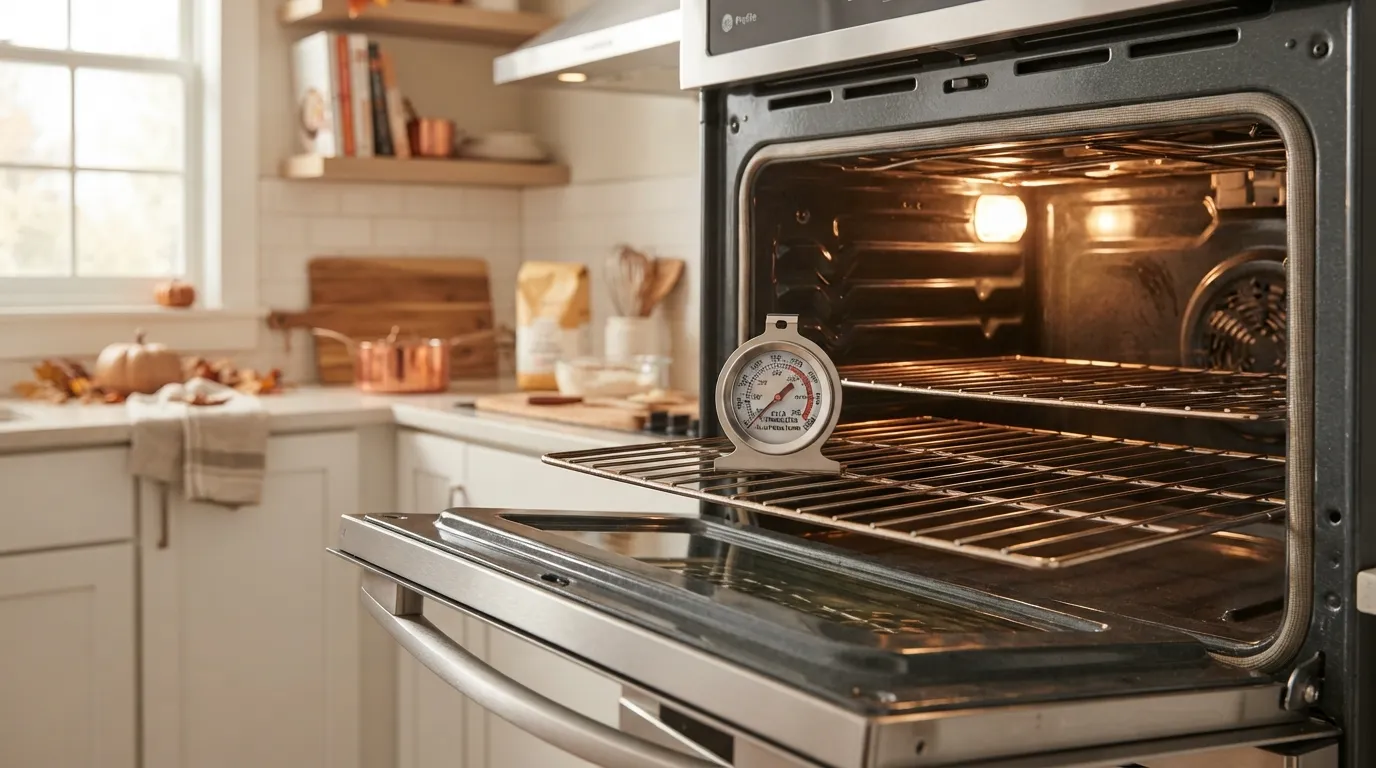
- Buy a dial oven thermometer. Any hardware store in Waco has one near the registers. It’s the only tool this job needs.
- Bake-test at 350°F. Thermometer on the center rack, oven set to 350, wait 20 minutes, read it. Within 25° of the dial is normal; most ovens can be adjusted from the control panel using the calibration steps in the manual. More than 25° off points at the sensor.
- Watch the bake element (electric ovens). It should glow an even orange, end to end, within a few minutes. Dark patches, a half-glow, or blistering means it’s on borrowed time.
- Listen to a gas oven light. Burner should catch within about 90 seconds of the igniter glowing. Slow, hesitant lighting means a weak igniter — the part fails gradually, then all at once.
- Check the door gasket. Run a hand around the closed door mid-bake. Warm drafts mean heat is escaping, and escaping heat is why “it cooks slow lately.”
- Fire every stovetop burner. All of them, together. Green-bean casserole needs real estate.
- Let it run hot for 45 minutes. A long preheat now exposes weak parts on your schedule, with nothing but a thermometer inside. Better today than with a 16-pound bird.
Pass everything? You’re done. Go worry about the guest list.
Do not run the self-clean cycle in November
This is the strongest opinion in this post, and we’ll defend it all day: self-clean mode is the classic pre-Thanksgiving oven killer. The cycle takes the oven to roughly 880°F for hours. That’s the hardest thing an oven ever does, and doing it days before the year’s biggest cooking marathon is asking an aging machine for a sprint before its race.
What self-clean takes out, in our experience: thermal fuses (the oven dies completely), control boards cooked by their own heat, and door latches that engage for the cycle and then refuse to release. Every November we meet a spotless oven in Belton or Crawford that’s locked shut with nothing wrong except the cleaning cycle that was supposed to help.
Clean it the boring way instead: racks out, baking-soda paste on the walls, skip the elements and the gasket. We covered the rack half of the job in how to clean oven racks. Save self-clean for January, when a failure costs you nothing but patience and parts have time to arrive.
The trade-off, stated honestly: hand-cleaning is slower and it won’t turn carbon to ash the way 880° does. Fine. A slightly imperfect oven cooks Thanksgiving dinner; a locked one doesn’t.
If the test fails: costs, parts, and why the calendar matters
Typical Central Texas ranges, parts and labor, quoted in writing before any work: a weak bake element runs $150–$350 — the full walkthrough is in our electric oven not heating guide. A gas igniter lands around $150–$300; here’s why a gas oven won’t light and what a tech checks. A drifted temperature sensor typically runs $100–$250.
None of those numbers change in late November. What changes is time. In the first week of the month, a part gets ordered, arrives, and gets installed before anyone’s basting anything. On the 23rd, the same repair fights holiday shipping and a full schedule. Found a problem? Get a written quote for the oven repair now and let the calendar work for you instead of against you.
And if the oven passes but runs 25° cold, respect what that means for the bird: the USDA’s safe minimum for turkey is 165°F internal temperature, and a cold-running oven turns a four-hour roast into a six-hour one with guests already circling the kitchen.
Holiday appliance prep beyond the oven
The oven takes the spotlight, but Thanksgiving is a whole-kitchen load test. Ten more minutes of holiday appliance prep covers the rest:
- Refrigerator: don’t wall off the vents with casserole dishes the night before. Cold air has to circulate, and an overstuffed fridge working against a warm kitchen is a classic morning-after surprise.
- Dishwasher: clean the filter before the plate marathon, not after it clogs mid-load.
- Disposal: no potato peels, no turkey skin, no grease. That trio jams more disposals on the fourth Thursday of November than the rest of the month combined.
Where you stop and call
A few findings end the DIY portion immediately. A gas smell at any point: don’t flip switches, get people out, and call your gas provider from outside. Sparks, buzzing, or a burning-plastic smell that isn’t food: breaker off, leave it off. A door that stays locked after a self-clean: power-cycle once at the breaker, give the latch a few minutes, and if it won’t release, stop — forcing it breaks the latch assembly you’re hoping to save. All of those are licensed-tech territory, and describing the symptom over the phone costs you nothing.
Common questions about pre-Thanksgiving oven prep
When should I test my oven before Thanksgiving?
Is it OK to self-clean my oven before Thanksgiving?
Why do ovens break down on Thanksgiving?
Can I get an oven repaired the week of Thanksgiving?
Test it this weekend
Twenty minutes, a $7 thermometer, and a hot 45-minute dry run: that’s the whole insurance policy, and it’s the cheapest part of your Thanksgiving. If the test turns something up, send us what you saw or call for a straight answer while the calendar’s still on your side.
The On Point Team · On Point Service Company — family-owned HVAC & appliance repair, McGregor, TX · Serving Waco, Temple, Belton, and surrounding Central Texas towns · Licensed & insured, TDLR License TACLB00069239E ·