


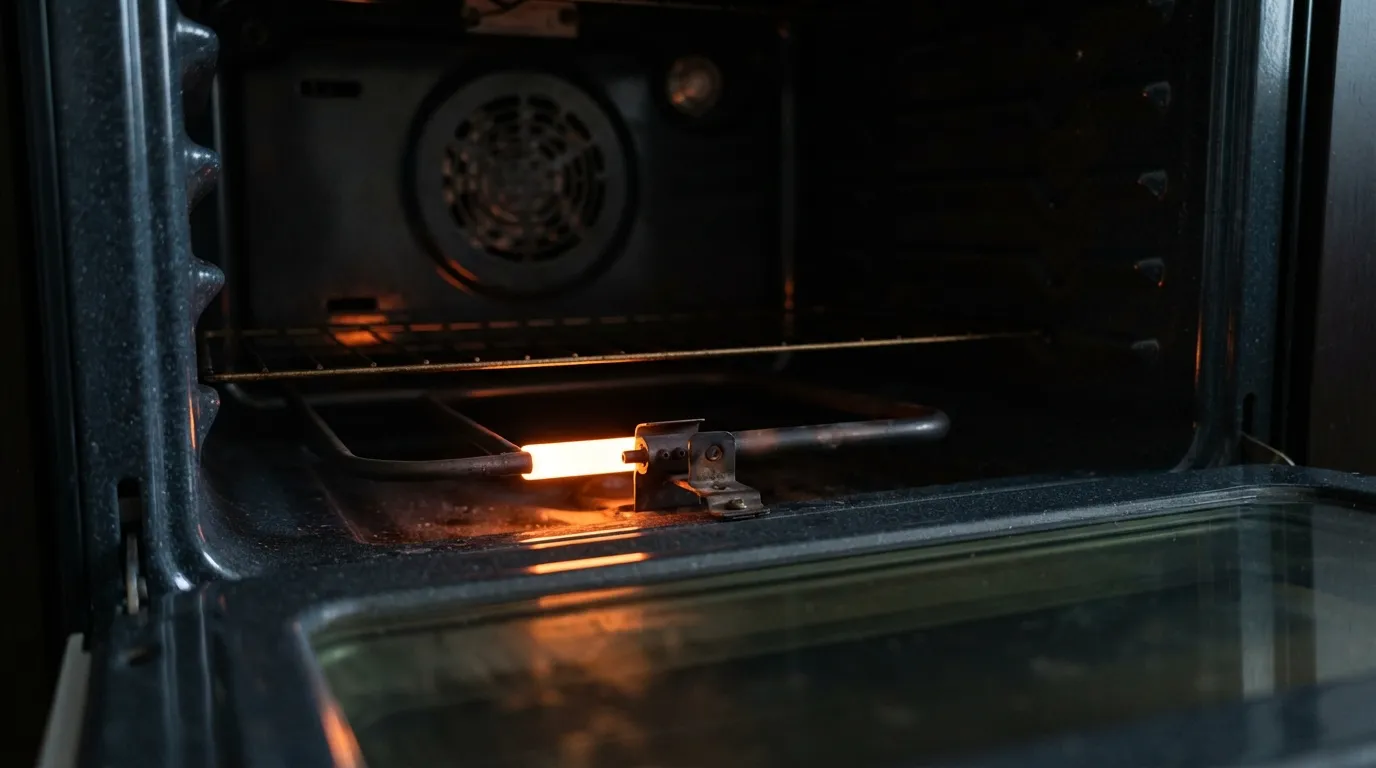
When a gas oven won’t light, the usual cause is a weak igniter: it glows but never gets hot enough to open the gas valve. The safe checks are the outlet, the controls, the door latch, and surface cleaning. Anything involving the igniter, valve, or gas line is licensed-tech work, no exceptions.
That last sentence isn’t a liability line. It’s the actual point of this post, because gas is the one appliance repair where a wrong guess doesn’t cost money, it costs more than that. Here’s how the system works, what you can rule out tonight, and where you hand it off.
How a gas oven lights (30 seconds of theory that explains everything)
Modern gas ovens don’t have a standing pilot light. When you set a bake temperature, a hot-surface igniter starts glowing. As it heats, it draws electrical current, and only when it pulls enough amps does the safety valve open and let gas flow. Glow, current, valve, flame — in that order, usually inside 90 seconds.
The system is built so gas cannot flow unless the igniter is hot enough to light it instantly. Which is elegant, and it’s also why the failure mode is so sneaky.
What you can check safely (all of it, and nothing more)
Gas ranges still need electricity, so a surprising number of “gas problems” are 120-volt problems:
- The outlet and breaker. Plug a phone charger into the range’s outlet if you can reach it, or check the kitchen breaker. No power means no igniter, no clicking, nothing.
- The controls. Control lock, delayed-start mode, or a Sabbath setting will quietly block the bake cycle. Power-cycle at the breaker for 60 seconds to clear a confused board.
- The door. A self-clean latch that didn’t retract keeps some models from lighting. Open and close it firmly once.
- The glow test. Set bake at 350°F, kill the kitchen lights, and look through the oven window (on many models you’ll see the glow rise from the floor vents or the broiler drawer). Steady orange glow that never produces a flame after two minutes: weak igniter, almost certainly. No glow at all: igniter or its power feed.
- Stove-top burners, for contrast. If the top burners light fine, gas supply to the range is good and the problem lives in the oven circuit. If nothing on the range lights and nothing clicks, the issue may be supply-side or electrical. Either way, that’s the end of the checklist.
Notice everything on that list is looking, listening, and pressing buttons. That’s deliberate.
Why “it glows” fools everyone
The igniter is the most misdiagnosed part in the kitchen. A failing igniter still glows orange, looks completely alive, and convinces half the internet the problem must be something else. But a tired igniter draws too little current, the valve never opens, and the oven sits there glowing politely at you forever.
We’ve been handed ranges with a brand-new sensor, a brand-new knob panel, and one very original igniter. The glow is not the test; the amp draw is, and measuring it means a clamp meter on a live circuit next to a gas valve. That’s ours to do, not yours.
Age matters too. Igniters are wear parts with a typical life of 8–10 years. If your range is from the mid-2010s and the oven’s gotten slow to light over months (that lengthening whoomp delay), the igniter has been writing you a resignation letter for a while.
When it’s not the igniter
Three other suspects, all pro territory:
- The safety valve. Rare, and it should only be condemned after the igniter’s amp draw tests good. Be suspicious of any diagnosis that starts at the valve.
- The spark module (that’s the clicker for the stove top): if burners won’t spark but the oven lights, the module or a wet igniter switch is the story. Clicking that won’t stop even with knobs off usually means moisture from a boil-over. Give it a day to dry before assuming failure.
- The gas supply. A partly closed shutoff behind the range, a regulator problem, or (out toward Crawford and Troy, where plenty of kitchens run on propane) an empty tank or a propane-vs-natural-gas orifice mismatch on a newly installed range.
If your gas oven won’t heat up fully but does light, that’s usually the same igniter story: it lights, then cycles too weakly to hold temperature.
Here’s where you stop and call a licensed tech
The line is bright and worth stating exactly:
- You don’t remove panels, test, or replace the igniter. It bolts in beside a live gas valve.
- You don’t touch the safety valve, regulator, connector, or anything downstream of the shutoff. Gas-line work is licensed work in Texas, full stop.
- You never chase a leak. If you smell gas with everything off (rotten egg, sulfur), don’t flip a switch, don’t relight anything. Get everyone out and call your gas provider’s line from outside; around Waco that’s Atmos Energy, whose smell-gas guidance is the standard: leave first, call second.
We put the line here for the same reason the valve won’t open for a cold igniter: the failure mode isn’t a redo, it’s a bad day. Breakers, buttons, and burner caps are yours. Everything with gas behind it is ours.
What it typically costs in Central Texas
Igniter replacement usually lands between $150 and $300 around here, parts and labor. Safety valves run $200–$400, spark modules $150–$300. Typical local ranges, not our price sheet. You’ll see a written quote for the gas oven repair before any work starts, and seniors and military get 10% off repairs.
One honest caveat: an igniter is a cheap fix, but on a 15-plus-year-old range it’s often the first domino. If the valve or board follows next winter, you’ll have paid twice toward a range you were about to replace anyway. Our common oven and stove problems guide has the repair-or-replace math; when the numbers are close, we’ll walk you through them instead of deciding for you.
Common questions about a gas oven that won’t light
Why does my gas oven click but not light?
Clicking is the stove-top ignition system; oven igniters glow silently. Clicking with no flame on a burner points at clogged ports, a wet igniter, or a crooked cap. That’s cleaning territory. An oven that’s silent and cold points at the igniter or its power feed.
Can I replace a gas oven igniter myself?
We say no, and not reflexively. The part itself is simple, but it lives beside a live gas valve, and confirming the diagnosis requires amp-draw testing on an energized circuit. This is exactly the repair the licensed-tech line exists for.
Why do the stove burners work but the oven won’t light?
Gas supply is fine; the failure is inside the oven’s own chain: igniter, valve, or the board that feeds them. Odds heavily favor the igniter, especially if lighting got slower over recent months.
Is it safe to keep using the stove top if the oven won’t light?
Generally yes, if the burners light normally and there’s no gas smell. The systems are separate. Any smell of gas changes the answer to no: leave and call from outside.
Troubleshooting Summary for On Point Service Company
When a gas oven won’t light, check power, controls, and the door. Watch for the glow. Then stop — everything past that involves gas, and gas repairs belong to a licensed tech. Tell us what you saw and we’ll give you a straight answer and a written quote before anyone touches a valve: request service here or call . Same-day availability when the schedule allows.
The On Point Team · On Point Service Company — family-owned HVAC & appliance repair, McGregor, TX · Serving Waco, Temple, Belton, and surrounding Central Texas towns · Licensed & insured, TDLR License TACLB00069239E ·