





HVAC upselling runs on eight recognizable moves, and every one of them collapses under the same three-part test: ask for the readings, ask for the options in writing, and take one night to decide. A diagnosis survives that test. A sales script doesn’t.
Before the field guide starts, the calm part, because it matters: most techs are honest, and this trade is full of skilled people who’d rather fix a $20 part than sell you a system. The problem is rarely the person in your attic. It’s the incentive structure behind some of them, and incentives are learnable, which means the moves are too.
Why upselling happens (nobody has to be a villain)
Across the industry, at shops of every size, local and national alike, plenty of service technicians earn part of their pay through commissions, bonuses per item sold (the trade calls them SPIFFs), or performance metrics tied to average ticket size. None of that is secret; it’s discussed openly in trade publications and tech forums. Some companies also run cheap tune-up specials that lose money unless the visits produce repair and replacement sales, which quietly converts a maintenance check into a prospecting call.
Put a decent person inside that structure and, across a thousand attics, the structure wins some of the time. The tech who “finds” a weak capacitor on every third visit may even believe it; borderline readings get read pessimistically when a bonus rides on pessimism.
Understanding that does two useful things. It lets you stay polite (you’re not accusing anyone; you’re checking work, which honest techs welcome). And it tells you exactly where the counter-pressure goes: onto paper, readings, and time. A commission can survive charm. It can’t survive documentation. The service call fee, by the way, is not one of these games — it pays for real diagnostic labor, and companies that charge one visibly are usually the ones with nothing to bury.
The eight moves, one by one
1. The capacitor scare close
The run capacitor is a genuinely common failure (a $10–$30 part, typically $150–$400 swapped in Central Texas), and that’s exactly what makes it the perfect stage prop. The move: “Your capacitor’s weak, and when it goes, it can take the compressor with it. I’d hate to see you buy a whole system over this.” Now a routine part carries a $9,000 shadow.
The disarm is one question: “What did it measure, and what’s it rated?” Capacitors are stamped with their rating in microfarads, and a meter reads the actual value in seconds. Weak is a number, not a mood. A reading 10% under label is a swap-it-soon conversation, calmly. No reading offered means the shadow was doing the selling.
2. “You can’t get parts for that anymore”
Built on a true story: R-22 refrigerant production ended in 2020, and recovered R-22 is genuinely expensive. The stretch is quietly extending “refrigerant is pricey” into “parts don’t exist,” when fan motors, capacitors, contactors, and boards for those systems remain widely available. A dead condenser fan motor on a 2009 unit is still usually a few-hundred-dollar repair with no refrigerant involved.
Ask: “Which part, exactly — and is the issue the component or the refrigerant?” If the honest answer is a major refrigerant-side failure on an R-22 system, replacement talk is fair, and we’ll say so in the inversion section below. If the answer gets vague, so was the diagnosis.
3. The today-only discount
“I can do $1,400 off, but only if we get you on the install schedule today.” Real prices are built from equipment, labor, and permit costs; none of those expire at sunset. A discount that exists only under a deadline exists to prevent comparison shopping, which tells you what comparison shopping would have found.
Ask: “Is that price good in writing for two weeks?” Written quotes at reputable shops hold for 15–30 days. Watch what happens to the discount when the deadline dies. And if it was ever conditional on you skipping a second opinion, you already know why.
4. The verdict with no readings
“She’s shot. Compressor’s gone. I wouldn’t put another dime in it.” Maybe true! Compressors do die, especially after fifteen Texas summers. But a grounded compressor is a testable, showable condition (resistance readings, tripped internal protection, amp draw), and a condemned system deserves an autopsy report, not a shrug.
Ask: “Show me what you measured.” A tech who just ran those tests can show you in ninety seconds, and the good ones enjoy doing it. “You wouldn’t understand it” is not a reading. Neither is a tap on the unit and a sad face.
5. The cascade
Every visit finds three more things: a hard-start kit, a surge protector, a UV light, a duct-sanitizing fog, a contactor that’s “pitted.” Individually small, collectively $1,900, and each pitched as protecting the last thing you bought. Add-ons are the quiet bulk of upsell revenue precisely because no single one feels worth arguing about.
Ask: “Rank these: which is urgent, which is optional, and which can wait a year — in writing.” An honest list almost always shrinks under ranking, because “optional, honestly” is hard to type next to a $349 UV light. Some add-ons are legitimate (a hard-start kit on an aging compressor has real cases); ranking finds them and drowns the rest.
6. The cracked heat exchanger photo
The heating-season version, and it needs careful words, because a genuinely cracked heat exchanger is a real safety issue involving combustion gases; treat a verified one seriously. That gravity is precisely why the diagnosis gets borrowed: it’s the one call that shuts off a furnace and opens a wallet in the same sentence, and a stock photo of a crack proves nothing about your furnace.
Ask: “Show me the crack on your camera, on this furnace, with my serial plate in the frame.” Legitimate finds come with scope footage or photos identifiably yours, and often CO readings for context. If the evidence is generic, the fear was too. Get the second look the same day; this one’s worth resolving fast in either direction, and it’s a free second opinion here, not a favor.
7. The monthly-payment pivot
“Just $158 a month” answers a question you didn’t ask. The pivot exists because $158 feels like a phone bill while $11,400 feels like a used car, and because stretching the term hides the total. Payments aren’t evil (honest financing is a real tool), but a payment quoted instead of a price is arithmetic with the lights off.
Ask: “What’s the total, the term, and the cash price?” Then decide repair-versus-replace on the total, never the monthly. (The fine print around 0% offers is its own minefield; we wrote up how HVAC financing actually works so you can walk in knowing where the tripwires sit.)
8. Good-better-best theater
Three proposals land on the counter: a stripped “base” option priced to look foolish, a premium option priced to gasp at, and a middle option that suddenly feels reasonable, which was its entire job. Retail anchoring, ported to your kitchen. The tiers themselves aren’t dishonest; equipment genuinely comes in grades. The theater is in how the base tier gets hobbled so the middle sells itself.
Ask: “What specifically does the base option not do — and which tier would you put in your own house?” The second half of that question produces more honesty per word than anything else on this page. Techs answer it like humans.
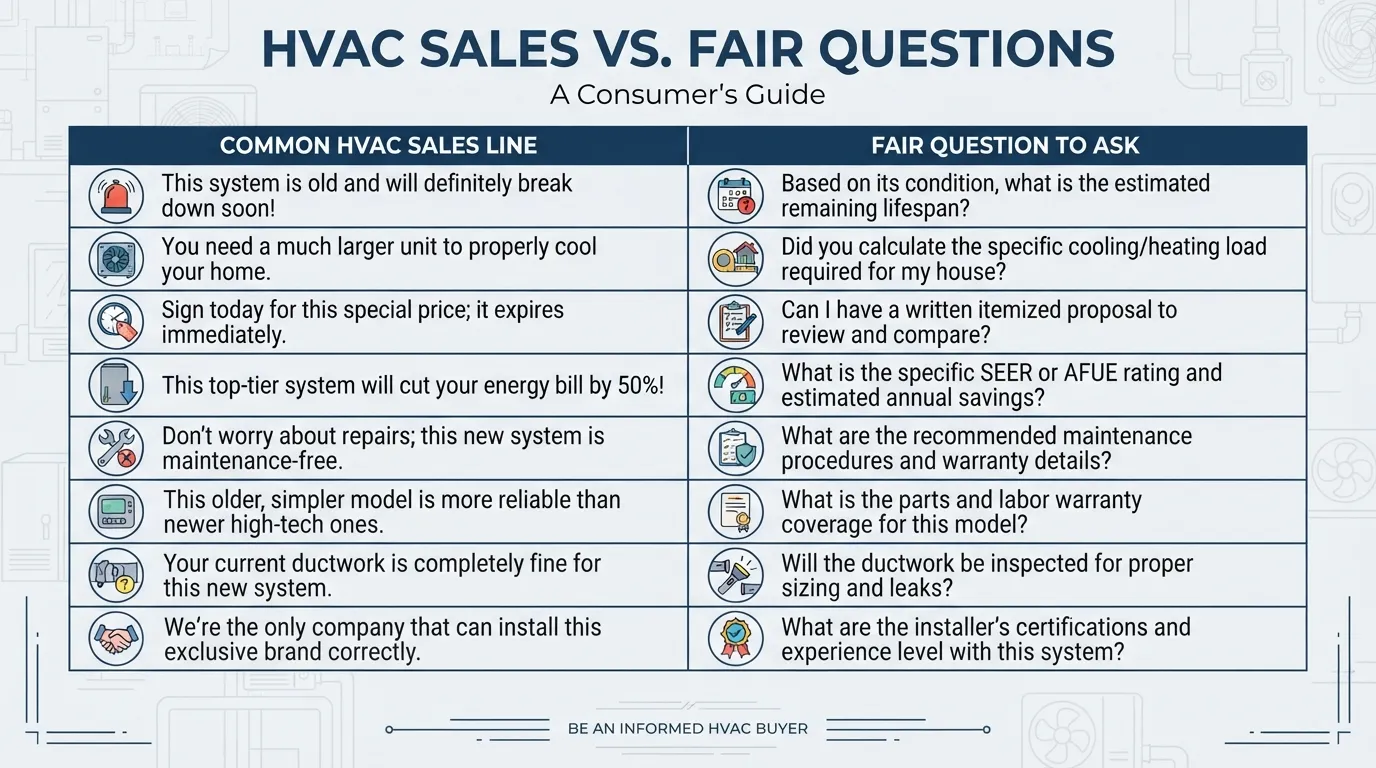
The cheat sheet: line, question, straight answer
| The line you hear | The fair question | What a straight answer looks like |
|---|---|---|
| “Capacitor could take out the compressor” | What did it measure vs. its rating? | A microfarad reading, the label value, a written swap quote |
| “Can’t get parts for these anymore” | Which part, exactly? | Part named, availability stated, refrigerant vs. component separated |
| “This price is today-only” | Good for two weeks in writing? | A written quote valid 15–30 days |
| “It’s shot, don’t waste money on it” | Show me the readings | Amp draw, resistance, pressures shown on paper, explained |
| “While I’m here, you also need…” | Rank urgent vs. optional, in writing | A ranked list where some items say “can wait” |
| “Heat exchanger’s cracked” (photo) | Show it on camera with my serial plate | Scope footage of your furnace, CO context, calm next steps |
| “Just $158 a month” | Total, term, and cash price? | All three numbers, no flinch |
| “Most folks pick the middle package” | What can’t the base do? Which would you buy? | Specific differences, and a human answer |
Print it, screenshot it, tape it inside the pantry door. The column that matters is the middle one — none of those questions is rude, and every honest tech in Texas can answer all eight without blinking.
What a legitimate diagnosis looks like
Knowing the bad patterns is half the field guide. Here’s the other half, so good work gets recognized too:
- Readings, shown unprompted. Temperature split across the coil, refrigerant pressures, capacitor values, amp draws against nameplate. Numbers first, conclusions second.
- The fault named specifically. “Failed run capacitor” or “low side pressure says leak” — not “she’s tired.”
- Options, plural, in writing. Repair versus replace with real numbers on each, and what belongs on that paper is its own anatomy lesson. Around here that paper arrives before any work starts, every time.
- A price that matches typical reality. Know the market brackets going in (what AC repairs typically cost in Waco) so quotes land against context instead of against fear.
- Time, offered freely. “Think it over, the quote’s good for two weeks” is the sound of a company with nothing to outrun. On a 100° day they’ll also tell you honestly whether the system limps safely while you decide.
Notice what’s on that list: evidence, paper, and patience. Notice what isn’t: urgency.
Do I need a new AC, or am I being sold one?
The self-test takes five minutes, no gauges required.
Age first. Under 10 years old, the default answer is repair; replacement talk on a young system needs an exceptional reason, in writing. Past 15, replacement stops being an insult and starts being arithmetic. In between sits the judgment zone, where the 10-year-old-AC question gets its own math.
Then the pattern. One clean failure after years of quiet service? That’s a part, not a verdict. Third visit this year, bills climbing, some rooms never cool anymore? The system’s voting, and it’s fair to listen.
Then the quote itself. Multiply the repair number by the years you’d bet it buys. A $600 repair that credibly buys three more summers beats a $10,000 system on pure dollars. A $2,400 repair that buys one nervous summer on a 16-year-old R-22 unit doesn’t. If the numbers land close, the full when-to-replace checklist breaks the tie with efficiency and refrigerant factors.
And if you were told you need a new AC without readings, without paper, and without time to run this test — that’s your answer about the seller, whatever turns out to be true about the system.
The honest inversion: sometimes the big quote is right
A field guide that treats every replacement quote as a con would be its own kind of scam. So, plainly: sometimes the $12,000 answer is the correct one, and here’s what that looks like.
A grounded compressor on a 16-year-old system. A refrigerant leak inside the evaporator coil of an R-22 unit, where the fix means chasing four figures of obsolete refrigerant into a machine already past life expectancy. A verified crack in a heat exchanger on a 20-year-old furnace. A system on its third major repair in two years. In those cases, the repair number stops competing with the replacement number and starts subsidizing a funeral.
How to tell the honest big quote from the theatrical one: it arrives with readings attached, it comes as options rather than an ultimatum, it survives two weeks on paper without shrinking, and the company selling it will cheerfully tell you to check them. When we’re the second look and the first company’s big quote holds up, we say exactly that. It’s the fastest credibility we ever earn, and the reader it costs us a sale to keep is the reader this whole page was written for.
If pressure ever crosses into something worse (work charged that wasn’t done, safety threats invented outright), that stops being a sales style and becomes a consumer-protection matter, and the Texas Attorney General’s consumer protection office takes complaints. Rare, worth knowing anyway.
The Philosophy and Standards of On Point Service Company
We’re a family shop in McGregor, and the recurring move our reviews mention is the one this page runs on: telling people when not to spend money. If it’s the capacitor, nobody here will sell you a condenser. The policies are built to make that checkable rather than take-our-word-for-it — written assessment & quote before any work, price match, and free second opinions, which exist precisely so the moves above have somewhere to go to die. From Waco to Temple to Belton, the honest answer to “do I need a new system?” is usually “let’s see the readings first,” and we’d rather be the shop that says so.
FAQ
How do I know if my HVAC tech is upselling me?
Is a $12,000 AC replacement quote ever fair?
Why do AC companies push new units so hard?
What readings should an AC tech show me?
Should I get a second opinion before replacing my AC?
Do maintenance-plan visits turn into sales visits?
Where to go from here
Save the cheat sheet, learn the three-part test, and stop worrying about hurting anyone’s feelings; honest techs like informed customers, and the other kind is why you read this far. If there’s a big quote sitting on your counter right now, get a free second opinion or call ; if the first company was right, we’ll be the second ones to tell you. HVAC upselling loses to paper, every time. 10% off repairs for seniors and military, always.
The On Point Team · On Point Service Company — family-owned HVAC & appliance repair, McGregor, TX · Serving Waco, Temple, Belton, and surrounding Central Texas towns · Licensed & insured, TDLR License TACLB00069239E ·