



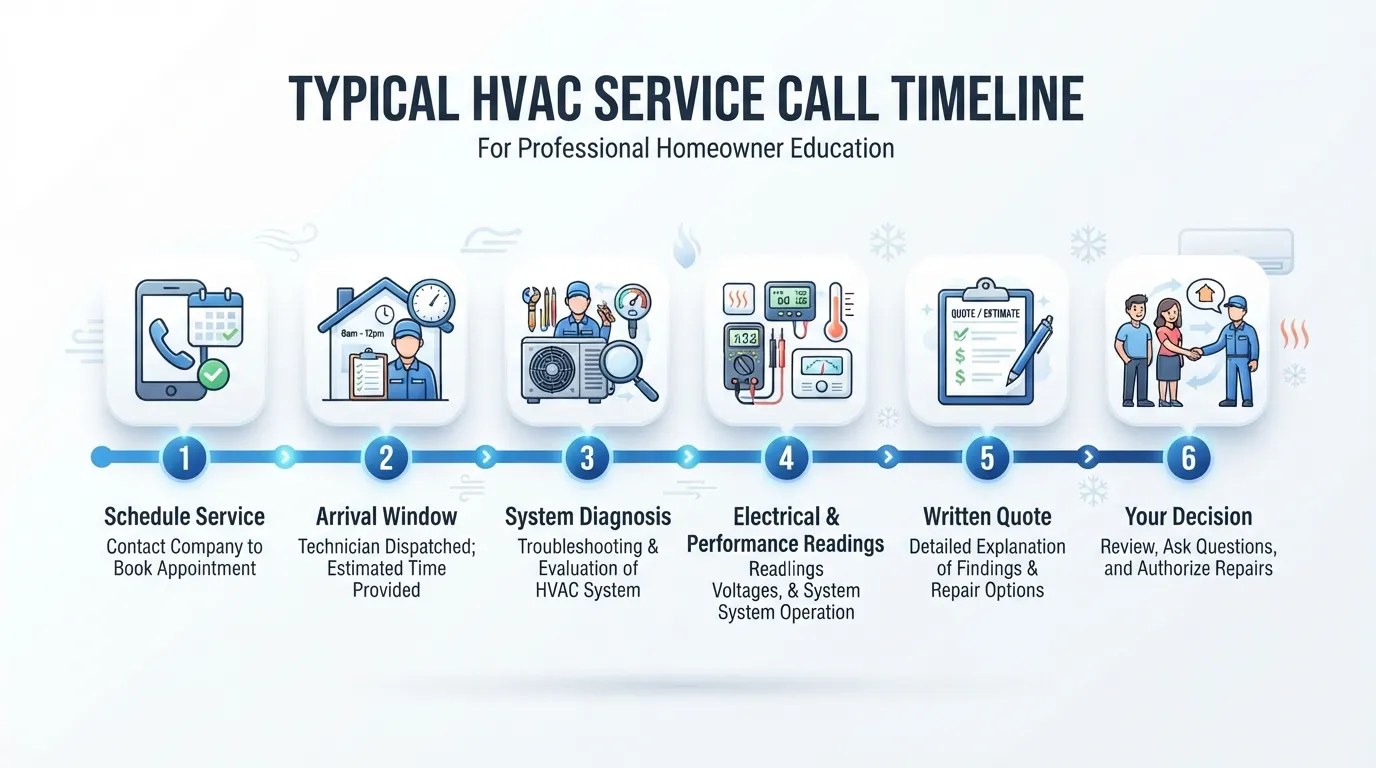
Here’s what to expect from an HVAC service call: a scheduling call where the fee gets stated plainly, an arrival window, 45 to 90 minutes of actual diagnosis, readings you can see, and a written quote you’re free to sleep on — or decline. That’s the whole shape of it. No part of a legitimate visit requires deciding anything on the spot.
One boundary before we walk it: this post is about what happens. What the visit costs, and why the fee exists at all, got its own full breakdown in what an HVAC service call costs. The two questions deserve separate answers, so we wrote them separately. This is the one you read so a stranger’s visit to your attic goes exactly how it should.
The phone call, before anyone drives
A good service call starts before the truck moves. When you call (us or anyone), two things should happen on that first phone call, and you should hear them without asking twice.
The fee gets stated. Repair visits carry a small service fee (travel + diagnostic) at any legitimate shop. You should hear the number, what it covers, and the answer to one question worth asking every time: how is the fee handled if you approve the repair? Companies handle that differently, and the ones worth hiring answer without a pause.
And you get asked real questions back. What’s the system doing? Any sounds, smells, breaker trips? When did it start? Filter age? A dispatcher who gathers symptoms is loading the truck with the right parts; one who only takes your address is loading a sales visit. Five minutes here is why some repairs finish in one trip instead of two.
Have your side ready: system age if you know it, what you’ve already tried, and gate codes or dog logistics. In a Waco July, morning callers get same-day slots more often than afternoon callers; the board fills by lunch.
The arrival window (and what fair looks like)
You’ll get a window, usually two to four hours, because the job before yours is a diagnosis too, and diagnoses don’t keep schedules. A Crawford run behind a stubborn Waco compressor pushes everything.
Windows slipping is normal. Silence isn’t. The fair standard is a call or text the moment a route runs long, with a real revised time — and that standard is on us to keep, not you to chase. If a company goes dark past its window twice, that’s data about how the repair will go.
The first twenty minutes: looking, not selling
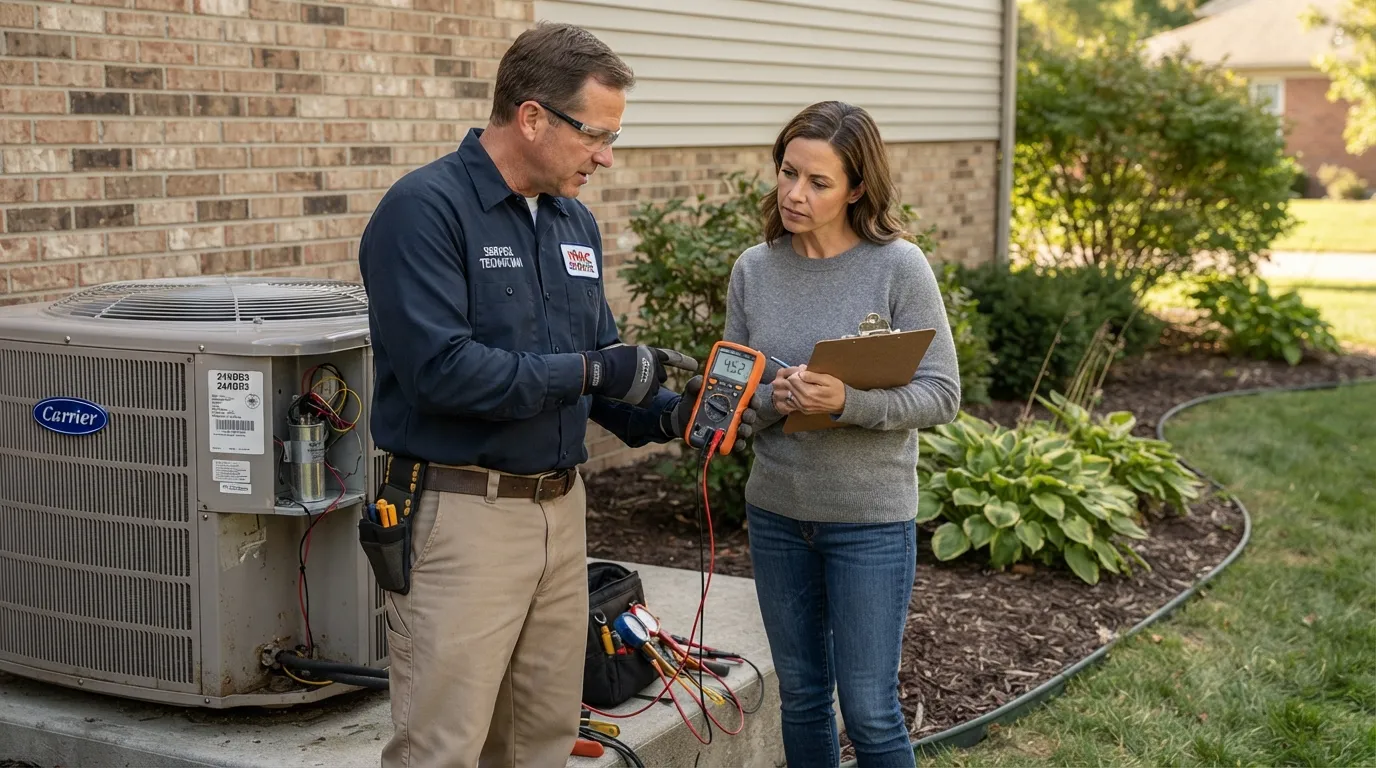
A real diagnostic follows a sequence, and watching for it is the easiest way to grade a tech. First the conversation: symptoms again, from you, in your kitchen. Then the thermostat, the filter, and the indoor unit: airflow, the coil, the drain line. Then the outdoor unit: panels off, capacitor tested, contactor inspected, refrigerant lines checked. Meters come out. The Department of Energy’s AC maintenance primer shows how many failure points live in that path, which is why a two-minute glance can’t diagnose anything.
What you’re watching for is order and instruments. A tech who works the sequence is finding your fault. One who skips to the condenser, shakes his head, and starts talking systems has skipped the part where evidence gets collected.
Stay nearby if you like. Good techs narrate; the ones we hire would rather show you the failed part than describe it.
The readings you should see
By the end of a legitimate diagnosis, numbers exist, and you’re allowed to see all of them:
- Temperature split: supply air versus return air, roughly 16–22°F apart on a healthy system
- Capacitor value: microfarads measured against the rating printed on its label
- Refrigerant pressures: gauge readings, not vibes
- Amp draws: motor and compressor, against the nameplate numbers
You don’t need to interpret any of it. You need to see that it exists, and hear it explained in plain English without irritation. “Your capacitor reads 28 on a 45 label — here’s the label” is a diagnosis. “She’s tired” is a horoscope. If a verdict arrives with no readings attached, that’s one of the classic pressure patterns, and it changes what you do next.
The written-quote moment
Here’s the hinge of the whole visit. Once the fault is found, the findings and the fix go on paper: written assessment & quote before any work, every time, no exceptions for “quick ones.” The paper should name the fault, the parts, the labor, and one total. What belongs on it, line by line, is its own anatomy lesson.
Then comes the part that tells you who you hired: the quote comes with time attached. You can approve on the spot if the answer’s obvious. You can also sleep on it, compare it, or take it shopping; a written quote from us stays valid long enough to check, and checking is encouraged. That’s the entire reason free second opinions exist as standing policy here: paper that fears daylight wasn’t honest paper.
The one thing that should never happen at this moment is a countdown. A price that expires when the truck leaves isn’t a price; it’s a trap with a clipboard.
If you say yes (and if you say no)
Yes: common parts live on the truck, so plenty of repairs finish the same visit; a capacitor swap is often twenty more minutes. Ordered parts mean a scheduled return, with the quote unchanged. Work matches paper; surprises require new paper and a new yes from you.
No: also a completely normal ending, and we mean that. You pay the service fee, keep the written diagnosis, and owe nothing else: no callback campaign, no “checking in” texts. The diagnosis is yours: use it to budget, to compare, or to get a straight answer from us on a second look at somebody else’s quote later. Roughly nobody regrets saying “let me think about it” to a four-figure decision, and any company that punishes the pause told you something worth knowing while it was still free.
Our honest trade-off, since this walkthrough promised the unvarnished version: the fee means a “no” isn’t completely free, and on a trivial fix that can sting. The alternative (companies that eat the fee invisibly inside repair prices) costs more and hides better. We’d rather charge it in daylight and hand you paper worth keeping.
What the visit costs
Short answer, on purpose: a typical service call in Central Texas runs in the low-to-mid hundreds at most shops, the fee covers travel and the diagnostic hour, and every dollar question past that (fair ranges, July pricing, why “free” repair estimates aren’t) lives in the cost post. This page walks the visit; that one prices it. Read both and you’re the best-prepared caller in McLennan County.
Common HVAC Service Call Questions for On Point Service Company
How long does an HVAC service call take?
Do I need to be home for an HVAC service call?
What should I do before the technician arrives?
Can I say no after the diagnosis?
The hundredth answer
Booking, window, sequence, readings, paper, and a decision that stays yours: that’s what to expect from an HVAC service call anywhere worth calling. If yours is due (cooling limping through this heat, a noise that wasn’t there in May), book the visit or call , Monday to Friday, 8 to 5, same-day when the board allows. You’ll get the walkthrough above, in exactly that order, with paper at the end. 10% off repairs for seniors and military, always.
The On Point Team · On Point Service Company — family-owned HVAC & appliance repair, McGregor, TX · Serving Waco, Temple, Belton, and surrounding Central Texas towns · Licensed & insured, TDLR License TACLB00069239E ·