



A real written HVAC estimate names the equipment by model number, breaks the work into line items, states who pulls the permit, and ends in one total you can hold somebody to. A verbal quote is a guess with good posture. The gap between those two documents is where most HVAC regret lives.
We put a written assessment & quote in front of every job before any work starts. It’s the company policy everything else here hangs on. This post is the anatomy lesson: what belongs on the paper, what its absence means, and how to use one estimate to keep the next company honest.
What counts as a written estimate for HVAC work
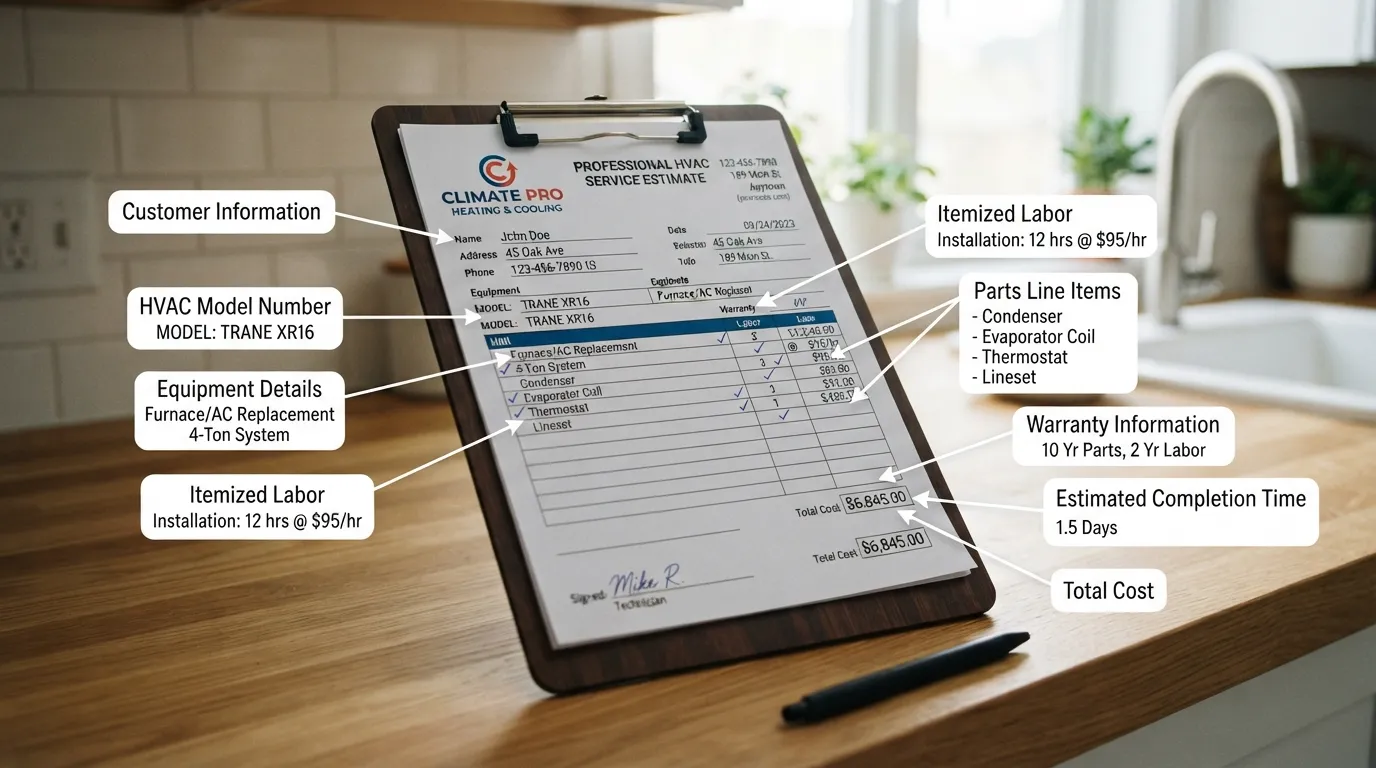
Here’s the definition worth keeping: a written HVAC estimate is a document (paper, PDF, or email, doesn’t matter) that states the diagnosis, the proposed work, the parts and equipment by name, the labor, any permit fees, and a total price, before work begins. If any of those pieces are missing, you have a note, not an estimate.
“Before work begins” is the load-bearing phrase. A detailed invoice after the fact describes what happened to you. An estimate is the only version you can still say no to.
The anatomy: what belongs on the paper
For a repair, the estimate should carry five things:
- The fault, named. “Failed run capacitor, 45/5 µF” beats “unit not cooling.” A named fault is checkable; a vague one isn’t.
- Parts, listed. What’s being replaced and, ideally, the part or model number, so you can compare quotes on the same thing.
- Labor, as its own line or clearly folded into a flat repair price. Either is fine. Invisible is not.
- The service fee, stated. Repair estimates carry a small service fee (travel + diagnostic) at any legitimate shop, ours included. It should appear on the paper, and how it’s handled should be answered before anyone drives — we broke down the whole economics of the service call fee separately.
- One total. Not “around,” not “depending.” A number.
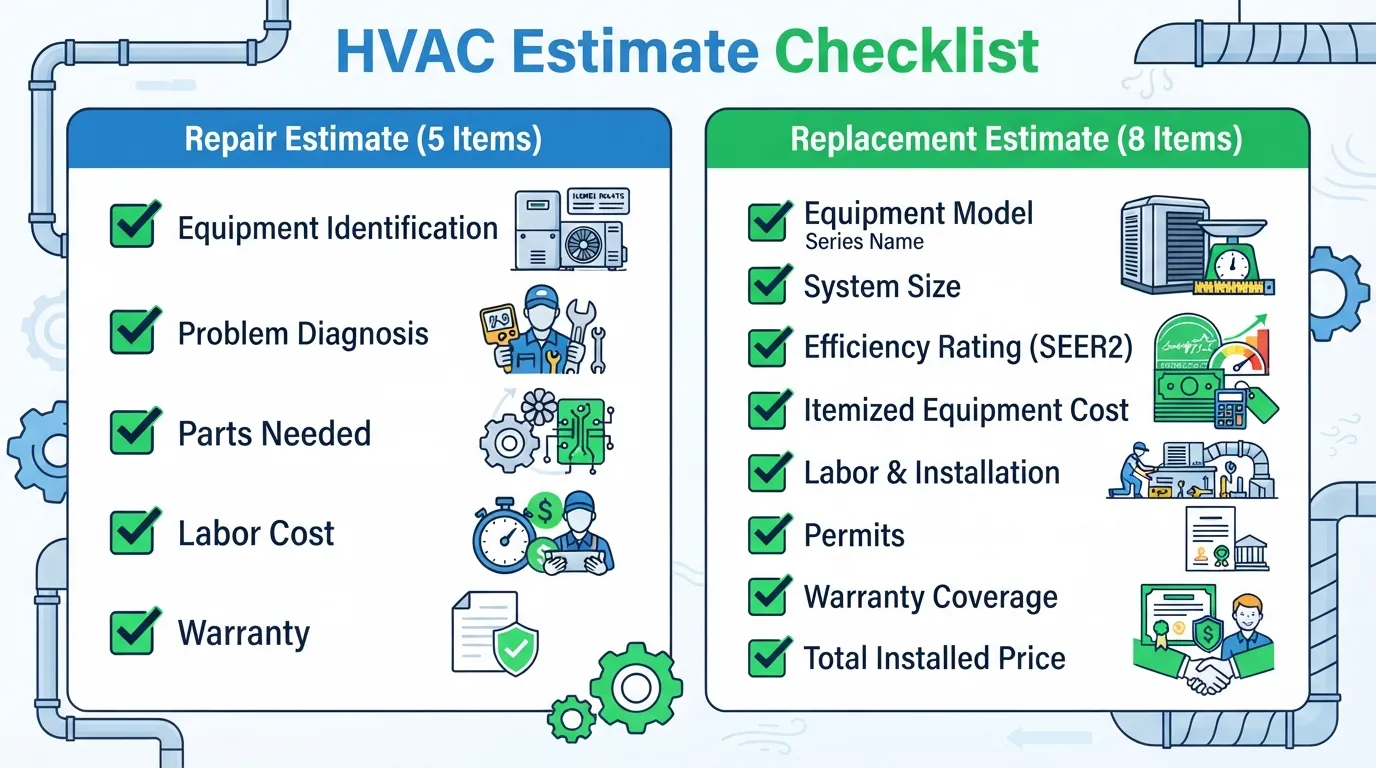
For a replacement or new system, the paper grows. Add: the exact equipment (brand, model, tonnage, SEER2 rating), the load calculation behind the sizing (a Manual J, the industry method published by ACCA, not a guess off square footage), plus ductwork or electrical changes, the permit and who pulls it, warranty terms in writing, and the removal of your old equipment. New-system quotes are also where estimates go free: we offer free estimates on new HVAC system installations only, because sizing a defined install is sales work, while diagnosing a broken system is licensed labor.
If a replacement quote is missing the model number or the load calc, you’re not being quoted a system. You’re being quoted a price point.
Red flags in a verbal quote
Some of these are laziness. A couple are strategy. All of them cost you.
- The suspiciously round number. “About $1,200” is not a diagnosis; it’s an opening position.
- A price that moves when you hesitate. Real numbers built from parts and labor don’t drop $400 because you frowned. Discounts that appear under pressure were padding a minute earlier.
- “We’ll know more once we’re in there.” Sometimes honest, since hidden ductwork surprises exist, but then the estimate should say so in writing, with the trigger and the cap named.
- Nothing to compare. A verbal quote can’t be set next to a second one, and that’s frequently its purpose. A free second opinion only works when there’s a first opinion on paper.
- Reluctance when you ask for it written. This is the cleanest tell in the trade. A company that won’t write its number down is telling you the number isn’t done moving. Believe them.
One flag pointed the other way, in fairness: a written estimate isn’t automatically an honest one. Paper can inflate as easily as air. What paper does is freeze the claim so it can be checked — which is all you need it to do.
Why “we’ll figure it out as we go” costs you
Say your blower motor dies in a Lorena rental the first 98° week of June. Tech A says “probably the motor, we’ll get it sorted, should be reasonable.” Tech B writes: ECM blower motor, part number, $XXX; labor, $XXX; service fee, stated; total, one number.
Tech A’s job drifts. The motor “turned out worse,” a control board joins the party, and the final bill arrives pre-justified: we did say we’d know more once we were in there. You agreed to a process, so you bought the process. Tech B’s job can still grow (real surprises exist), but every addition needs a new piece of paper and a new yes from you. Scope creep has to ask permission.
That’s the entire function of the document. It converts “trust me” into “check me,” and honest companies prefer being checkable. It’s also, not coincidentally, the same reason to hire a licensed HVAC company instead of a handyman: licenses and paper both exist to make promises enforceable.
Our policy, in exact words
So there’s no ambiguity about where we stand, here’s the policy set, verbatim, the way we run it from McGregor across Waco, Temple, and Belton:
- Written assessment & quote before any work. Every job. No exceptions for “quick ones.”
- No hidden fees. The total on the paper is the total.
- Price-match guarantee. A fair written number from another licensed shop for the same repair? We’d rather match it than argue.
- Free second opinions. Already holding someone else’s quote? We’ll look and tell you straight, no obligation.
- Repair estimates carry a small service fee (travel + diagnostic). Stated up front, on the paper.
- Free estimates on new HVAC system installations only. Install quotes are free; diagnostic work isn’t, and we’d rather say that in daylight than bury it in the repair price.
Our opinion, plainly: the written-quote habit is the single cheapest way to sort this industry. It costs an honest company nothing and costs the other kind everything.
Using one estimate to check another
The quiet superpower of a written HVAC quote is comparison. Two written estimates for the same repair should name the same fault and roughly the same parts; if one says capacitor and the other says compressor, somebody’s wrong, and now you know to find out who before money moves. That’s exactly when a second opinion earns its keep: bring us the paper, or bring ours to somebody else. Paper doesn’t mind being graded. If you’re staring at a quote right now and something smells off, send it over and get a straight answer; worst case, we confirm it’s fair and you’ve lost ten minutes.
Essential HVAC Estimate Queries for On Point Service Company
Should an HVAC quote always be in writing?
What should an HVAC estimate include?
Is an HVAC estimate free?
How long is an HVAC quote good for?
The short version
Fault named, parts listed, permit assigned, one total, all of it before work starts — that’s a written estimate, and HVAC work without one is a favor you’re doing somebody else’s margin. Get yours in writing from whoever you call. If you’d like it from us: request a written quote or call . 10% off repairs for seniors and military, always.
The On Point Team · On Point Service Company — family-owned HVAC & appliance repair, McGregor, TX · Serving Waco, Temple, Belton, and surrounding Central Texas towns · Licensed & insured, TDLR License TACLB00069239E ·