






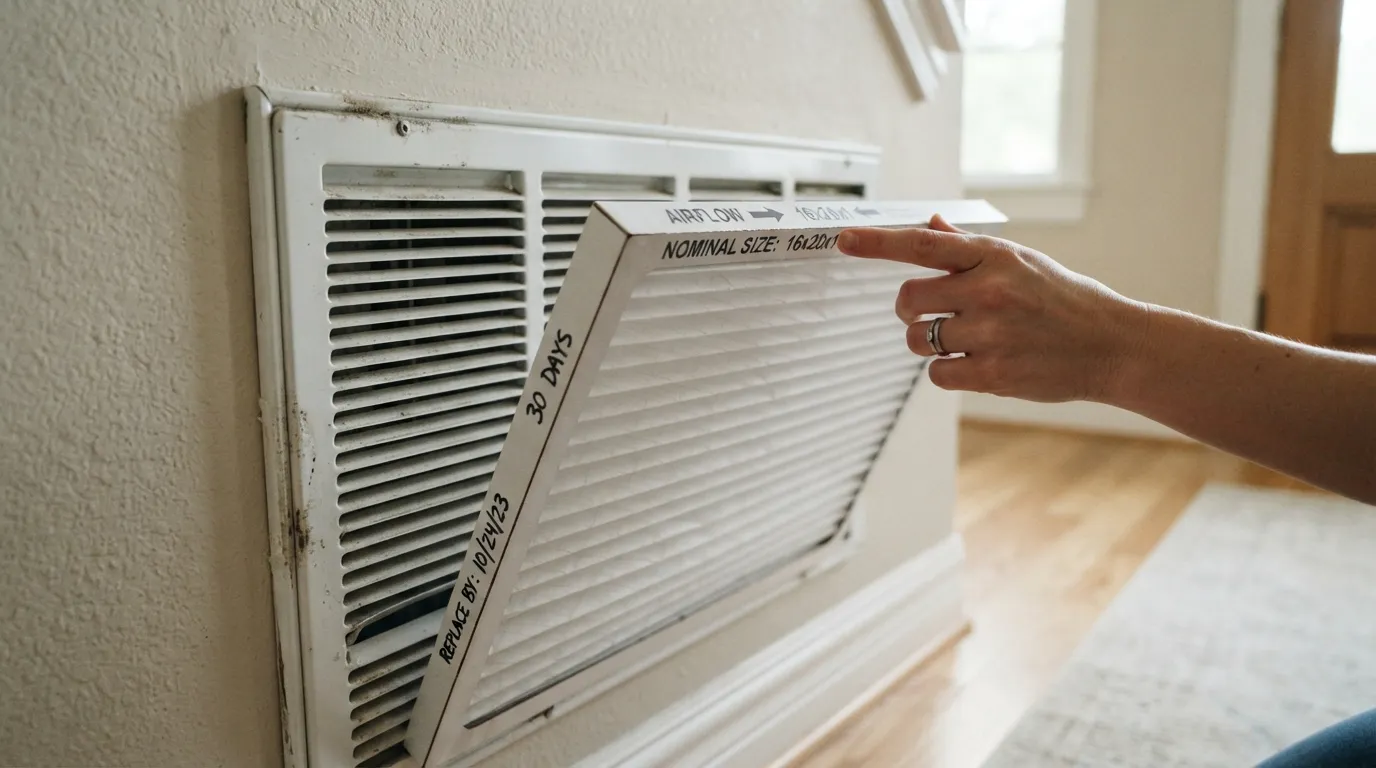
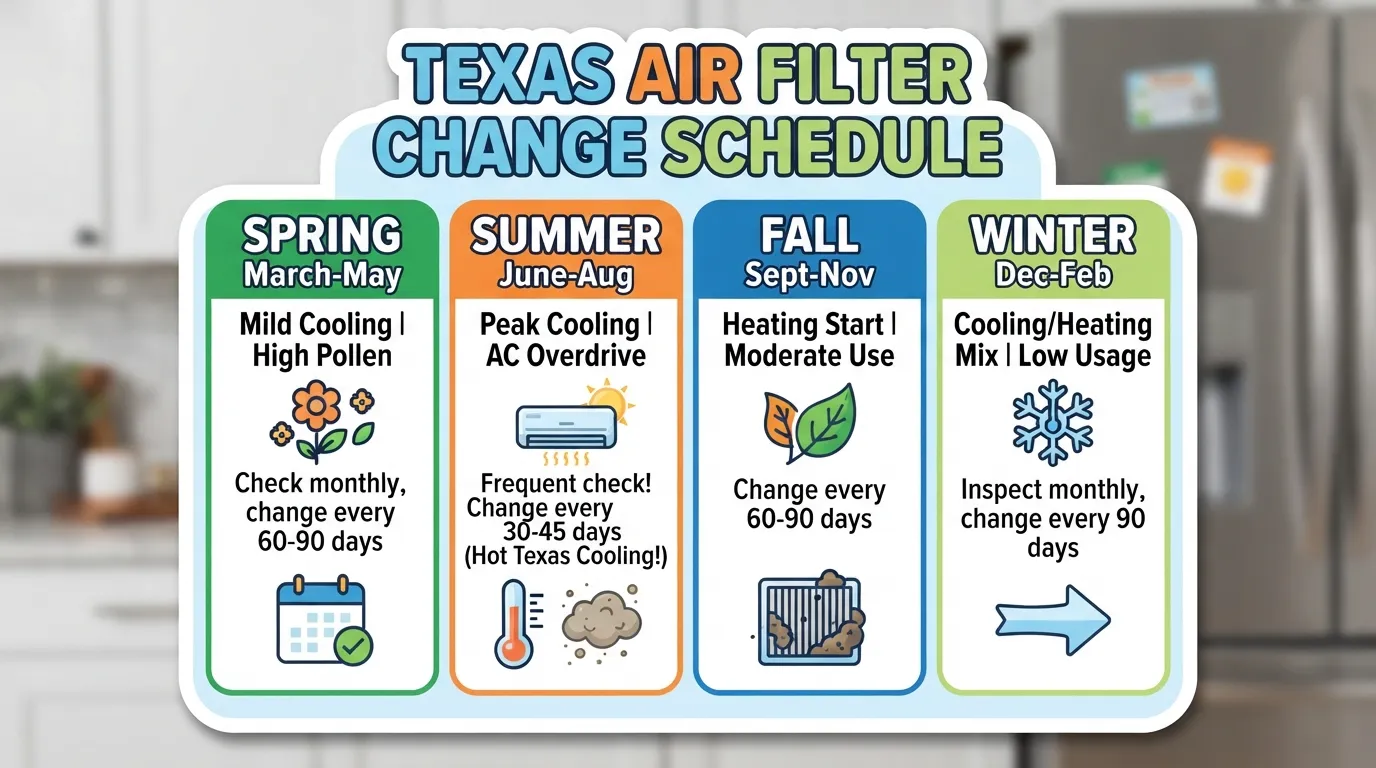
In Texas, change a 1-inch air filter every 30 to 60 days in summer, every 30 to 60 through the heart of heating season, and stretch toward 90 only in the mild fall weeks. During oak pollen season, make it 30, flat. Thicker 4-to-5-inch media filters buy you 6 to 12 months. That’s the honest schedule, and it’s shorter than the box’s famous “90 days” for one simple reason: filters age by run-hours, and a Central Texas system runs a lot of hours.
Here’s the full schedule, the MERV translation, and the mistakes that cost real money.
The honest Texas schedule
- Summer (May–September): every 30–60 days. Toward 30 if the AC barely rests, and in a Waco July it barely rests.
- Oak pollen season (mid-March–April): every 30 days, no stretching. Check it at two weeks.
- Mild fall (October–November): 60–90 days. The system’s half-asleep; enjoy it.
- Heating season (December–February): back to 30–60 days once the furnace works nightly.
- 4-to-5-inch media filters: every 6–12 months, lean early in a dusty or furry house.
When in doubt, pull it and hold it to a light. Light barely gets through, it’s done, whatever the calendar says. Total honesty: nobody remembers this stuff unaided, so write the date on the filter’s cardboard edge with a marker when you install it. Lowest-tech maintenance tracking on earth, works every time.
Why the box says 90 and your house disagrees
The number printed on HVAC filters assumes a national-average system running a few hours a day in a moderate climate. That filter math was written for Ohio.
A Central Texas AC in August runs most of the afternoon and well into the night, which means your filter processes an Ohio month of air in a week or two. Same filter, same box, triple the duty. The 90-day promise isn’t a lie so much as a different climate’s truth, and following it here is how returns end up wearing a gray fur coat by Labor Day.
MERV rating, translated
MERV is just a capture score: the higher the number, the smaller the particles the filter grabs. EPA’s plain-English MERV explainer has the full chart; here’s the practical version for HVAC filters at home.
| MERV | What it catches | Watch out for |
|---|---|---|
| 1–4 (fiberglass) | Bugs, lint, gravel, optimism | Barely protects the equipment |
| 5–8 (pleated) | Dust, pollen, dander | The sweet spot for most homes |
| 9–12 | Finer dust, more allergens | Fine if changed on time |
| 13+ | Smoke, bacteria-sized particles | Airflow tax; many home blowers can’t breathe through it |
Our stance for most Central Texas houses: pleated MERV 8 to 11, changed on the schedule above. The dollar fiberglass pads are a false economy; they exist to protect the machine and barely manage that.
The too-high-MERV trap
Here’s the opinion the filter aisle won’t volunteer. A higher MERV number means a denser weave, and a denser weave means your blower pulls harder to move the same air. Lots of residential systems were never designed for MERV 13, and a 13 that’s half-loaded with Texas dust is functionally a plywood sheet with a rating sticker.
The results show up as comfort problems that get misdiagnosed as equipment problems: weak airflow, rooms that won’t cool, iced-up coils, a blower running hot. A MERV 8 changed on time beats a MERV 13 changed late, every single time, and it’s cheaper twice over.
If allergies are driving the upgrade urge, spend the effort on cadence instead: MERV 11, a hard 30-day schedule, and closed windows on high-count days do more for your sinuses than a filter your system can’t breathe through. During spring, that cadence is the whole game; our oak pollen season playbook covers what those weeks do to filters and coils.
Your modifiers: pets, pollen, dust, and people
Adjust the schedule toward 30 days for any of these, and stack them honestly:
- Shedding pets. One dog, subtract a couple weeks from every interval. Multiple pets, just make it monthly and stop negotiating.
- Oak pollen season. Covered above: 30 days, checked at two.
- Remodeling or new construction nearby. Drywall dust is a filter’s nemesis. Check weekly until the work ends.
- A full, busy house. Doors opening, kids, dirt in and out; more air processed means faster loading.
- Nobody home most days? You’ve earned the long end of each range. Congratulations on the quiet.
What a late filter actually costs you
A choked filter is the cheapest part in the system quietly attacking the most expensive ones.
Airflow drops first, so the coil runs colder than designed and can ice into a solid block; if your vents are blowing weak, warmish air in July, that’s the frozen-coil story. Runtimes stretch next, because moving less air per minute means more minutes, and the meter counts every one; a stale filter is one of the first suspects in why your electric bill spiked. And the blower motor, working against a wall all season, wears years early.
If the filter’s been in since last spring and the system’s already misbehaving, a fresh one is still step one, but it may not undo the damage. Our air conditioner repair visits start with a written assessment and quote, and we’ll tell you plainly if the fix was $8 of filter all along. It happens more than anyone would like.
Common questions about changing air filters
How often should you really change your air filter?
What happens if you don’t change your air filter?
What MERV rating should I use?
Are expensive air filters worth it?
Where to go from here
Thirty to sixty days, shorter for pets and pollen, marker on the cardboard edge. That’s how often to change your air filter in Texas, and it’s the highest-return two minutes in home maintenance. If a season of neglect already turned into weak airflow or warm vents, request a written quote or call — worst case it’s a repair, best case we hand you a filter and an honest grin.
The On Point Team · On Point Service Company — family-owned HVAC & appliance repair, McGregor, TX · Serving Waco, Temple, Belton, and surrounding Central Texas towns · Licensed & insured, TDLR License TACLB00069239E ·