




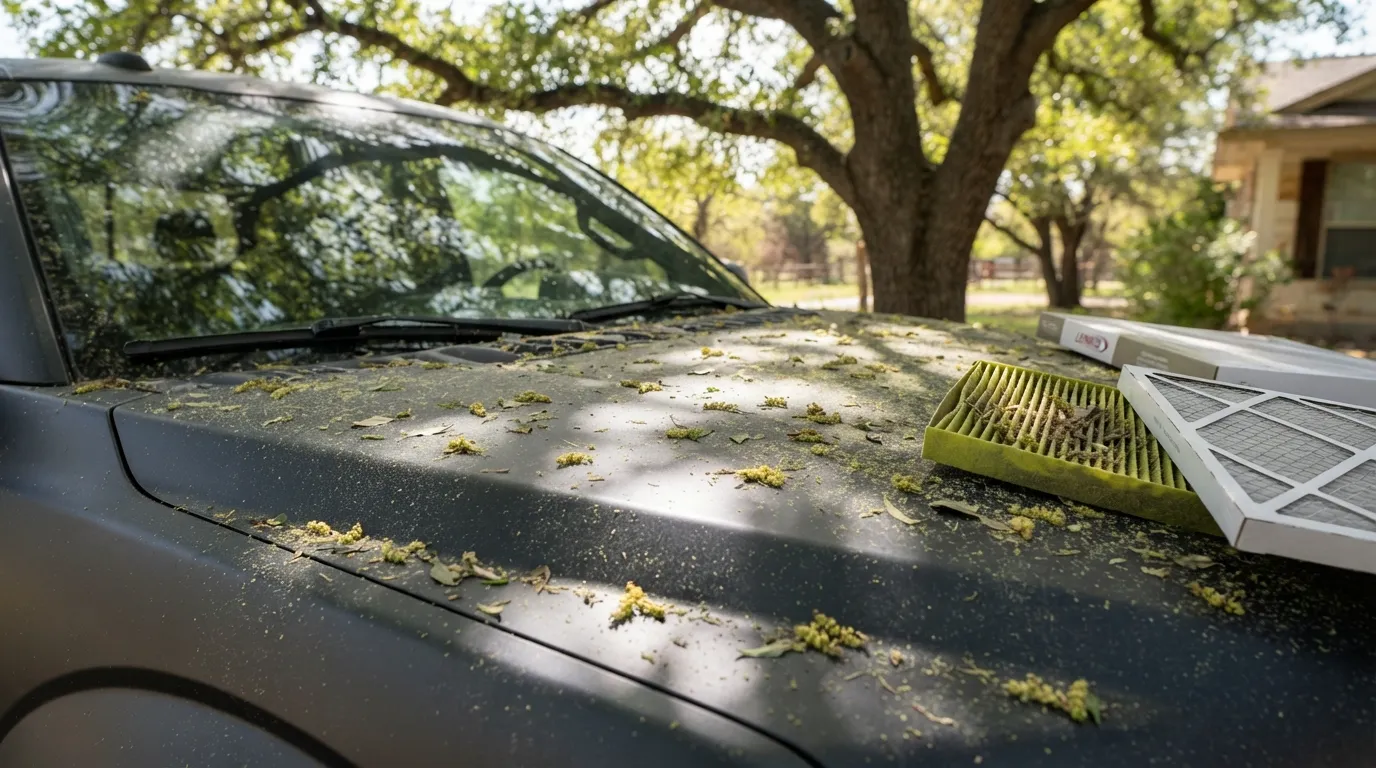
Every March, the live oaks dump a yellow-green film across Central Texas: your truck, your porch rails, your patio furniture, and, less visibly, your HVAC filter and outdoor coil. The routine that gets a system through it is short. Check the filter every two weeks from mid-March through April and change it by day 30. Rinse the outdoor coil monthly. And skip the “better” filter upgrade, because what pollen season demands is a more frequent filter, not a fancier one.
Here’s the whole playbook, including the part where we talk you out of spending money.
What oak pollen actually does to your HVAC
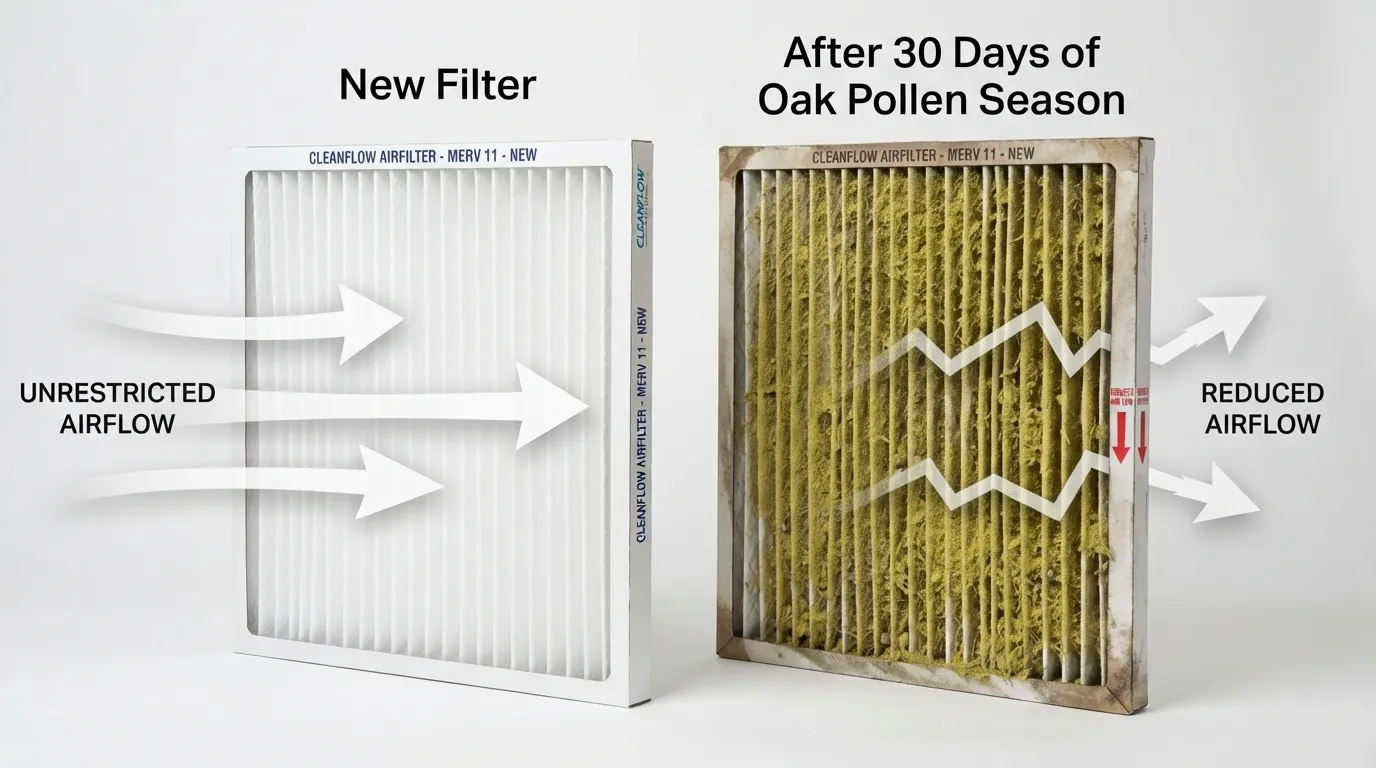
The same film you’re rinsing off the windshield is being pulled through your return grille all day. An oak pollen hvac filter problem builds quietly: the filter loads in half its usual time, airflow drops, and the system runs longer cycles to move the same amount of cool or warm air.
Outside it’s worse. The condenser coil is a giant outdoor air strainer, and in spring it collects pollen plus catkins, those worm-looking tassels the live oaks throw down by the bucket. A matted coil can’t shed heat, and a coil that can’t shed heat turns into longer runtimes now and a “failing AC” call by the first heat wave.
None of this is failure. It’s seasonal load, and it has a seasonal answer.
Cadence beats upgrades: the filter honesty
Here’s where we differ from the filter aisle. Oak pollen grains are big, as airborne particles go. A standard pleated MERV 8 filter catches them just fine. You do not need a MERV 13 “allergen” filter to stop oak pollen; you need whatever decent filter you already use, changed on time.
The trap runs the other way. A high-MERV filter is a denser weave, and by April 1 a dense filter half-loaded with pollen is a wall. Your blower strains against it, airflow sags, and the system you were protecting works harder than it would’ve with a humbler filter swapped on schedule. A MERV 8 changed at 30 days beats a MERV 13 changed at 90, and it isn’t close.
The full MERV story, thickness options, and the year-round schedule live in our air filter guide for Texas homes. For pollen season, the short version stands: cadence over upgrades.
The pollen-season filter calendar
| Season | Check it | Change it by |
|---|---|---|
| Oak pollen (mid-Mar–Apr) | Every 2 weeks | 30 days, no stretching |
| Summer (May–Sep) | Monthly | 30–60 days |
| Mild fall (Oct–Nov) | Monthly | 60–90 days |
| Heating season (Dec–Feb) | Monthly | 30–60 days |
The check costs nothing: pull it, hold it to a light. If light barely gets through, or the intake side has gone from white to a dusty gold, it’s done, whatever the calendar claims.
Rinse the condenser: the ten-minute routine
Once a month during pollen season, give the outdoor unit a bath. The full version:
- Kill the power at the outdoor disconnect box or the breaker. Non-negotiable first step.
- Pull off the big stuff. Catkins, leaves, and grass clippings off the top grille and sides, by hand.
- Rinse with a garden hose, gentle pressure, angled down the coil fins from the top. You’re washing a screen, not stripping paint.
- Skip the pressure washer. It folds the soft aluminum fins flat, and flattened fins are exactly the airflow blockage you were trying to prevent.
- Let it drip dry, power back on. Done.
No coil chemicals, no foams, no opening the cabinet. Pollen rinses off with water. If the coil is greasy-grimy beyond what a hose fixes, or anything inside the cabinet looks suspect, that’s tech territory; the panels stay closed and the capacitor stays untouched, full stop.
Inside the house: grilles, registers, and the duct-cleaning pitch
Wipe the return grille and vacuum the register faces; that fuzz is part pollen, part everything else, and it’s the visible edge of your airflow path.
Now the honest part. Pollen overwhelmingly stops at the filter, which is the filter’s whole job. Spring is also when duct-cleaning offers bloom, and most homes don’t need one: EPA’s guidance on duct cleaning says it’s never been shown to actually prevent health problems, and recommends it mainly for specific cases like visible mold or vermin. If your allergies are raging, the fixes that work are the 30-day filter cadence, closed windows on high-count days, and time. Save the duct money.
When pollen season turns into a repair call
The coil that never got rinsed doesn’t complain in April. It complains in late May: warm air from the vents, an outdoor unit running loud and long, a breaker that trips on the first 95-degree afternoon, sometimes a frozen line. By then it reads like a dying AC, and some of those units get replaced when they needed a cleaning and a part.
If your system limps out of pollen season, our air conditioner repair visits start with a written assessment and quote, so you’ll know whether it’s a rinse-and-part situation or something real. A spring tune-up covers the deep coil cleaning properly; what tune-ups cost and which plans are worth it is its own conversation.
We’ll say the quiet part: this season makes us money in June from coils that a $0 rinse in March would have saved. We’d rather have the honest version of you as a customer.
Common questions about pollen and your HVAC
Does oak pollen affect air conditioning?
What’s the best AC filter for pollen season?
Can I hose off my AC unit?
When does oak pollen season end in Central Texas?
Where to go from here
Filter every 30 days, hose the coil monthly, wipe the grilles, keep your duct-cleaning money. That’s the whole oak pollen season defense, and it costs almost nothing from Crawford to Robinson. If the system comes out of spring wheezing anyway, request a written quote or call — we’ll tell you straight if it’s a cleaning, a part, or nothing at all.
The On Point Team · On Point Service Company — family-owned HVAC & appliance repair, McGregor, TX · Serving Waco, Temple, Belton, and surrounding Central Texas towns · Licensed & insured, TDLR License TACLB00069239E ·