






When a dishwasher smells, the cause is almost always food sitting in the filter, slowly going bad in a warm, damp box. Ten minutes of filter cleaning plus a hot vinegar cycle clears most odors. A sewer smell points to the drain hose instead, and a burning smell means stop using it and call.
Same appliance, very different problems. Here’s how to tell which one you’ve got, starting with the overwhelming favorite.
The filter is guilty until proven innocent
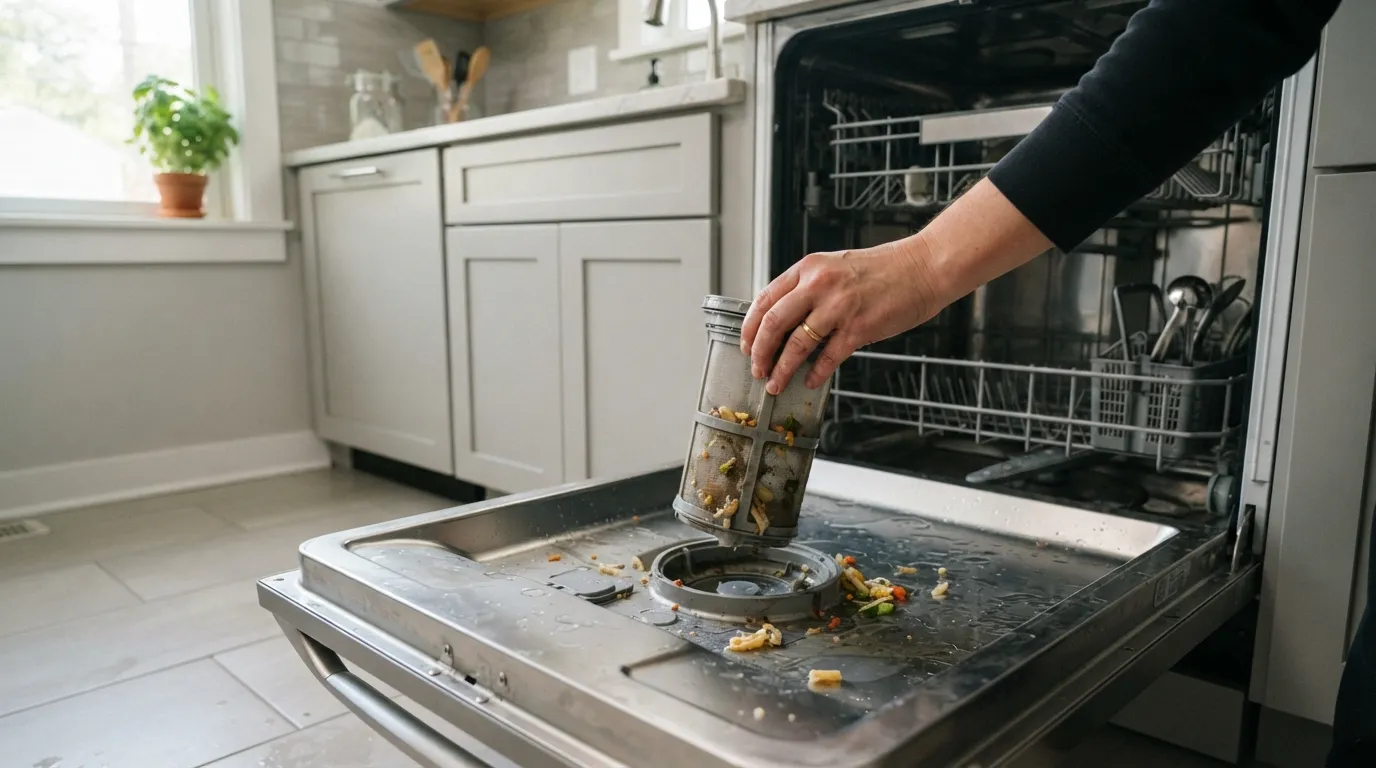
Every dishwasher made in the last couple of decades has a filter in the tub floor, and most owners have never met it. Twist the cylinder under the bottom spray arm a quarter turn, lift it out, and you’ll usually find the whole mystery: a film of grease, a rind of last month’s dinners, maybe a shard of glass holding a little colony of its own.
Rinse it under hot water, scrub it with dish soap and an old toothbrush, wipe out the well it sits in, and lock it back in place. That’s the entire job, and it fixes the smell more often than every other step in this post combined. If yours doesn’t twist out the way described, layouts vary a little by brand; your manual or GE Appliances’ care pages map the differences in ten seconds.
One local wrinkle: around Waco and Temple, our hard water lays a chalky film over the mesh that traps food particles even when the filter looks clean. If you see white crust, soak the filter in vinegar for 15 minutes first. Hard water quietly works against every water appliance in the house, and what it does to them over time is worth five minutes of reading if your glasses come out cloudy too.
The vinegar cycle, and what it can’t do
After the filter’s clean, set a bowl with two cups of white vinegar upright on the top rack and run the hottest cycle, empty. The acid strips grease film and mineral scale off the tub, the arms, and the parts you can’t reach. If odor lingers, follow with a cup of baking soda scattered on the tub floor and a short hot cycle.
Two warnings, both firm. Don’t run bleach in a dishwasher with a stainless interior, and never mix bleach with vinegar anywhere, same-cycle or back-to-back without a rinse; that pairing makes chlorine gas. And skip the perfumed “dishwasher freshener” clip-ons entirely. They’re air freshener for a garbage problem, and we’d rather you spend the three dollars on vinegar that actually removes the cause.
What vinegar can’t do: fix a hose that’s routed wrong, drain standing water, or repair anything. It’s a cleaner, never a cure for mechanical problems.
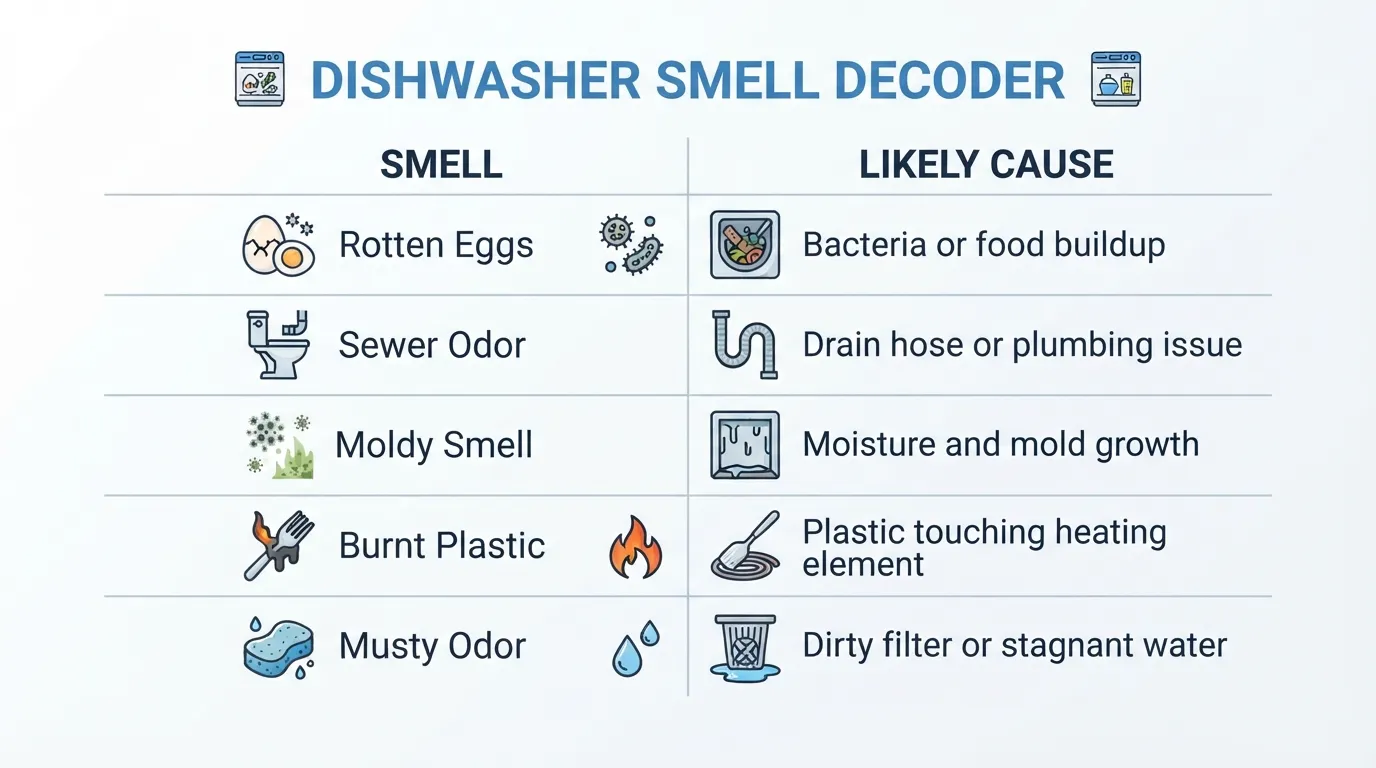
Decode the smell before you scrub twice
| The smell | Most likely cause | Your move |
|---|---|---|
| Rotten eggs / old food | Food in the filter or spray arm gunk | Clean filter, vinegar cycle |
| Sewer or sulfur | Drain hose missing its high loop, or air-gap gunk | Fix the hose routing |
| Musty / wet dog | Biofilm from cool, short cycles | Hot cycles, vinegar, leave door cracked |
| Fishy or sour that returns fast | Standing water below the tub | Run the drain checks |
| Burning plastic or hot metal | Item on the heating element, or a component failing | Stop the machine, call |
The bottom row is the one people rationalize away. A melted spatula on the element explains it once. A burning smell with nothing visible on the element doesn’t get a second run; that’s an electrical symptom, and it goes straight past DIY.
The sewer smell lives in the hose, and sometimes next door
A dishwasher’s drain hose ties into the sink’s plumbing, and physics does the rest. If the hose doesn’t rise in a high loop under the counter before it drops to the drain or disposal, sink water and sewer gas can wander back into the tub. The check costs nothing: open the cabinet, and make sure the hose arcs up near the countertop’s underside before heading down. No loop? Zip-tie it up there. Done.
Two related suspects while you’re under the sink. A garbage disposal packed with scraps will perfume the dishwasher that drains through it, so run it clear with cold water. And if there’s a chrome air-gap cylinder by the faucet, pop the cap and clean it out. If any of this comes with water pooling in the tub between cycles, the smell is the symptom and the drain is the disease; the four drain checks run that problem to ground.
While you’re in there: the spots everyone misses
Food hides in more places than the filter. Wipe the door’s bottom lip and the gasket’s lower fold, where rinse water never reaches. Pull the spray arms and poke the clogged holes clear with a toothpick; a blocked arm leaves food on dishes, and food left on dishes becomes tomorrow’s smell. After a week of Baylor game-day dishes, that door lip alone can explain everything.
Give the racks a look too. Peeling vinyl and rust won’t usually smell, but they snag food that does, and a rusting rack is a $15 recoat job, never a reason to shop for a machine.
Honest trade-off before the next section: the filter-and-vinegar routine only works if it actually happens monthly, and nobody remembers a chore with no reminder. Tie it to the water bill. The machines we see with zero odor history are almost never fancier, they’re just cleaned on a schedule.
The smells that mean stop and call
Three situations end the DIY portion:
- A burning or hot-plastic smell with nothing melted on the element
- A sewer smell that survives the high-loop fix and a filter cleaning
- Any smell paired with standing water that returns cycle after cycle
The first is electrical until proven otherwise. The second usually means a plumbing-side problem. The third is a drain or pump issue wearing a smell as a disguise. Our dishwasher repair team diagnoses all three the same way: a written assessment and quote before any work, so you know whether it’s a $150-class fix or a bigger conversation. Same-day slots are often available across the Waco area, and repairs carry our 10% senior and military discount.
Common questions about dishwasher smells
Why does my dishwasher smell like rotten eggs?
How do I get rid of the smell in my dishwasher?
Can I put bleach in my dishwasher?
Why does my dishwasher smell like burning?
Where to go from here
Filter, vinegar, high loop, in that order, and the smell loses. If it keeps winning, or it smells like burning even once, get a straight answer and a written quote or call . A dishwasher that smells wrong after real cleaning is telling you something, and finding out costs less than replacing dinner plates’ worth of guesswork.
The On Point Team · On Point Service Company — family-owned HVAC & appliance repair, McGregor, TX · Serving Waco, Temple, Belton, and surrounding Central Texas towns · Licensed & insured, TDLR License TACLB00069239E ·