



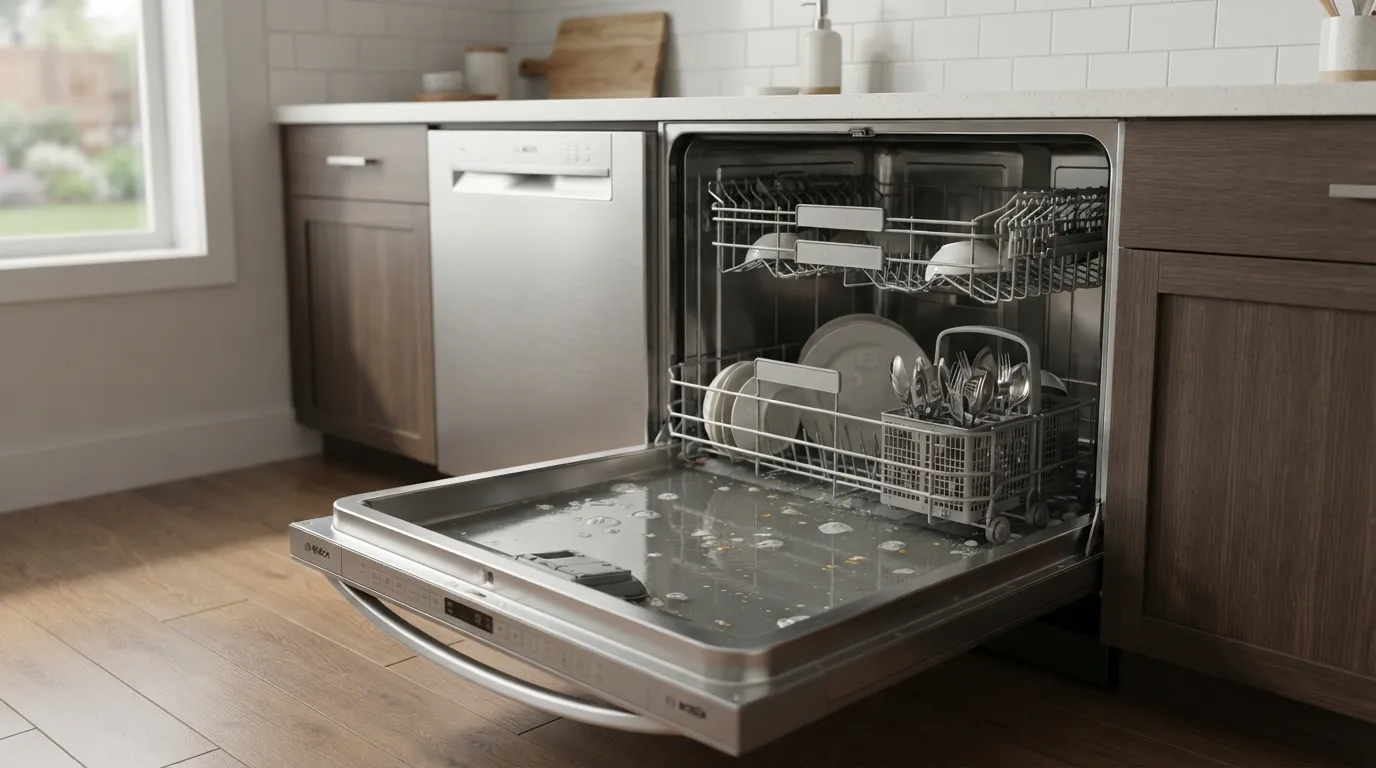
A dishwasher that won’t drain almost always has a blocked path, not a broken machine. The usual culprits, in order: a gunked-up filter, a garbage disposal problem next door, a clogged air gap, or a kinked drain hose. All four are checkable in under half an hour with zero tools, and most drain calls we run in the Waco area end at check one or two.
That’s not great for our invoice totals. It’s still the truth, so here’s the list.
Check 1: The filter (this is it more than half the time)
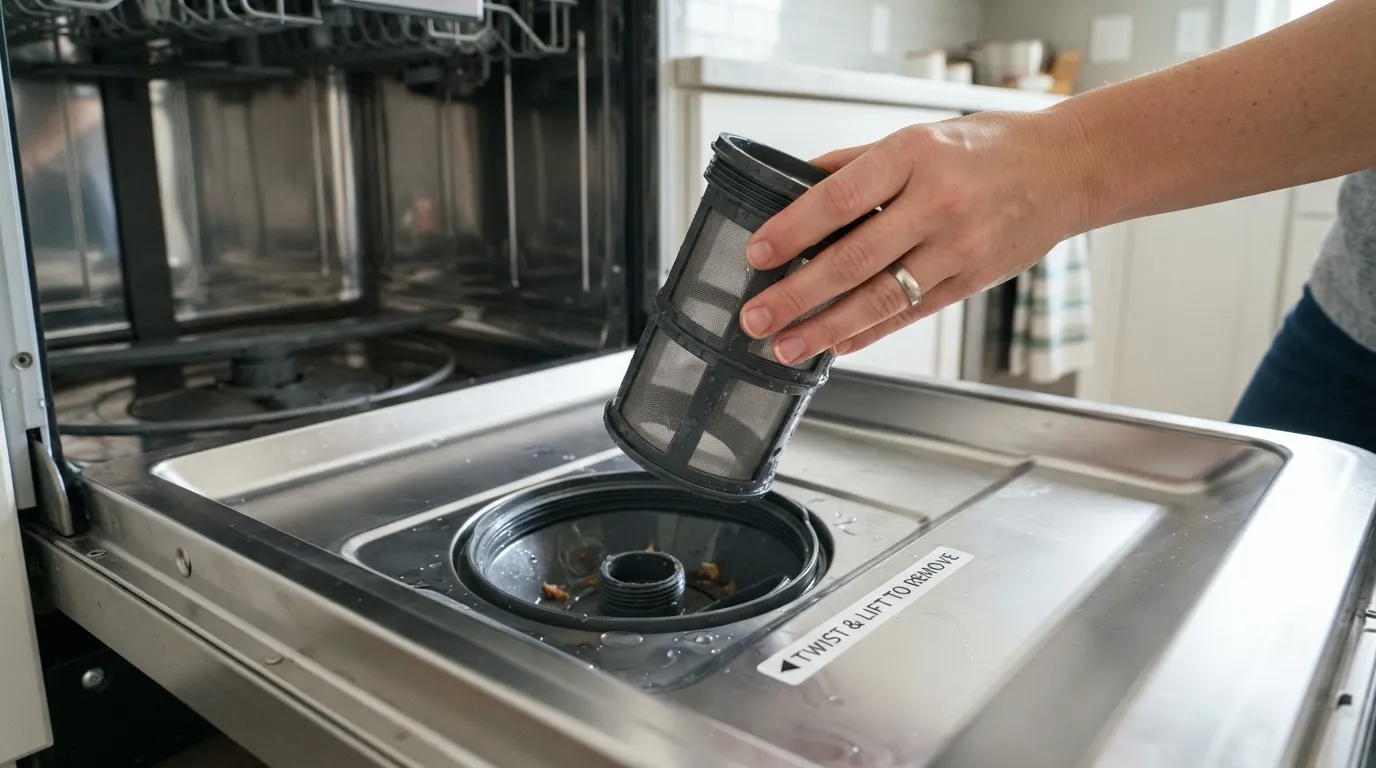
Down in the floor of the tub, under the bottom spray arm, there’s a round filter assembly. Twist the cylinder a quarter turn, lift it out, and be brave about what you find. Food sludge, glass shards, a pistachio shell, the label off a jar: we’ve pulled all of it out of machines from Robinson to Troy.
Rinse the filter under hot water with a soft brush (an old toothbrush is perfect), wipe out the well it sits in, and twist it back in until it locks. Don’t run the machine without it seated; that’s how food gets into the pump, and the pump is where this stops being free.
Central Texas adds its own wrinkle here. Our hard water crusts calcium onto the filter mesh, so a filter can look clean and still be half-sealed. If the mesh has white scale on it, soak it in vinegar for 15 minutes before you rinse. Hard water quietly shortens the life of every water-using appliance in the house; we wrote up what hard water does to appliances if yours is a repeat offender.
Check 2: The garbage disposal next door
Strange but true: your dishwasher drains through your garbage disposal. The drain hose ties into the disposal’s side port, which means two disposal problems become dishwasher problems.
A full disposal. If the disposal is packed with food scraps, the dishwasher’s water has nowhere to go. Run the disposal for 15 seconds with cold water flowing, then try the dishwasher again. This fixes an embarrassing number of “broken” dishwashers, and nobody should feel bad about it.
The knockout plug. If the drain problem started right after a new disposal went in, this is your answer, nearly guaranteed. New disposals ship with the dishwasher port sealed by a plastic knockout plug that the installer is supposed to punch out. Skip that step and the dishwasher can’t drain a drop. InSinkErator’s own support pages walk through it; removal takes a hammer, a screwdriver, and one satisfying tap, with the disposal’s power off first.
Check 3: The air gap (that chrome cylinder by the faucet)
Some sinks have a small chrome or plastic cylinder up on the counter near the faucet. That’s a dishwasher air gap, and its whole job is keeping dirty sink water from siphoning back into your dishwasher. Older Waco kitchens have them more often than newer builds out toward China Spring, where a high-looped hose usually does the same job.
If you’ve got one and the dishwasher won’t drain (bonus clue: water spits out of the cylinder mid-cycle), pull the cover off, unscrew or unsnap the cap, and clean out the gunk with a paper towel or a bottle brush. Thirty seconds, done. No air gap on your counter? Skip to check four.
Check 4: The drain hose
Pull the machine’s kick plate area into view and look behind it if you can, then check under the sink where the hose runs to the disposal or drain. You’re looking for a kink, a crush point from something shoved under the sink, or a hose that droops low and flat. Straighten what you find. That’s the whole check; if the hose itself is clogged deep inside, that’s disconnect-and-flush territory, and we’d rather you hand that one off.
Now run a short cycle and watch it drain. Fixed? Wonderful, you owe us nothing. Still standing water? Keep reading.
One more thing: never pour drain cleaner in a dishwasher
We’ll plant a flag on this. No Drano, no Liquid-Plumr, not once, not “just a little.” Chemical drain cleaner doesn’t clear the parts of a dishwasher that actually clog, it eats pump seals and gaskets, and the next cycle washes what’s left of it over the things you eat off. Anyone who suggests it is signing you up for a pump replacement on layaway. Vinegar and a filter rinse: yes. Caustics: never.
When it’s time to stop and call
If the filter’s clean, the disposal runs clear, the air gap’s open, and the hose lies straight, the blockage is past the reachable stuff: usually the drain pump, a stuck check valve, or a deep hose clog. That’s disassembly work around standing water and electricity, and it’s where you stop. Scoop the standing water out with a cup and towel so it doesn’t go stale, and let a tech take it from there.
This is honestly the least glamorous call we run, and the one where a written quote before any work earns its keep: a drain pump is a modest, fixable part, and you shouldn’t be quoted a new machine for one. Same-day slots are often available across our Waco service area. And if the math between fixing and replacing is the real question on your mind, our dishwasher repair-or-replace guide does that arithmetic in plain numbers.
Common questions about a microwave that won’t heat
Why is my dishwasher not draining?
How do I force my dishwasher to drain?
Is standing water in the bottom of my dishwasher normal?
Can I use Drano to unclog my dishwasher?
Where to go from here
Filter, disposal, air gap, hose, in that order. You’ll solve it yourself better than half the time, and it costs you nothing but a slightly gross ten minutes. If the water’s still standing after all four, request a written quote or call , and we’ll give you a straight answer on whether it’s a $150-class fix or something worth a bigger conversation.
The On Point Team · On Point Service Company — family-owned HVAC & appliance repair, McGregor, TX · Serving Waco, Temple, Belton, and surrounding Central Texas towns · Licensed & insured, TDLR License TACLB00069239E ·