



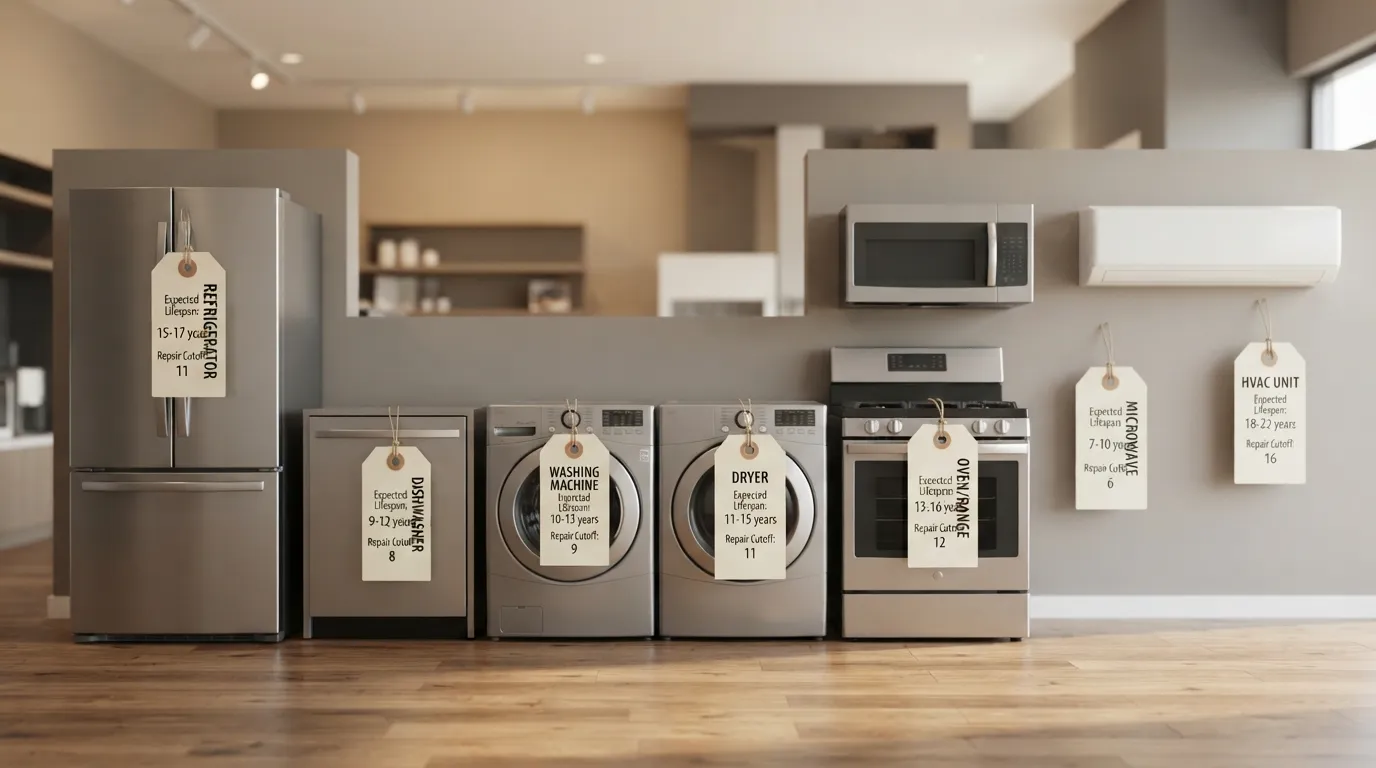
Most major appliances last 9 to 15 years. Dishwashers sit at the short end, gas ranges at the long end, and almost everything in Central Texas runs shorter than the national tables claim, because hard water quietly works half these machines to death. Below is the appliance lifespan chart we quote from on real service calls: typical years, the local hard-water penalty, what kills each machine early, and the age where repair money stops making sense.
Bookmark the chart, then read how to use it. The chart tells you what’s normal. The cutoff column tells you what to do about it.
In this guide:
- The appliance lifespan chart
- How long do appliances last? Reading the chart right
- Kitchen appliances, machine by machine
- Laundry: washers and dryers
- Water heaters: the quiet short-timer
- HVAC: different lifespans, much bigger math
- The hard-water penalty, explained
- What kills appliances early
- The repair-cutoff age: how to use it
- Adding years without babying anything
- When the chart says replace but repair still wins
- Common questions
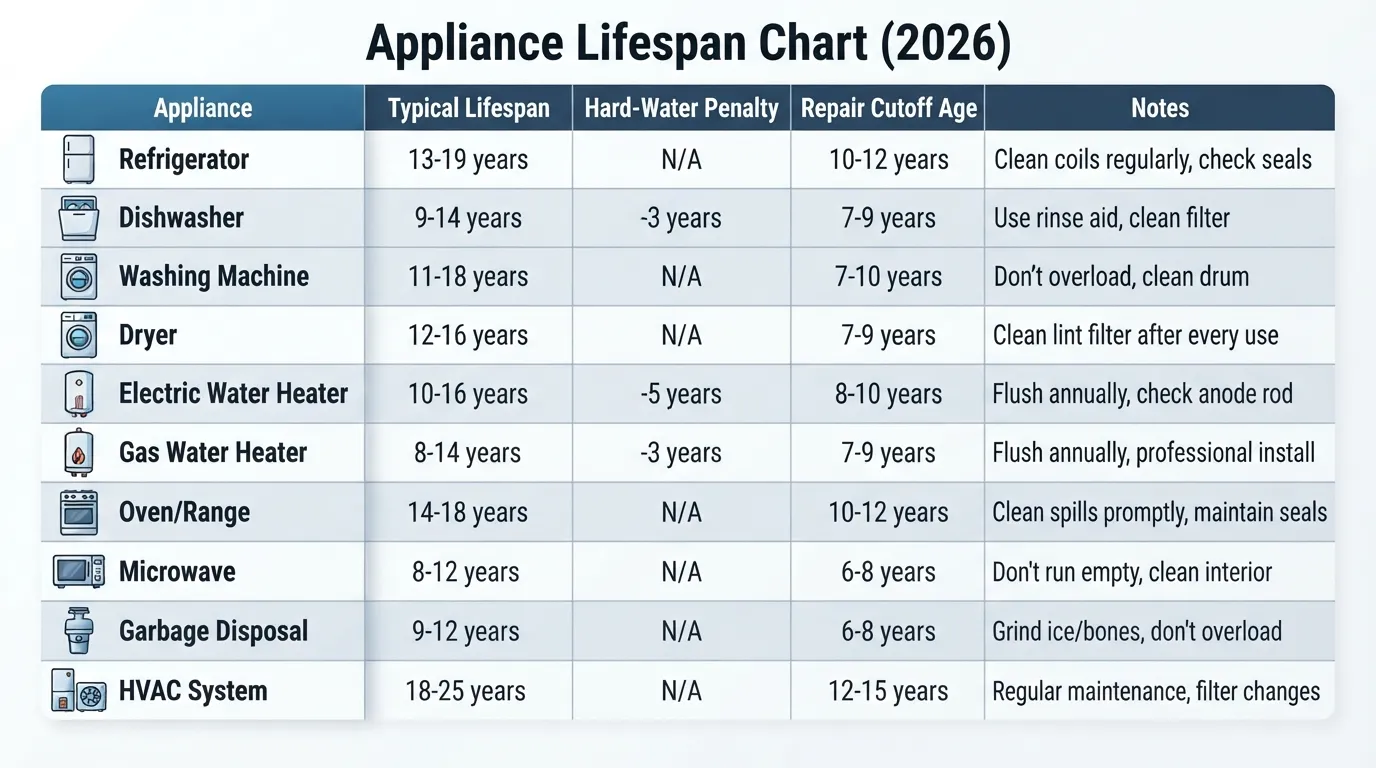
The appliance lifespan chart
Typical years reflect national data (the NAHB’s life-expectancy research and ENERGY STAR guidance), adjusted by what actually shows up in Waco-area kitchens and garages. The hard-water column is ours; no national chart prints one.
Appliance | Typical years | Hard-water penalty | What kills it early | Repair-cutoff age |
|---|---|---|---|---|
Refrigerator | 10–15 | Low (ice maker, water valve) | Dirty coils, garage heat | 8–10 |
Freezer | 10–15 | None | Door seals, garage heat | 10 |
Dishwasher | 9–10 | High: −2 to −3 yrs | Scale, debris in the pump | 8 |
Washer, top-load | 10–12 | Moderate: −1 to −2 yrs | Overloading, unlevel install | 8 |
Washer, front-load | 8–11 | Moderate | Bearings, overloading | 8 |
Dryer | 10–13 | None | Clogged vent, lint | 10 |
Range, electric | 13–15 | None | Self-clean abuse, spills | 12 |
Range, gas | 15+ | None | Burner neglect (minor) | 14 |
Wall oven | 15+ | None | Self-clean abuse | 12 |
Microwave | 7–10 | None | Running empty, door slams | 5–6 |
Garbage disposal | 8–12 | Moderate | Grease, fibrous scraps | Usually replace |
Water heater, gas tank | 8–12 | High: −2 to −4 yrs | Sediment, spent anode | 8 |
Water heater, electric tank | 10–15 | High | Scaled elements | 10 |
Central AC / heat pump | 15–20 national; 12–15 here | n/a | Dirty coils, oak pollen, run hours | 10–12 |
Gas furnace | 15–20 | n/a | Starved airflow, skipped filters | 15 |
Ranges assume ordinary use and basic care. A machine can beat its number or miss it badly, and the rest of this guide is about which way yours is headed.
How long do appliances last? Reading the chart right
Averages hide two things, and both matter more than the brand name.
Duty cycle beats calendar age. A dishwasher in a family of six runs twice as many cycles as the same machine in an empty nest, so it reaches “10 years old” in five. When we assess a machine in Temple or China Spring, we’re guessing at cycles, not birthdays. You should too: a lightly used 12-year-old washer can be a better keep than a hammered 7-year-old one.
Quality tiers bend everything. Builder-grade units (the ones installed by the hundred in new subdivisions) tend to land at the bottom of every range. Mid-tier machines hit the middle. Premium machines don’t necessarily last longer, but they’re worth repairing longer, which works out to the same thing.
And one opinion to calibrate your expectations: new appliances, as a class, don’t age like the avocado-green tanks your grandmother owned. More electronics, more sensors, thinner metal. Ask any tech who’s worked both eras. The trade is real (new machines use far less water and power), but longevity paid for the efficiency, and the chart’s numbers already reflect it.
Kitchen appliances, machine by machine
Refrigerators (10–15 years) are the marathoners, mostly because they never stop running, and their one demand is airflow across clean coils. The classic early death is the garage fridge: a Texas garage in August is a 110° room, and asking a compressor to hold 37° in it is hospice care. If yours lives in the garage, subtract years. The deeper story on compressors, sealed systems, and fridge aging is in our guide to how long refrigerators last.
Dishwashers (9–10 years) are the hard-water casualty of the kitchen. Scale crusts the heating element, stiffens the spray arms, and chews the pump seals, which is why the chart docks them 2–3 years around here. When one starts failing, the money question answers fast — we ran the full repair math, with local ranges, in what dishwasher repair costs.
Ranges and wall ovens (13–15+ years) outlive everything else in the kitchen. Electric ranges die by element, switch, and board; gas ranges barely die at all if the burners stay clean. Their one accelerant is the self-clean cycle — an 880° stress test that pops thermal fuses and cooks control boards, and the reason we tell people to run it in January or never.
Microwaves (7–10 years) are the disposable athlete of the group: cheap to buy, rarely worth opening past year five or six. Running one empty and slamming the door are the two habits that shorten the countdown.
Disposals (8–12 years) usually don’t get repaired at all; by the time one leaks or seizes beyond a reset, replacement is the honest quote.
Laundry: washers and dryers
Washers carry the hardest duty in the house: water, weight, motion, detergent, repeat. Top-loaders average 10–12 years, front-loaders a bit less, and the death certificate usually says bearings — that helicopter spin-cycle roar every second-floor laundry room in a new Belton subdivision learns eventually. Overloading is the accelerant. The drum doesn’t care that the comforter technically fit.
Dryers are simpler animals and last 10–13 years, with one caveat that outranks lifespan: a clogged vent. Lint chokes airflow, cycles stretch, the machine cooks itself, and a packed vent is a genuine fire hazard on top of it. Clean the lint screen every load and have the vent line cleared when cycles slow down. It’s the cheapest year-adder in this whole guide.
Water heaters: the quiet short-timer
Nobody thinks about the water heater until the garage floor is wet, and that’s a shame, because it has the shortest life of any big appliance in the house: 8–12 years for a gas tank, a little more for electric. Central Texas hard water is the main thief: sediment piles up on the tank floor, the burner works through an insulating blanket of minerals, and the sacrificial anode rod that protects the tank gives its life a few years earlier than the manual assumed.
The chart’s honest advice: at year 8–10, start treating a tank water heater as a scheduled replacement, not a surprise. A planned swap on your calendar always beats an eruption on the water heater’s.
HVAC: different lifespans, much bigger math
Your AC and furnace belong on the chart, but their decisions play by different rules, because replacement isn’t $800 — a full system swap typically lands between $6,000 and $12,500 around here.
National guidance says central ACs and heat pumps run 15–20 years. In Central Texas, plan on 12–15: our cooling season runs eight months, 100° heat domes stack run-hours fast, and spring oak pollen mats condenser coils every April. Furnaces fare better, 15–20 years, mostly because ours work a short season. The lifespan levers are unglamorous: filters changed on time, coils rinsed each spring, and problems fixed while they’re small. With the stakes that much higher, the cutoff-age logic matters more, not less: past 10–12 years, every big AC repair deserves the replacement conversation, in writing.
The hard-water penalty, explained
McLennan and Bell County water is hard: dissolved calcium and magnesium that precipitates out as scale wherever water gets heated or sits. Every appliance that drinks water pays a tax: dishwashers, washers, water heaters, ice makers, disposals. Scale insulates heating elements (so they run longer and hotter), stiffens valves, clogs screens, and grinds at pump seals.
The compound effect is brutal: hard water can turn a 12-year appliance into an 8-year appliance, and it does it invisibly — no leak, no noise, just a machine that ages in dog years. We wrote the full breakdown, including which machines suffer most and what descaling actually helps, in what hard water does to your appliances. If you moved here from somewhere with soft water, recalibrate your expectations. Machines age faster in Waco than they did in Seattle.
What kills appliances early
The same five causes, in the order we meet them on calls:
- Hard water. See above; the region-wide tax.
- Heat and starved airflow. Dirty fridge coils, packed dryer vents, clogged AC filters. Machines don’t die of work; they die of working hot.
- Overloading. Washer drums, dryer drums, dishwasher racks stacked like Tetris. Capacity labels are engineering, not suggestions.
- Power events. A hard summer of brownouts and one good lightning storm can take out more control boards than five years of ordinary aging. Boards are the new weakest link.
- Skipped cleaning. Filters, traps, screens, and coils. Ten minutes a month, or a service call a year. That’s the exchange rate.
None of those require a wrench to prevent. That’s the good news buried in the chart: most early appliance deaths are optional.
The repair-cutoff age: how to use it
The cutoff column is the chart’s whole reason to exist, so here’s the logic. Every repair is a bet that the rest of the machine holds. Early in life, great bet. Past the cutoff age, you’re installing a new part in a machine whose every other part is announcing retirement — and the second failure usually arrives before the first one’s paid for itself.
Pair the cutoff with the 50% rule: if a repair costs more than half of decent replacement, replace. Under the cutoff age and under 50%, repair without guilt. Over both, stop. In between, the tiebreakers are quality tier, whether the failure is a wear part or a core system (the major-vs-minor repair line matters here), and whether parts even exist for your model anymore.
Say your 9-year-old mid-tier fridge in Robinson needs a $700 sealed-system job. Cutoff age: reached. 50% rule: blown, against a $1,100 replacement. That’s a no, and an honest shop says so in the written quote — our refrigerator repair team puts that math on paper before any work starts. The full decision tree, for every machine and every gray zone, lives in our guide to appliance repair vs. replacement.
Adding years without babying anything
You don’t need an appliance-care hobby. You need about an hour a season:
- Refrigerator: vacuum the coils twice a year; leave breathing room behind it.
- Dishwasher: rinse the filter monthly; run a citric-acid or vinegar descale a few times a year in our water.
- Washer: level feet, real load sizes, leave the door cracked between loads.
- Dryer: lint screen every load; vent line cleared when cycles stretch.
- Range: clean burner ports; skip self-clean before holidays, or forever.
- HVAC: filters monthly in summer, a spring coil rinse before the heat arrives.
And one purchase-side opinion, since it decides lifespan before day one: buy simple. Every extra touchscreen, sensor, and app connection is a future failure point with a board price attached. The plainest machine in a good product line is usually the one still running at year 14.
As for extended warranties — most of them cost more than the statistical repair they insure, which is exactly why they’re profitable to sell. Skip them on cheap, simple machines. They only start to pencil out on complex, expensive units where one board failure equals the premium.
When the chart says replace but repair still wins
The cutoff ages are rules of thumb, not laws, and four situations regularly overrule them. Built-ins and counter-depth units, where replacement means thousands plus carpentry. High-end machines, where a $400 repair preserves a $2,500 asset. Discontinued sizes, where the replacement doesn’t exist in your cabinet’s dimensions. And waiting-list models, where “replace it” means six weeks of coolers in the kitchen.
The reverse is also true, and it’s the trade-off worth admitting: repairing at the cutoff can be the wrong kindness. A machine kept alive at year 12 is still a year-12 machine tomorrow. When the honest math says the money belongs in the next appliance, we’d rather say that and lose the ticket.
Common questions about appliance lifespans
Which appliance lasts the longest?
How long do appliances last in hard water areas?
Is it worth fixing a 10-year-old appliance?
Do new appliances last as long as old ones?
What’s the first thing to die on most appliances?
Should I repair or replace an appliance at the cutoff age?
What to do with your number
Find your machine on the chart, note the gap between its age and its cutoff, and let that gap set your strategy: maintain it, budget for its successor, or stop feeding it repairs. If a specific machine is forcing the question this week, ask us for a straight answer or call — you’ll get a written quote, the age math behind it, and a free second opinion if someone else already quoted you. That’s how long appliances last around here, and what to do about it, all on one page.
The On Point Team · On Point Service Company — family-owned HVAC & appliance repair, McGregor, TX · Serving Waco, Temple, Belton, and surrounding Central Texas towns · Licensed & insured, TDLR License TACLB00069239E ·