



Monday, 7:52 a.m. The waiting room reads 84°, the first patient lands at 8, and the rooftop unit that quit sometime Saturday spent two full days dying where nobody could hear it. That failure wasn’t bad luck. It was a maintenance calendar nobody owned.
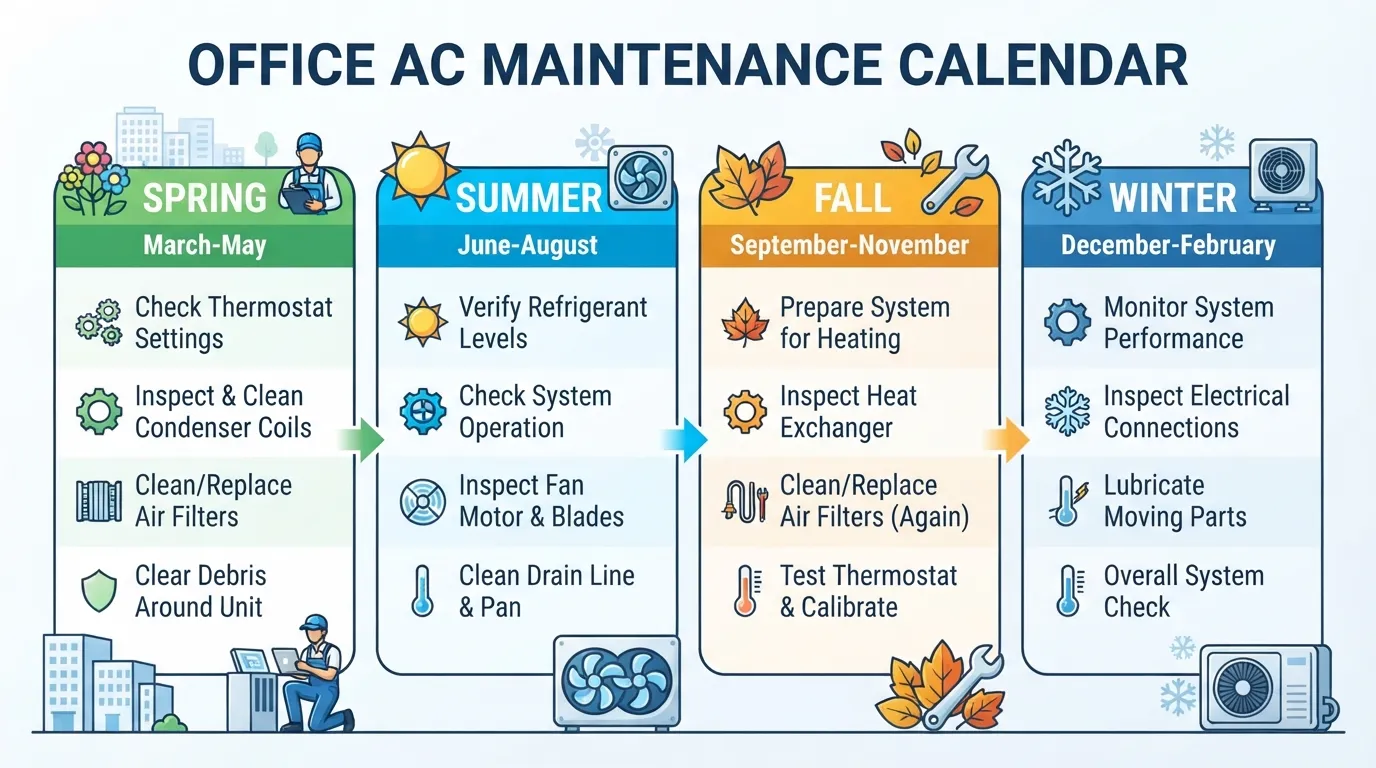
Office air conditioning maintenance runs on a short list: filters checked monthly and changed on traffic rather than the box’s schedule, coils cleaned each spring before the first 100° week, condensate drains watched through the humid months, a heating check each fall, and a thermostat program that stops cooling empty rooms. Two professional visits a year carries most small buildings.
Here’s the calendar, and the honest math on whether a maintenance contract deserves your signature.
What “office AC” means here, and why rooftop units die young
This guide covers the equipment small Waco-corridor offices actually run: package rooftop units (RTUs) over strip retail and standalone buildings, and split systems in converted houses, which is half the law offices in Waco. If your building has a chiller plant and a building engineer, this guide is beneath both of you.
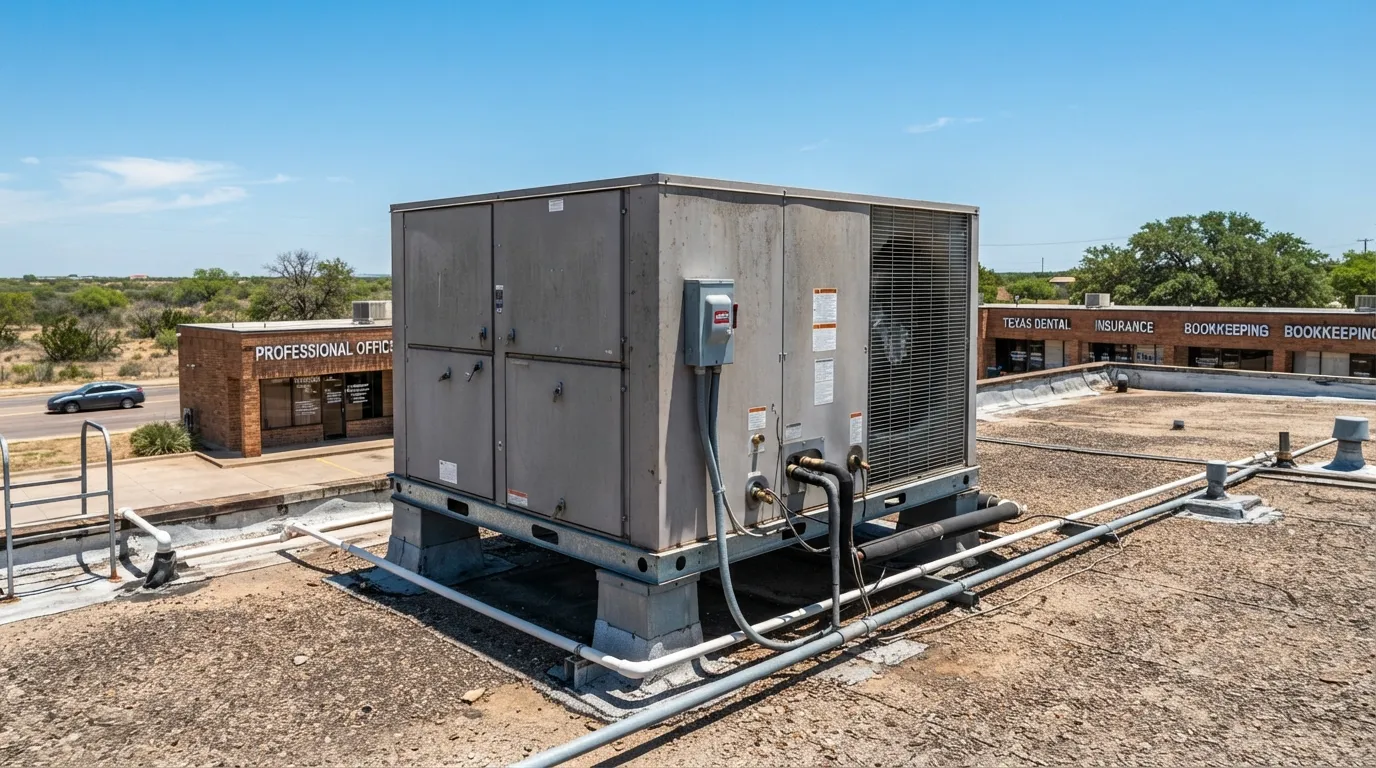
The office building air conditioner has a shorter life than its residential cousin, and the gap is earned. An RTU works 50- and 60-hour weeks, sits in full Texas sun, takes the hail your parking lot takes, and degrades in a place nobody visits. A home unit gets noticed when it rattles. A rooftop unit rattles for a year, alone.
That’s the whole thesis of office maintenance, and it’s opinion number one: out of sight is why these units die young. Every habit below is a way of putting eyes and ears back on a machine you never see.
Filters: on a real schedule, not the box’s schedule
The “every 90 days” printed on a filter box assumes a tidy suburban living room. An office off a gravel lot, a dental operatory with lab dust, a church that runs hard twice a week then sits: none of those are that living room.
Check monthly, change on evidence. Hold the filter up to light; if light struggles through, air does too. Doors that open to the street, remodel dust, oak pollen season in spring, and plain foot traffic all shorten the interval, and a $15 filter changed early beats a frozen coil every time. Our Texas filter schedule guide breaks down the intervals by conditions, and the logic transfers straight to light commercial.
One trade-off worth knowing before you upgrade filters: jumping to a high-MERV filter without checking what the blower can pull is an airflow tax. Better filtration is real, but on an older RTU it can starve the system into the exact icing problems you were preventing. Match the filter to the equipment, and when in doubt, ask rather than guess.
The spring coil cleaning that beats the first 100° week
Condenser coils on a roof collect everything spring throws: oak and cottonwood pollen, dust, whatever the last storm lifted. A matted coil can’t reject heat, so capacity drops and runtime climbs right as Central Texas lines up its first 100° week, usually by early June.
Book a professional coil cleaning and cooling check each spring, April into May, before the heat arrives and before every HVAC schedule in the county fills. The visit typically covers coil condition, refrigerant charge, electrical wear, and drains; the residential version of that pre-summer routine is in our prepare-your-AC-for-summer guide, and an RTU needs it more, because nobody’s walking past it all winter noticing trouble.
While you’re at it, walk the roof with your own eyes twice a year if access is safe and allowed, or ask whoever services it for photos. Bent fins from hail, debris nests against the coil, a unit sitting in a pond of drain water: five minutes of looking catches all three.
Thermostat wars, settled by policy
Every office runs this experiment: someone’s freezing, someone’s melting, and the thermostat becomes a diplomatic incident by Thursday. Settle it with policy instead of physics. Pick an occupied cooling setpoint in the 74–76° band, give exactly one person the keys, and put a locking cover on the stat. Buy the lockbox; it pays for itself the first week, and morale survives once people stop relitigating the number daily.
The bigger money hides after hours. An office that’s empty from 6 p.m. to 7 a.m. and all weekend has no business holding 74° through those hours, and a programmed setback of several degrees across nights and weekends is the cheapest energy win a small building gets. ENERGY STAR’s building guidance starts small offices at exactly this: schedules and setpoints first, because they’re free. A connected thermostat that reports runtime also tattles when something starts failing, which is half its value.
If your summer utility bills already look wrong, the diagnostic list in why is my electric bill so high applies to a small office almost line for line: runtime, filters, coils, duct leaks, and setpoints, in that order.
The drain line and the ceiling stain nobody owns
Cooling a humid Texas building wrings gallons of water out of the air every day, and all of it leaves through a condensate line that grows algae from May to October. When the line clogs, the water finds a ceiling tile, and the brown ring over reception appears a week before anyone connects it to the AC.
During cooling season, put a monthly reminder on somebody’s calendar: check the visible drain outcome (many RTUs drain onto the roof, splits to a visible termination), look for water where it shouldn’t be, and treat a musty smell near supply vents as a clue rather than a candle problem. Clearing and treating lines is standard fare on professional visits; between visits, your job is noticing early, because a tile stain is cheap and a collapsed wet ceiling is not.
Maintenance contract or pay-per-visit?
Honest answer: it depends on how many machines and how much discipline you have, and here’s how to decide.
Pay-per-visit wins for a single RTU or split with a manager who actually owns the calendar: two scheduled visits a year, filters handled in-house, eyes on the roof twice a year. You get most of the protection with no recurring commitment. That discipline is the price, and most offices quietly fail to pay it by August.
Contracts win when there’s more than one unit, when nobody owns the calendar, or when your lease demands documented maintenance. Read that lease clause twice, by the way: plenty of strip-center leases put HVAC maintenance on the tenant and replacement on the landlord, which means skipped maintenance can turn into a fight about who buys the new unit. Documented visits are cheap insurance in that argument. A fair contract prices near the same two visits plus scheduling priority and a paper trail; a bad one is a coupon book. Ask what’s actually on the checklist before signing anything.
[CONFIRM: whether OPSC offers commercial maintenance plans — placeholder per queue; if plans exist, terms and the direct offer go here. Until confirmed, the honest line stands:] whether a formal plan or simple scheduled visits fits your building is a phone conversation, and asking us costs nothing.
Where the office manager’s job ends
Plenty of this list is yours: filters, thermostat programs, calendar reminders, keeping the area around any ground-level condenser clear, and reporting new noises the week they start instead of the month the unit dies. Those habits are most of the outcome.
The stop-lines are the same ones we hold for homeowners, scaled up. Refrigerant is EPA-certified-tech territory under federal law, electrical panels and contactors stay shut, and nobody on your staff should be on a roof wrestling equipment, period. When a visit’s on the table and you want to understand the invoice before it exists, what a service call costs explains the fee anatomy we put in writing.
[CONFIRM: commercial service scope — if OPSC’s light-commercial HVAC work is confirmed, the direct service line replaces this note.] Until then, the ask-first version: call with your building type and equipment (rooftop package or split, roughly how old), and ask whether it’s work our techs take on. Straight yes or no, two minutes, and a pointer if it’s a no.
FAQ: office air conditioning maintenance
How often should office air conditioning be serviced?
What temperature should an office be set to?
How long do rooftop units last?
Do office air conditioning systems need different filters than home systems?
A Preventative HVAC Maintenance Schedule by On Point Service Company
Own the calendar and the rest follows: filters monthly, coils every spring before the first 100° week, drains watched all summer, heat checked each fall, and a thermostat that sleeps when the office does. If you’d rather hand the calendar to someone, or you just want the lane question answered for your building, get a straight answer or call .
The On Point Team · On Point Service Company — family-owned HVAC & appliance repair, McGregor, TX · Serving Waco, Temple, Belton, and surrounding Central Texas towns · Licensed & insured, TDLR License TACLB00069239E ·