


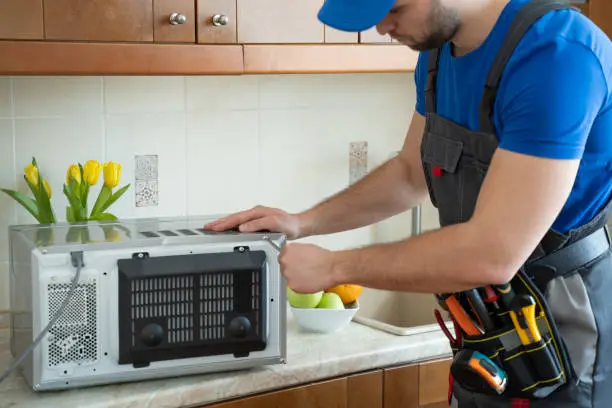
Here’s the answer most repair companies won’t put in writing: if your microwave cost less than $150 new, it’s almost never worth repairing. Pay for the fix on a $600 over-the-range unit, skip it on the $89 countertop from the garage. The microwave repair or replace question is really a math question — and the math has sharp edges.
Below is the whole calculation: what each failure typically costs to fix in Central Texas, which ones you can check yourself for free, and the one component that makes microwaves the single worst DIY appliance in your house.
The Short Version: Our $150 Rule
If a microwave cost less than $150 new, replace it when it fails — almost any honest repair runs $100–$300 once parts, labor, and the trip are counted. Repair starts making sense for over-the-range, drawer, and built-in models, where replacement itself costs $400–$1,500 and includes installation labor.
That’s the rule. The rest of this article is the “almost” — because a $40 fix on a nice unit is real money saved, and a $250 fix on a tired one is money burned.
Repair or Replace: The Cost Table That Decides It
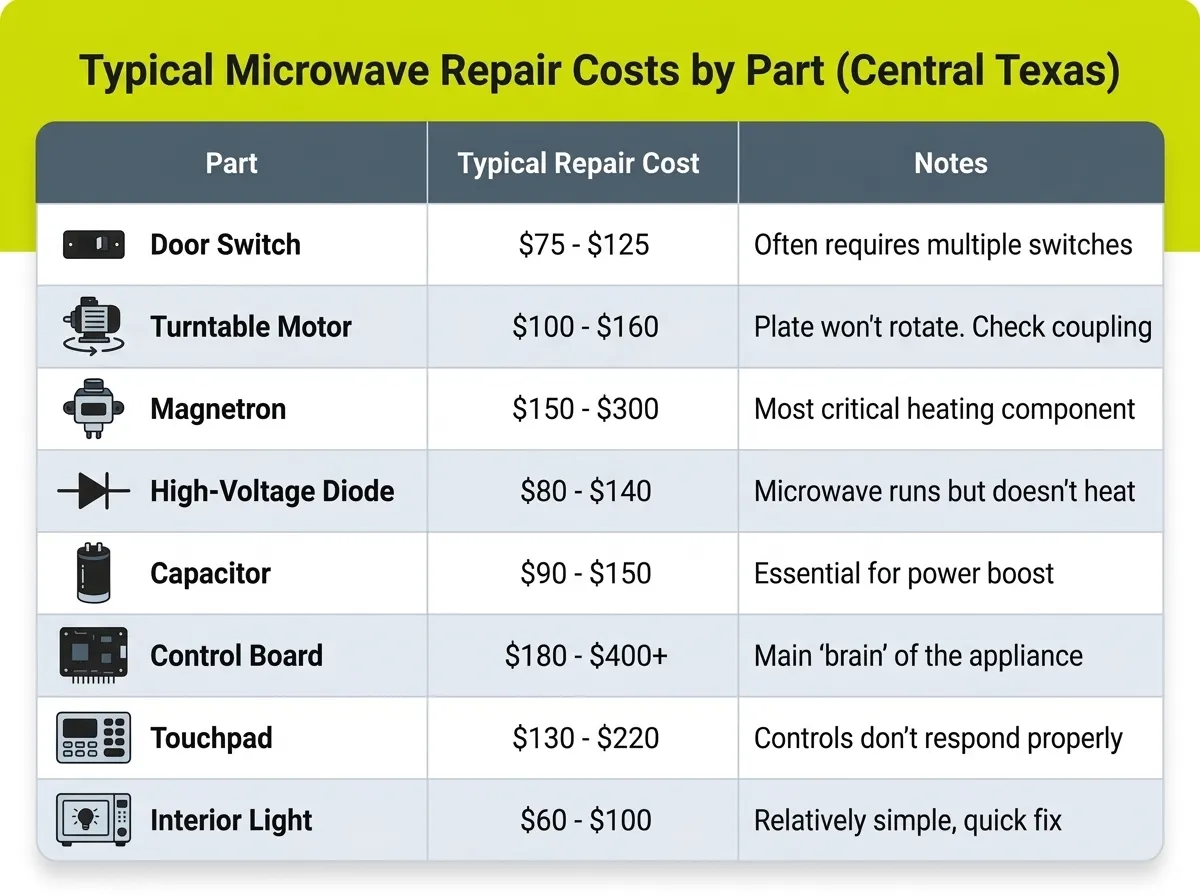
These are typical Central Texas ranges for what actually goes wrong, not quotes — every brand and mount type prices differently, which is why anything you’re asked to pay should arrive as a written number first. Diagnostic visits across the appliance industry usually run $75–$150, and on a countertop microwave that fee alone can be a third of the unit’s value. We’d rather tell you that here than in your kitchen.
| What failed | Typical repair range (Central TX) | Countertop verdict | Over-the-range / built-in verdict |
|---|---|---|---|
| Door switch or latch | $100–$200 | Replace, unless it’s nearly new | Repair |
| Turntable motor | $100–$150 | Toss-up | Repair |
| Magnetron (no heat) | $150–$350 | Replace | Repair if under ~5 years old |
| High-voltage diode | $100–$200 | Replace | Repair if newer |
| Control board | $150–$400 | Replace | Toss-up — get the written quote |
| Cavity rust or arcing burns | Often not repairable | Replace | Replace |
Two patterns worth naming. Repairs on the high-voltage side (magnetron, diode, capacitor) cluster at the expensive end and only pencil out on expensive units. Repairs on the mechanical side (doors, latches, turntables) are cheaper and die-cast into the repair column for anything that’s bolted to your cabinets — because with an over-the-range unit, “just replace it” quietly includes uninstalling and installing, and that changes the whole equation.
Can a Microwave Be Repaired? (Usually — Here’s What Breaks)
Yes, nearly every microwave failure is technically repairable. The question is never can it be fixed; it’s whether the fix costs more than the machine is worth. Four failures cover most of what we hear about:
It runs but won’t heat. The turntable spins, the light’s on, the timer counts down, and your coffee comes out cold. That’s the high-voltage trio — magnetron, diode, or capacitor — and it’s both the most common serious failure and the most dangerous one to chase yourself.
The turntable stopped turning. Usually the least serious problem on this list, and sometimes free to fix. Food heats unevenly, cold in the middle.
The door won’t latch, or the unit won’t start. Microwave doors do a safety job: the interlock switches behind them are what allow the thing to run at all. A door problem that “just needs a little bending” is a problem you don’t freelance — the door assembly is also what keeps microwave energy inside the box, and the FDA sets strict leakage limits on exactly that.
Sparks, buzzing, or burning smells. Sometimes it’s a fork. Sometimes it’s chipped rack paint or a greasy waveguide cover arcing. Sometimes it’s a component failing loudly. Sparking with no metal inside means stop using it until someone looks — a scorched cavity gets worse, not better.
How to Fix a Microwave: The Four Checks That Are Actually Safe
About one “dead microwave” in five is nothing of the sort. Before you spend a dollar, run these — all of them external, none of them involving a screwdriver:
- The outlet, the breaker, and the GFCI. Kitchens run on GFCI-protected circuits, and a tripped GFCI looks exactly like a dead appliance. Press the reset button on the outlet (it may be a different outlet on the same circuit), then check the breaker panel. After the spring storms roll through McLennan County, we hear about a wave of “dead” kitchen appliances that were one reset button away from working.
- The turntable and roller ring. Lift out the glass tray and the plastic roller ring under it. Wash both — dried spills glue rollers in place more often than motors fail. Reseat the tray so it locks onto the center coupler instead of sitting beside it.
- The door and its seal faces. Look for crumbs and grease on the mating surfaces, a sagging hinge, a crack in the latch. Clean, don’t bend. If the latch is visibly broken, that’s a parts repair — priced on the table above.
- The mug test. Heat a mug of water for 60 seconds. Piping hot: your problem is uneven heating, which is usually the turntable or a dirty waveguide cover (the little mica panel inside the cavity — wipe it gently). Lukewarm or cold: that’s the high-voltage side, and your decision moves to the table above.
While you’re in there: if you have an over-the-range unit, the grease filters underneath rinse clean with dish soap, and the charcoal filter behind the vent grille swaps in five minutes. Neither fixes a breakdown. Both make the microwave you keep work like it should.
That’s the end of the safe list. Not the halfway point — the end.
Where You Stop: The Capacitor Is Not a Suggestion
Inside every microwave cabinet is a high-voltage capacitor, and it’s the reason we tell people a microwave is the one appliance you never open — more emphatically than we say it about anything else in your kitchen.
Here’s the plain version. That capacitor stores upwards of 2,000 volts, and it’s built to hold that charge — for hours and sometimes days after the unit is unplugged. Unplugging the microwave does not make it safe. The cabinet screws are not the line between brave and careful; they’re the line between a $150 decision and an emergency room. Discharging a capacitor is a trained procedure with the right tools, and it is nobody’s first YouTube project.
So the stop-lines, and we mean every one
- Never remove the outer cabinet. Not to look, not to test with a multimeter, not because the video made it look quick. The magnetron, diode, transformer, and capacitor all live in there, and the EPA’s guidance on radiation protection is a good reminder that this appliance earns its warning labels.
- Never bend, shim, or “adjust” door hardware or interlock switches. The door is radiation shielding with hinges on it.
- Never run it with a scorched, arcing cavity while you think it over. Unplug it and decide.
- If it sparked, smoked, or smells electrical, it’s done working for the day — the question is only whether a licensed tech or a recycling bin sees it next.
You can check breakers, trays, rollers, filters, and door surfaces. Everything past that is where you stop and call a pro — or skip the call and buy new, which for plenty of microwaves is the honest answer.
When Repair Actually Makes Sense
The repair column earns its keep in five situations:
- It’s an over-the-range, drawer, or built-in unit. Replacement means $400–$1,500 plus installation, plus matching the finish of the appliances around it. A $180 door-switch repair on a $700 OTR unit is easy math. This is also where a microwave failure is worth mentioning when you already have someone out for oven and stove repair — built-in microwaves often share a wall cavity, a circuit, and a trim kit with the wall oven, and one visit beats two.
- It’s under five years old and it wasn’t cheap. Quality units justify mid-range fixes.
- The failure is mechanical. Doors, latches, turntable motors — the affordable end of the table.
- It’s still under warranty. Magnetrons in particular often carry longer manufacturer warranties than the rest of the unit — check your paperwork before paying anyone.
- Matching matters. A discontinued finish on a built-in suite can make a $250 repair cheaper than the remodel-scale alternative.
Say your five-year-old OTR unit quit heating the week your in-laws arrive for a Baylor game weekend. The magnetron swap quotes at $280; the matching replacement is $649 plus install, and it’s backordered. That’s a repair, and it’s not close.
When Replacement Wins
- It’s a countertop unit that cost under $150. The $150 rule, again. This is most microwaves in most kitchens, and no repair visit changes the math.
- It’s 8–10 years old, whatever the mount. You’d be putting a new engine in a car with no doors.
- The cavity is rusting or burn-scarred. Interior coating failures aren’t economically repairable, and arcing over bare metal only escalates.
- It’s the second failure. A control board after a door switch means the unit is telling you something. Believe it.
- The quote crosses half the replacement cost. Our written quotes exist exactly so you can do this comparison before any work happens — that’s the point of putting the number on paper.
One honest trade-off to know about the replacement route: new budget microwaves aren’t built to outlast your mortgage either. If you replace a $90 unit every 6–8 years, you’re doing it right — that’s the design economy of the category, not bad luck.
How Long Do Microwaves Last?
Plan on 7–10 years. Industry references like InterNACHI’s appliance life-expectancy chart put the average at about nine, and that squares with what shows up on kitchen counters around Waco and Temple. Heavy use shortens it. So do habits: running it empty stresses the magnetron with nowhere for the energy to go, slamming the door beats up the interlocks, and letting splatter bake on turns the waveguide cover into an arc lamp.
Central Texas adds one quirk of its own — power. Spring storm season flickers and the occasional grid hiccup are hard on control boards, which is why a dead display after an outage is such a common story here. A $20 surge protector under the counter is the cheapest microwave insurance sold, provided the unit is a countertop model (OTR units on dedicated circuits are a different conversation).
None of that changes the decision framework. It just moves the date you’ll use it.
If You Replace It: What 2026 Prices Look Like
Typical retail lanes, so the repair quote has something honest to stand next to:
| Type | Typical 2026 price | Notes |
|---|---|---|
| Countertop | $60–$250 | The $150 rule lives here |
| Over-the-range | $250–$600 | Plus roughly $100–$200 installation |
| Drawer / built-in | $500–$1,500+ | Trim kits and cutout sizes matter |
If you’re replacing an over-the-range unit, measure the cutout and check the mounting-plate style before you buy — “standard” is a loose term in kitchens older than about 2005, which describes a lot of housing stock in Waco proper. And if you’re not sure whether the rest of the aging kitchen lineup is next, our guide on whether an appliance is worth repairing or replacing applies the same honest math to the fridge, the dishwasher, and the rest.
FAQ: Microwave Repair or Replace
Can a microwave be repaired? Almost always, technically — doors, switches, turntable motors, magnetrons, and boards are all replaceable parts. Whether it’s worth repairing depends on the unit: usually yes for over-the-range and built-in models under ~8 years old, usually no for countertop units that cost less than $150 new.
Is a microwave worth fixing if it won’t heat? Not heating usually means the magnetron, diode, or capacitor — $100–$350 territory. On a countertop unit, replace it. On a newer over-the-range or built-in model, get a written quote; the repair often beats $400–$1,500 plus installation.
How much does microwave repair cost? Typical Central Texas ranges: $100–$200 for door switches or diodes, $100–$150 for turntable motors, $150–$350 for a magnetron, $150–$400 for a control board — plus an industry-standard diagnostic visit around $75–$150. Always get the number in writing before work starts.
Why is my microwave running but not heating? The lights, fan, and timer run on ordinary house voltage, but the heating happens on a separate high-voltage circuit — magnetron, diode, capacitor. When that side fails, everything looks normal and nothing gets hot. It’s the classic serious microwave failure, and it’s not a DIY diagnosis.
Is it dangerous to fix a microwave yourself?
Yes — uniquely so. The high-voltage capacitor holds a multi-thousand-volt charge even after the unit is unplugged, and the door assembly is engineered radiation shielding. Cleaning trays, rollers, filters, and door surfaces is safe. Opening the cabinet is not, full stop.
How long do microwaves last?
About 7–10 years on average — call it nine. Age is half the repair-or-replace decision: a $200 fix on a 9-year-old unit buys you the oldest microwave on the block, not a new lease on life.
The Straight Answer, In Person
Run the four safe checks, apply the $150 rule, and let the table do the deciding. If the math says replace, we just saved you a service fee — spend it on the nicer unit.
And if you’re staring at a repair quote on any kitchen appliance and something about it smells off, that’s what free second opinions are for. Our guide to avoiding overpaying and dodging dishonest appliance techs covers the red flags, and anywhere around Waco, McGregor, Temple, Belton, China Spring, Robinson, Lorena, Moody, Crawford, or Troy, you can call for a straight answer and a written quote before anyone touches anything. Same-day availability when the schedule allows, and seniors and military take 10% off repairs.
On Point Service Company is a family-owned HVAC and appliance repair company in McGregor, TX, serving the greater Waco area with 20+ years of combined experience. Licensed & insured · TDLR License TACLB00069239E ·