


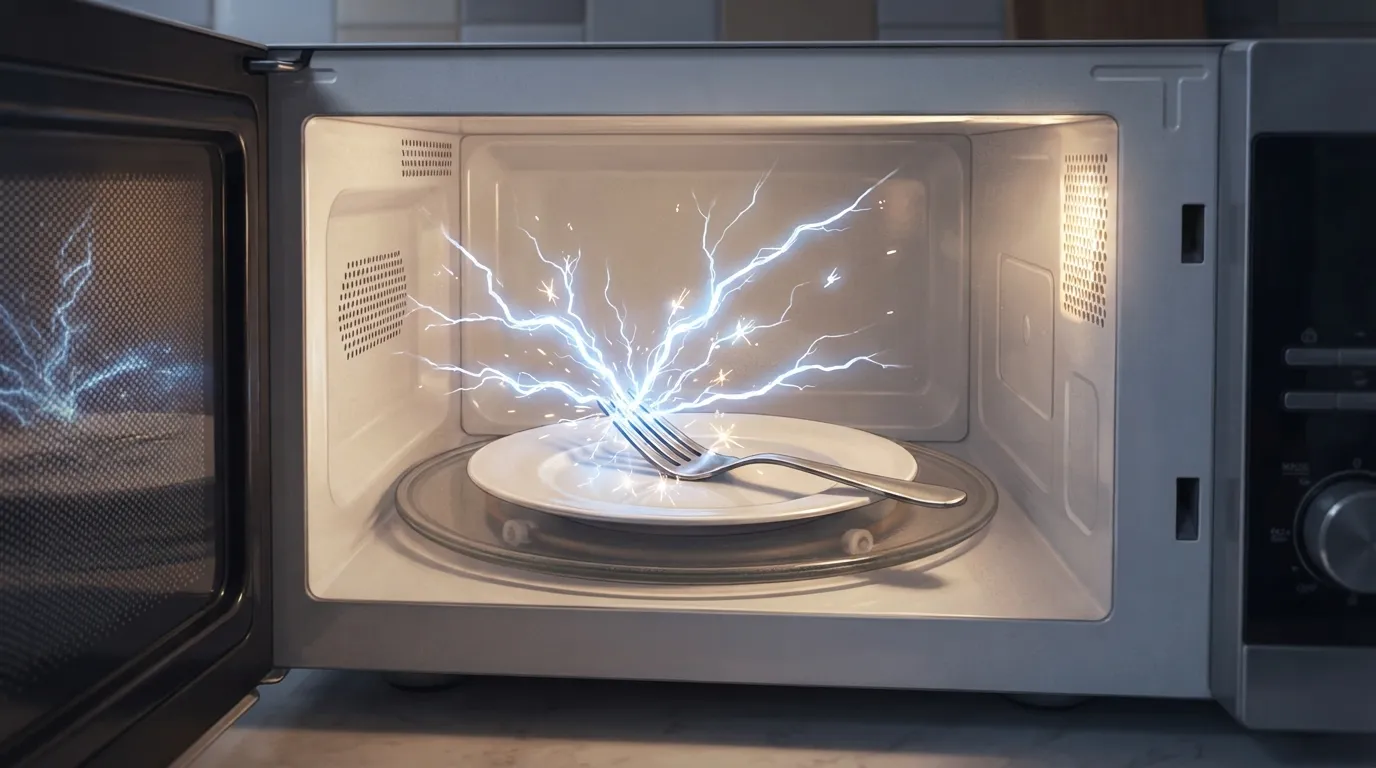
You put metal in the microwave, it sparked like a tiny thunderstorm, and now you’re wondering what it cost you. Probably nothing. A few seconds of arcing almost never kills a microwave; the machine’s own walls are metal, after all. Run the five checks below and you’ll know in about five minutes whether yours shrugged it off, which is the usual outcome, or actually took damage.
Why metal sparks in there at all
Microwaves work by bouncing energy around a sealed metal box until your food absorbs it. The walls handle that fine because they’re smooth, grounded sheets. A fork is a different animal: thin points and sharp edges concentrate the energy until it jumps through the air as a spark. Same reason lightning hits antennas instead of parking lots.
That’s why a spoon often sits in a mug of soup without drama while a fork puts on a light show, and why crumpled foil is the worst offender in the building. Points and edges make arcs. Arcs scorch whatever they land on.
The sparks themselves aren’t little explosions inside the machinery. They’re surface events. The question is only whether one of them burned something that matters, and that’s checkable from the outside.
The 5-minute damage check
Unplug it first, then work down the list.
- Scan the walls and ceiling. Look for pit marks, black scorch spots, or bubbled paint, especially near where the metal sat. Tiny gray pinpricks are cosmetic. Exposed bare metal under chipped paint matters more; note it.
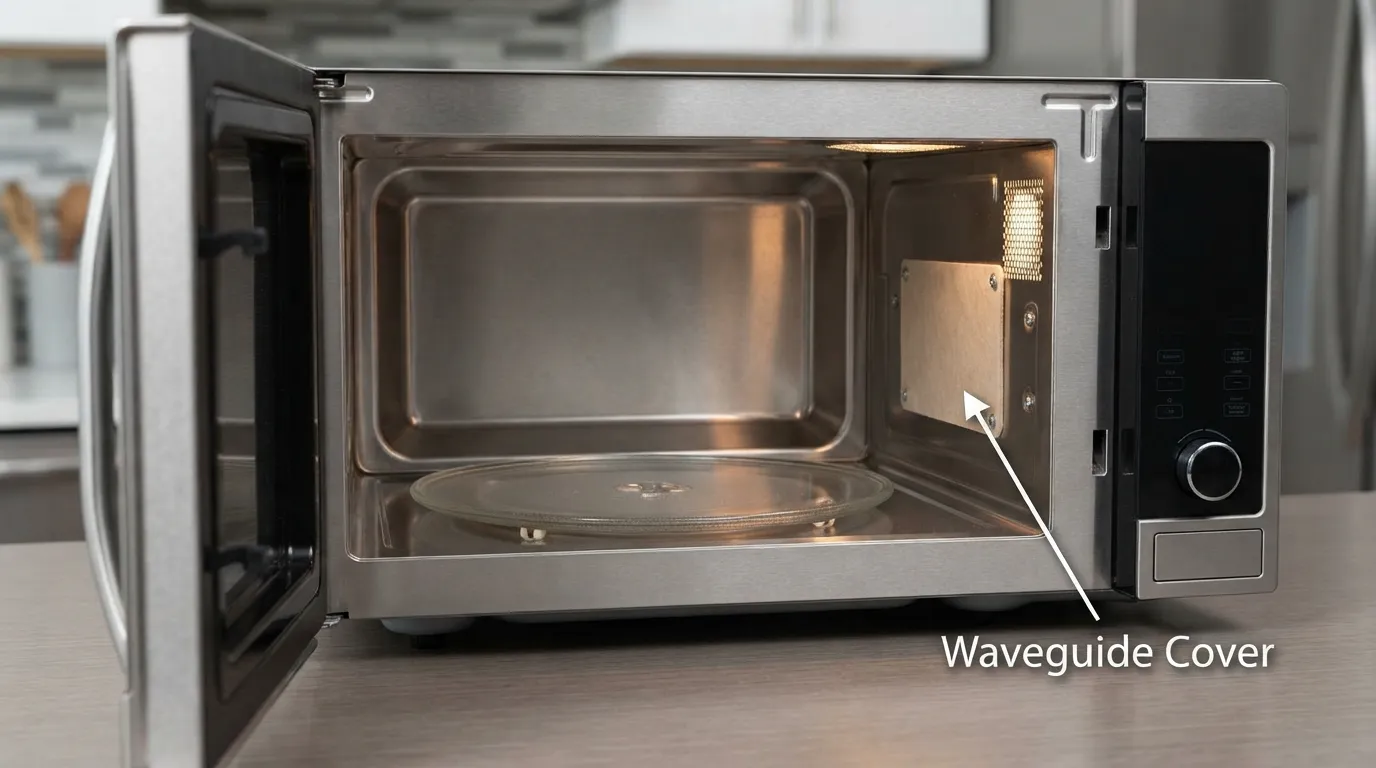
- Find the waveguide cover. It’s the small rectangular panel on the inside wall, usually the right side, often a slightly rough cardboard-like material (mica). This is the part that actually takes the hit. Look for burn marks, holes, or charring.
- Sniff. A faint ozone smell right after arcing is normal and fades. A persistent burnt-electronics smell that’s still there an hour later is a bad sign.
- Glance at the door glass and seal. Arcing near the door is rare, but check the mesh screen in the glass for burn marks. That mesh is part of what keeps the energy inside.
- Run the water test. Plug it back in, heat one cup of water for 60 seconds. It should be steaming-hot and the machine should sound like it always has. Hot water, normal hum, no new sparks: you’re done. Go live your life.
Most people clear all five. If you didn’t, here’s what the failures mean.
What the results mean
Scorched or holed waveguide cover. The most common real casualty, and the reason we said “note it.” A burned mica cover keeps arcing every time you cook, because the char itself conducts. The part costs a few dollars, but on many models replacing it properly (and confirming nothing behind it burned) means service, not a shopping cart. Keep reading for where that math lands.
Water stays cold. The arc found something in the heating circuit, most likely the magnetron’s era ended. That’s the exact territory of our microwave not heating guide, and the honest answer there applies here: for most countertop units, that repair costs more than the machine.
Sparks with nothing metal inside. Stop using it. Recheck the cavity for a forgotten twist-tie or a chipped rack support, and if it’s genuinely empty and still arcing, the char or a damaged cover is doing it. Unplug it until someone looks at it.
Where you stop, every time
Nothing behind the shell. A microwave cabinet hides a high-voltage capacitor that can hold a lethal charge for days after unplugging, and no $8 mica panel is worth testing that. External checks like the five above are safe; screwdrivers are not. If yours failed the check, the next step is a phone call, not a teardown. Our microwave repair guide draws the same line for every microwave symptom, and it’s the hardest line we publish.
And the money side, told straight: a $70–$150 countertop unit that failed the water test isn’t worth a service ticket. Replace it without guilt. An over-the-range or built-in unit is a different conversation, and a free second opinion beats guessing. We’d rather talk you out of a repair than sell you one that doesn’t pencil.
So can metal ever go in the microwave?
Short answer: sometimes, but the manual decides, not the internet.
Stainless steel? Cookware and travel mugs, no. They block the energy from reaching the food and invite arcing at edges. The exception: the metal racks that shipped inside some over-the-range models are engineered and positioned for that specific cavity. Factory rack, fine. Random steel bowl, no.
Aluminum foil? The USDA’s microwave guidance allows small, smooth, flat pieces for shielding thin edges of food. Honestly, skip it anyway. Crumpled edges arc, and every game-day weekend we hear about a foil-wrapped brisket plate that lit up somebody’s microwave in Waco. Transfer the food; it takes ten seconds.
The microwave safe symbol? Wavy horizontal lines on the bottom of a dish. It means the container itself won’t overheat, leach, or arc. No symbol doesn’t automatically mean unsafe, but with metallic-painted ceramics (that gold rim is real metal), assume trouble.
Common questions about a microwave that won’t heat
How do you fix a microwave after putting metal in it?
Usually you don’t have to. Remove the metal, wipe out any soot, and run the one-cup water test. If it heats normally with no new arcing, there’s nothing to fix. If the waveguide cover is scorched or the water stays cold, it needs a tech’s eyes, and on cheap countertop units, replacement usually beats repair.
Is it safe to use the microwave after it sparked?
If it passed the five checks (no scorched cover, no burnt smell, heats water, no spontaneous sparking), yes. Arcing is a surface event, not a countdown timer. If it failed any check, unplug it until it’s been looked at.
Can metal in the microwave break it?
It can, but it usually doesn’t. The realistic casualties, in order: the mica waveguide cover, cosmetic wall scorching, and (rarely) the magnetron if arcing was prolonged. A few seconds of fork lightning almost never totals the machine.
Where to go from here
Run the water test before you spend a dollar or a worry. If it failed, decide by price bracket, and if it’s a built-in or the sparks came with a side of burnt smell, get a free second opinion or call . If the real problem turns out to be the oven or range beside it, that’s our lane too, written quote first, like always.
The On Point Team · On Point Service Company — family-owned HVAC & appliance repair, McGregor, TX · Serving Waco, Temple, Belton, and surrounding Central Texas towns · Licensed & insured, TDLR License TACLB00069239E ·