


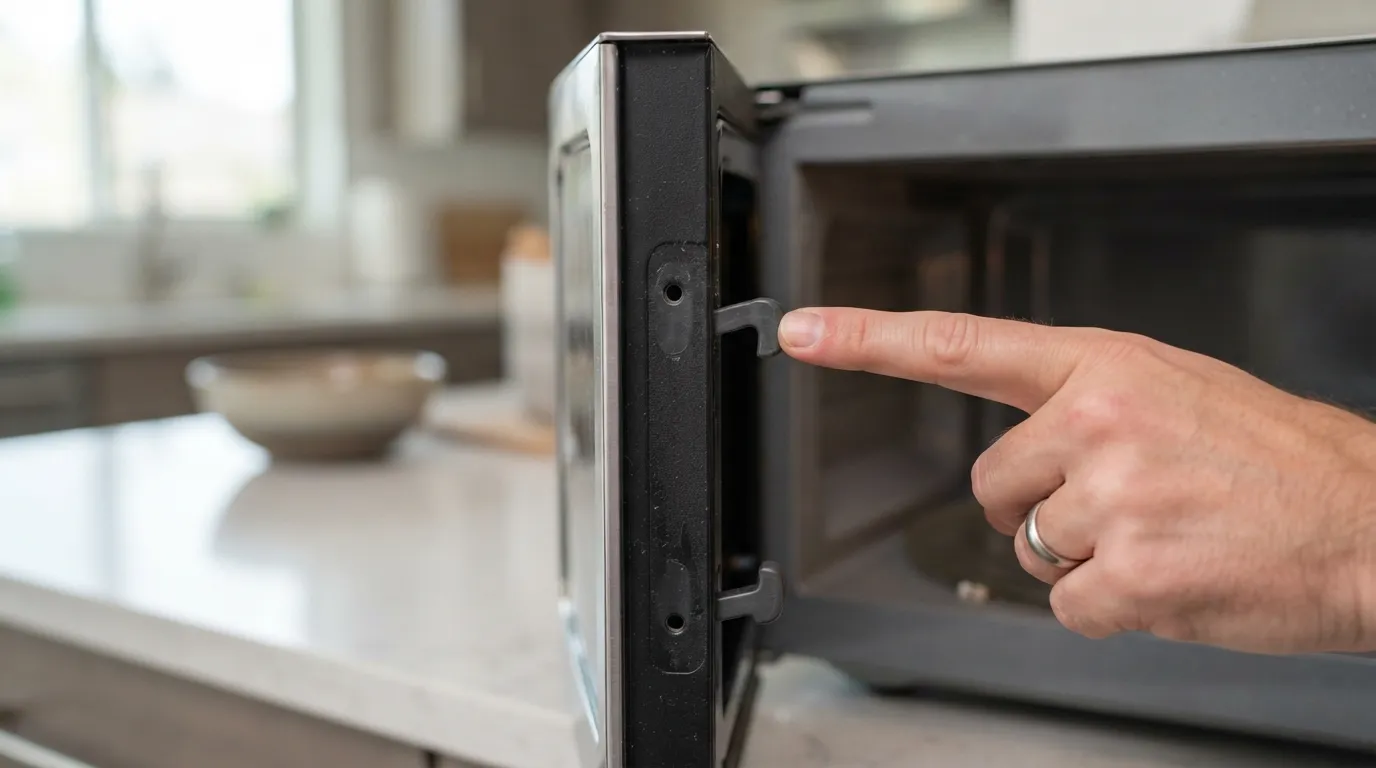
A microwave door that won’t close is usually one of four things: food debris packed into the latch, a cracked latch hook, a sagging hinge, or a warped door. And a door that won’t close is why a microwave won’t start, because the door is the safety system. Until three hidden switches agree the door is fully shut, the machine refuses to make heat. Check the cheap stuff below first. Most of the time the fix costs nothing.
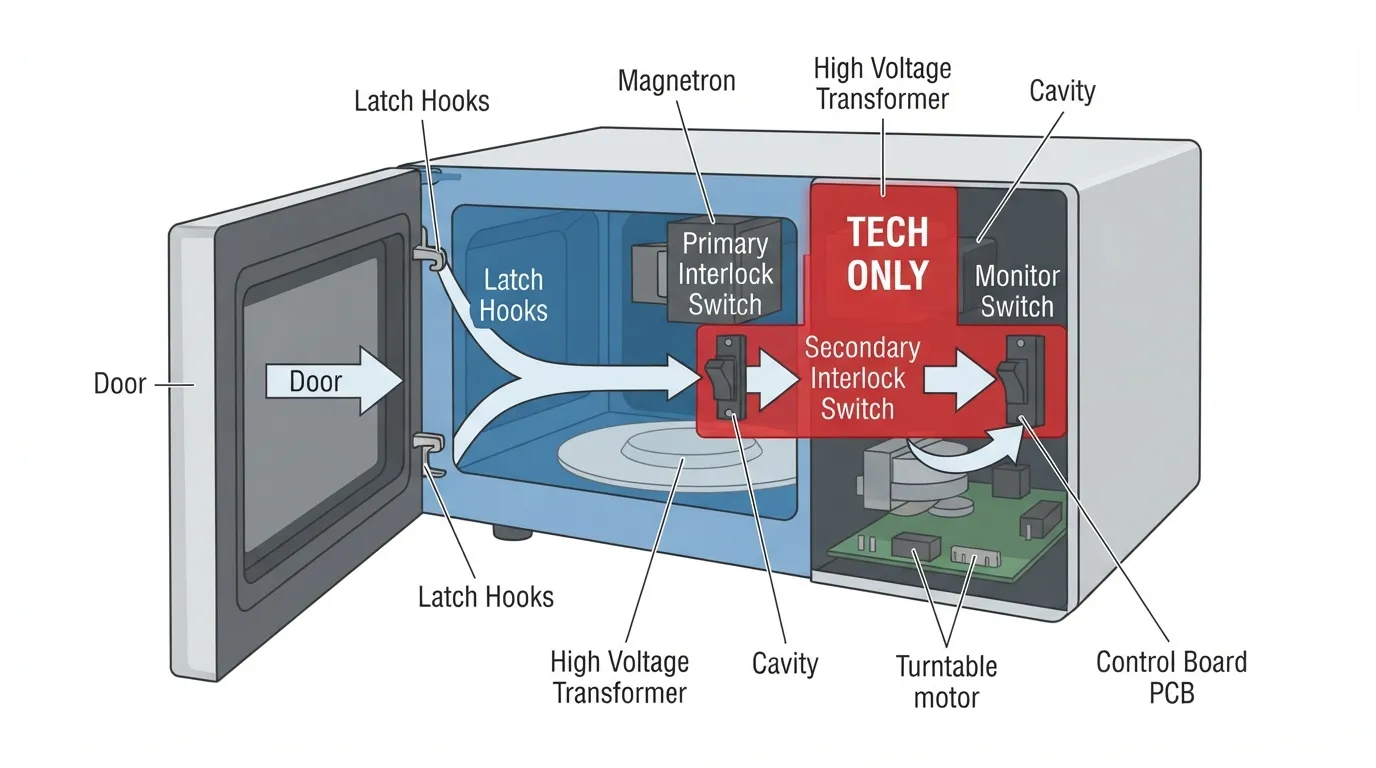
The door is the off switch. Literally.
Every microwave sold in the US has door interlock switches, usually three, buried behind the front panel. When you shut the door, the latch hooks press those switches in a set order, and only then will the unit run. It’s a federal design requirement, and the FDA’s microwave guidance explains why: the interlocks exist so the machine physically can’t cook with the door open.
That design has a side effect. A door problem doesn’t always look like a door problem. Sometimes the door seems to close fine, but a worn hook isn’t pressing its switch anymore, so the display works and the microwave just won’t start. If you came here from that symptom, you’re in the right place too.
One warning before the checklist, because it matters: never tape, wedge, or trick a microwave door into “closed.” Those switches are the thing standing between you and a machine that runs open. Work with the safety system, not around it.
Five checks that don’t need a screwdriver
Do these from the outside. Every one of them is free.
- Clean the latch pocket. Crumbs, grease, and one renegade Cheerio can keep a hook from seating. Wipe out the slots on the frame where the hooks land, and clean the hooks themselves. You’d be amazed how often this is the whole repair.
- Look at the latch hooks. Open the door and press each plastic hook with a finger. They should feel spring-loaded and snap back. A hook that flops, sticks, or shows a visible crack is your culprit.
- Close it and count the clicks. A healthy door gives a firm, positive click (some give two). A door that needs a shove, or bounces back open, is telling you where to look.
- Sight the hinges. Close the door and step to the side. If the top corner sits proud of the cabinet while the bottom tucks in, or the gap around the door is uneven, the hinge side is sagging or the door has warped.
- Test the release button. On push-button models, the button lifts the hooks through a spring linkage. If the button feels dead or gritty, the linkage behind it may have slipped, and the door was never the problem.
Still won’t close, or closes and still won’t start? Then something inside has actually failed, and here’s where we draw the line.
Where you stop and call a tech (the interlock line)
For ovens and dryers we’ll happily walk you through more. For microwaves, the checklist above is the whole list, and it ends at the outer shell.
Replacing a latch hook, a door switch, or a hinge means opening the cabinet. Inside that cabinet is a high-voltage capacitor that holds a charge measured in thousands of volts, for days, even with the unit unplugged. Unplugging it does not make it safe. This is the one appliance in your kitchen where a confident YouTube afternoon can be fatal, which is why our microwave repair guide repeats the same line: nothing behind the shell is a homeowner job.
The interlock switches get one extra sentence, because people love to bypass them. A microwave with a jumped or misadjusted door switch can run with the door ajar, and that’s not a money problem anymore. That’s a “microwave radiation and your eyeballs” problem. Don’t.
The honest math on microwave door repair
Here’s the part the latch-kit listicles skip.
The parts are cheap. A latch hook or a door switch is a $10–$30 part almost everywhere. The repair still doesn’t pencil out for most countertop units, because bench time is the real cost: professional microwave door repair typically lands between $100 and $200 in Central Texas once diagnosis and labor are counted. A basic countertop microwave runs $60–$150 new at any big-box store in Waco.
So we’ll say what a repair company probably shouldn’t: if it’s a $90 countertop unit with a broken latch, that latch is a death sentence. Recycle the machine at the city e-waste drop-off and spend the repair money on one with a better door. We’d rather lose that ticket than have you pay more than the microwave is worth. It’s the same math as a microwave that runs but won’t heat, and it flips the same way.
When the repair wins: over-the-range units, drawers, and built-ins. Those run $400 to well past $1,000 installed, and a door repair on a $900 built-in is easy money in the other direction. Folks from Lorena to China Spring call us for exactly this second opinion every month, and about half the time the answer is “fix it.”
If what’s actually acting up is the bigger stuff, our oven and stove repair crew handles that lane every week, with a written quote before any work.
Common questions about a microwave that won’t heat
Why won’t my microwave door close?
Nine times out of ten: debris in the latch pocket, a cracked latch hook, or a sagging hinge. Clean the latch area and inspect the hooks first. If a hook is visibly broken or the door sits crooked, the door needs service, not force.
Why won’t my microwave start if the door seems closed?
A worn hook or failed interlock switch. The door has to press internal switches in sequence before the microwave will run, so “won’t start” is often a door problem wearing a disguise. If the display works but nothing happens when you hit start, suspect the door first.
Can I use a microwave if the door doesn’t close properly?
No. It usually won’t run anyway, and you should never rig it to. The door and its switches are the safety system that keeps microwave energy inside the box. A unit that runs with a compromised door needs to be unplugged and repaired or replaced, full stop.
How much does microwave door repair cost?
The typical range in our area is $100–$200 for latch or switch work on common models, parts included. That’s more than most countertop microwaves cost new, which is why we usually reserve door repair for built-in and over-the-range units.
Where to go from here
Clean the latch, check the hooks, count the clicks. If the door still won’t close, decide by price bracket: countertop under $200, replace it guilt-free; built-in or over-the-range, get a free second opinion or call before you buy anything. You’ll have a straight answer and a written quote before anyone spends a dollar.
The On Point Team · On Point Service Company — family-owned HVAC & appliance repair, McGregor, TX · Serving Waco, Temple, Belton, and surrounding Central Texas towns · Licensed & insured, TDLR License TACLB00069239E ·