





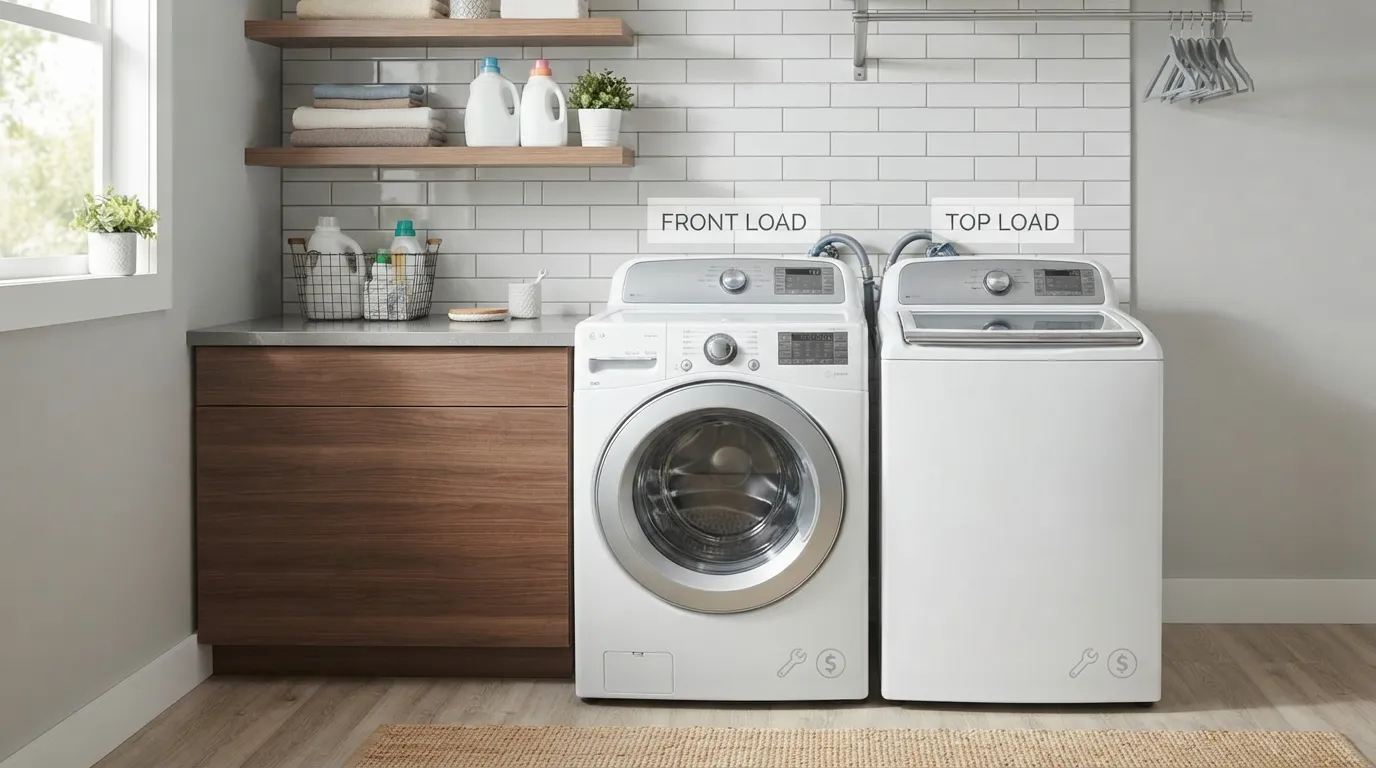
Here’s the front load vs top load washer question answered from the repair van instead of the showroom: top-loaders are cheaper to fix, and it isn’t close. Front-loaders wash better and sip water, but their three signature failures (drum bearings, door boots, and mold) cost more than anything a basic top-loader is likely to throw at you.
That doesn’t make the front-loader the wrong buy. It makes it a machine you’re agreeing to maintain. Here’s the comparison sales floors skip, with typical Central Texas ranges so the numbers mean something.
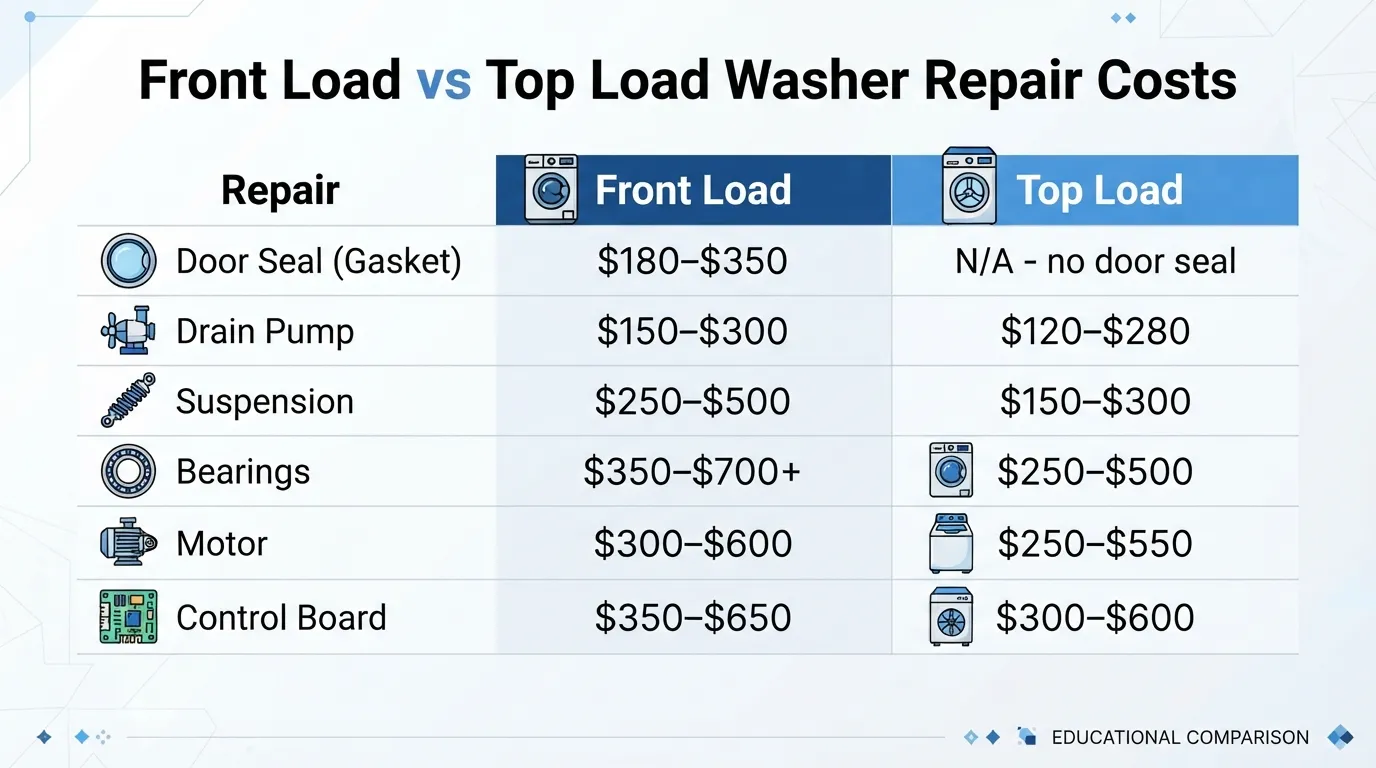
Front load vs top load repairs, side by side
Ranges below are industry-typical for our area, parts and labor together, for budgeting rather than quoting. Your machine’s real number comes in writing, before any work.
| Failure point | Front-loader | Top-loader | The pattern |
|---|---|---|---|
| Drum bearings | $300–$500+ | $200–$400, and rarer | Sideways drum carries the load on its bearings |
| Door boot / lid switch | $150–$300 (boot) | $100–$200 (switch) | Boots tear and mold; switches just die |
| Mold and odor | $0 in habits, teardown money if ignored | Rare | Sealed door + horizontal drum |
| Suspension | $150–$300 (shocks) | $150–$300 (rods) | Roughly a tie |
| Drain pump | $150–$350 | $150–$350 | A tie; both eat socks |
| Control board | $250–$500 | $250–$500 | Electronics don’t care which way the drum faces |
Read the table bottom-up and the story’s clear. The shared parts cost the same. The differences all live in the front-loader column, and they’re the expensive rows.
Why front-loaders cost more when they break
Physics, mostly. A horizontal drum hangs its full soaked weight on the rear bearings every second it spins, and when those bearings fail, the repair means splitting the machine’s tub. That’s why the range starts at $300 and why, on a mid-priced machine past eight years, we often quote it honestly and then recommend against it.
The door boot is the other budget line nobody plans for. That big rubber bellows seals a door that gets slammed, snagged by zippers, and colonized by mildew, and it’s a wear item the same way tires are.
And mold deserves its own sentence, because it’s the failure that isn’t one. A front-loader that stinks hasn’t broken; it’s been sealed up wet a few hundred times. The fix is habits and a monthly clean, and we laid out the whole washer cleaning and maintenance routine precisely because it’s the difference between a great front-loader and a regretted one.
Why top-loaders break cheaper
Gravity does the sealing. No boot, no sealed wet box, no mold career. The lid switch that replaces all that drama is a $100-class part.
The drum sits upright on suspension rods that cost little and forgive a lot, and most components are reachable without splitting the machine, which shows up as fewer labor hours on the invoice. Simple machine, simple bills.
The trade-offs run the other way, and they’re real: a top-loader uses noticeably more water per load, cleans heavy soil a little worse, and an old-style agitator is hard on delicates. Cheap to fix has never meant better at washing. It means the ownership math is friendlier, especially past year eight.
The tiebreakers that actually decide it
Where the machine lives. Upstairs laundry, like most of the newer two-story builds around China Spring, argues for whichever machine shakes least, and a front-loader at high spin on a wood subfloor needs its suspension healthy and its feet perfect. Our washer shaking checklist applies to both types, but second-floor front-loaders get first call on it. The narrow laundry alcoves in older Waco houses sometimes make the decision by tape measure instead.
Our water. Central Texas hard water scales heating elements and inlet valves on both types with perfect fairness, so what hard water does to appliances belongs in either machine’s file. Front-loaders’ lower water use means slightly less mineral throughput; call it a minor point in their favor.
How long you keep machines. If your family runs appliances to 12 years and beyond, the simpler machine ages cheaper. If you trade at 7 or 8, the front-loader’s big-ticket years may never arrive on your watch.
Electronics. Either type can be bought plain or loaded. Every app-connected extra is another board that can fail, and boards are the priciest row on the table. Buy the drum, skip the dashboard. That’s an opinion, and we’ll keep it.
Our honest pick, and the fine print
For most households that just want the lowest lifetime repair bills: a plain, well-reviewed top-loader, no agitator tower, minimal electronics. It’s the machine we’d put in a rental in Belton or a first house in Robinson without a second thought.
Pick the front-loader if the washing quality and water savings matter to you AND you’ll honestly do the two-minute habits: door cracked open, gasket wiped, monthly hot clean. Kept that way, front-loaders are excellent machines, and the ENERGY STAR clothes washer data backs the efficiency case. Just size the savings honestly; it’s utility-bill money, real but modest, never a payment plan for a pricier machine.
And the fine print from the repair side: whichever type you own right now, don’t replace it over one scary quote. Bearings, boards, and boots all have prices where repair still wins, and a written quote with a straight answer costs you nothing but the trip fee to find out which side of the line you’re on. Free second opinions are our standing policy for anyone told their machine is done.
Common questions about front load vs top load washers
Which is more reliable, a front load or top load washer?
Are front load washers more expensive to repair?
Do front load washers still have mold problems?
Which type of washing machine lasts longer?
Where to go from here
Buy the top-loader for cheap ownership, buy the front-loader for wash quality plus a promise to maintain it, and buy either one plain. If you’re reading this because your current machine is mid-breakdown, get a straight answer before you spend anything or call . We fix both types across the Waco area, and we’ll tell you honestly when fixing is the wrong answer.
The On Point Team · On Point Service Company — family-owned HVAC & appliance repair, McGregor, TX · Serving Waco, Temple, Belton, and surrounding Central Texas towns · Licensed & insured, TDLR License TACLB00069239E ·