




A dryer not heating but still tumbling usually comes down to three suspects: a lint-choked vent that made the thermal fuse blow, a burned-out heating element on electric models, or a failed igniter on gas. Check the vent first, because a blocked vent is what kills fuses and elements in the first place.
That order will save you real money. Here’s the full diagnosis, plus the exact point where you should put the screwdriver down.
The good news about a dryer that spins but won’t heat
If the drum turns and the timer counts down, the expensive half of your machine is fine. Motor, belt, rollers, controls: all working. The heat side of a dryer is a short list of modest parts, and no-heat calls sit at the cheap end of dryer repair as a category.
So don’t shop for a new dryer yet. Most of these end in a part, an hour, and a lesson about lint.
One caveat before the checklist: electric and gas dryers fail differently, and one check below applies only to electric machines. It happens to be the fastest one.
Check the breaker first (electric dryers, 60 seconds)
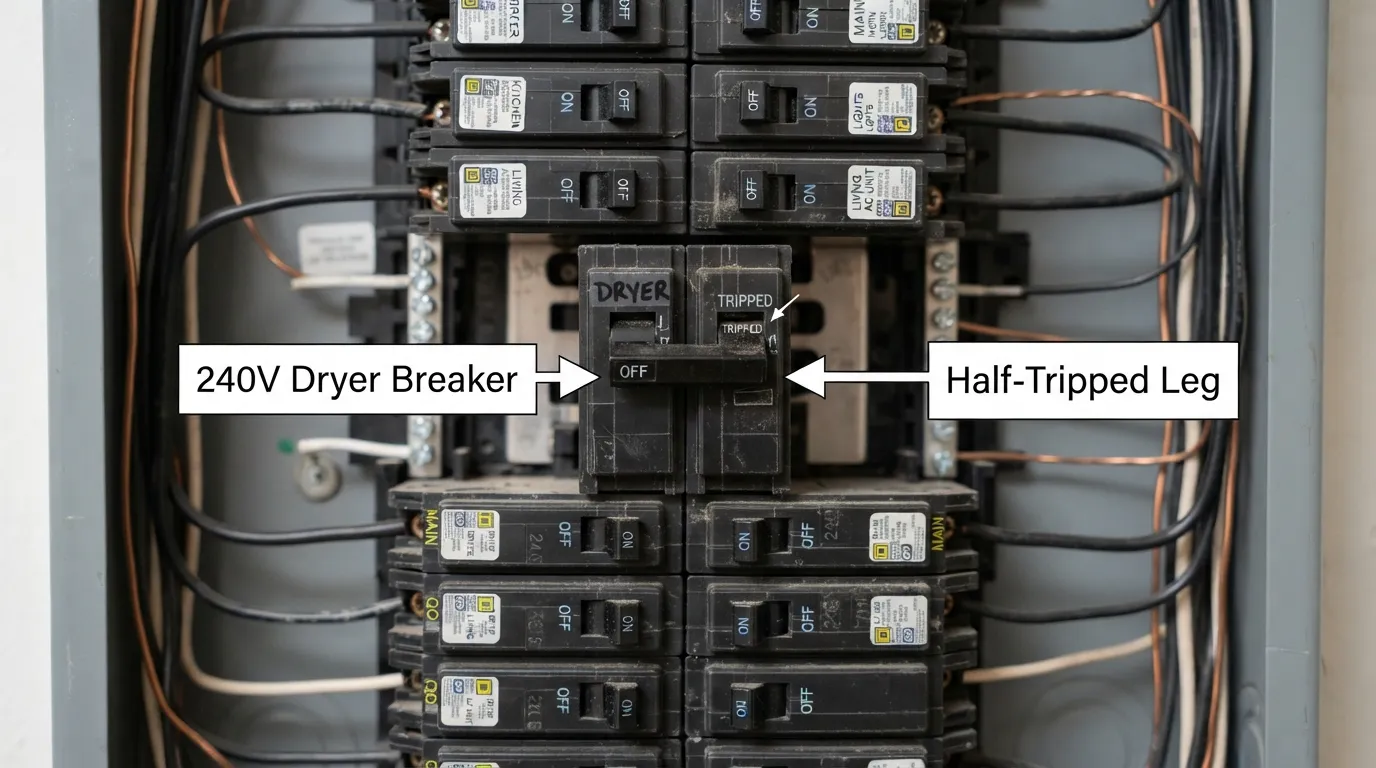
Electric dryers run on a double 240-volt breaker, and here’s the trick: the heating element needs both halves, while the motor runs on one. When a single leg trips, you get this exact symptom. Drum spinning, air cold.
Flip the dryer’s breaker fully off, then fully on. Don’t just eyeball it; a half-tripped double often looks untouched. If heat comes back, you’re done, and if the breaker pops again, stop there. A breaker that won’t stay on is protecting you from something, the same rule we gave for an AC that keeps tripping its breaker, and resetting it over and over isn’t a fix.
Gas dryer? It plugs into a normal outlet, so check the plug is seated and the outlet works. That’s the whole electrical check for gas machines.
The vent is the usual villain, and it frames the other two
A dryer doesn’t dry with heat alone. It pushes hot, wet air out through the vent, and when lint chokes that path, heat piles up inside the cabinet until the safety hardware shuts it down on purpose. That’s the sequence behind most no-heat dryers: slow loads for months, then one day, cold air.
The tell is history. If your loads were already taking two cycles to finish before the heat quit, this is a vent story until proven otherwise.
You’re allowed to do every bit of this check yourself. Unplug the machine, pull it away from the wall, detach the duct, and clear the lint from both the duct and the port on the dryer’s back. Then find the outside flap and clean that end too. In a Central Texas August the laundry room is already pushing 90, so pick a morning, bring a shop vac, and expect to be mildly horrified by what comes out.
And the part we say calmly, once: lint is kindling. The Consumer Product Safety Commission has warned about lint-fed dryer fires for years, which is exactly why every safety device in the machine is built to fail toward “no heat.” A dryer that quit heating did its job. Clean the vent before you restore the heat.
The thermal fuse: a one-time safety that never forgives
Somewhere in the airflow path sits a thermal fuse, a small part with one job. If the air gets dangerously hot, it blows, and once blown it never resets. On a lot of Whirlpool-built machines it lives on the blower housing; other brands tuck it near the element or the burner. Same idea everywhere.
Here’s the opinion that saves people a second breakdown: replacing a thermal fuse without cleaning the vent is the most wasted repair in the laundry room. The fuse didn’t fail. It reacted. Put a new one in the same clogged machine and you’ve scheduled a rerun, usually within a month or two.
Testing the fuse means opening the cabinet and working a meter around wiring, and that’s past the DIY line we’re comfortable drawing for you. One thing we’ll say in writing: never bypass or jumper a thermal fuse to “test” the dryer, no matter which video makes it look harmless. That fuse is the only thing standing between a clogged dryer and the fire statistics.
Elements and igniters, in plain English
Electric machines heat with a coiled element that simply breaks with age, the way a light bulb does. The symptom is clean: everything runs normally and the air never warms. Overheating from a blocked vent shortens an element’s life too, which is why the vent keeps showing up in this story.
Gas machines light a burner instead. An igniter glows orange, a valve opens, flame heats the air. When the igniter weakens or the valve’s coils die, you get clicks and glow but no heat, sometimes visible through the lower grille. Looking is fine. Everything past looking involves the gas line, and that’s a hard stop, no exceptions, not even for the confident.
What a no-heat fix typically costs around Waco
Industry-typical Central Texas ranges, parts and labor together: a thermal fuse replacement usually lands between $100 and $200, a heating element between $150 and $300, an igniter about the same, and a professional vent cleaning between $100 and $200. Typical ranges, not our menu. The real number for your machine comes as a written quote before any work starts, so you can say no without owing anything but the trip fee.
Repairs carry our 10% senior and military discount, and same-day slots are often available from Waco down to Temple and Belton.
Now the honest trade-off. If your vent run is short and you can pull the dryer out yourself, do the vent before you call anyone, including us. Paying a service fee to remove lint you could reach is a bad deal, and we’d rather you spend the visit on parts that actually need a meter. Plenty of Lorena homeowners have fixed a “dead” dryer with ten minutes and a shop vac, and it’s the right outcome.
Where you stop and call a licensed tech
You handle: the breaker flip, the plug check, the lint trap, the vent run, the outside flap.
A tech handles: anything behind the cabinet panels, fuse and element testing, every part on the gas side, and any breaker that re-trips after one reset. Add one more: a burning smell that stays after the lint is gone. That’s a stop-everything symptom, and we mean today, with the dryer off.
Common questions about a dryer that won’t heat
Why is my dryer running but not heating?
Can a clogged vent stop a dryer from heating?
How much does it cost to fix a dryer that’s not heating?
Should I just replace a dryer that won’t heat?
Where to go from here
Breaker, vent, then the phone. You’ll fix a surprising share of no-heat dryers with the first two, free. If the air’s still cold after that, get a straight answer from a real person or call , tell us what the drum’s doing, and we’ll tell you honestly whether it’s a fuse-and-vent morning or something bigger.
The On Point Team · On Point Service Company — family-owned HVAC & appliance repair, McGregor, TX · Serving Waco, Temple, Belton, and surrounding Central Texas towns · Licensed & insured, TDLR License TACLB00069239E ·