


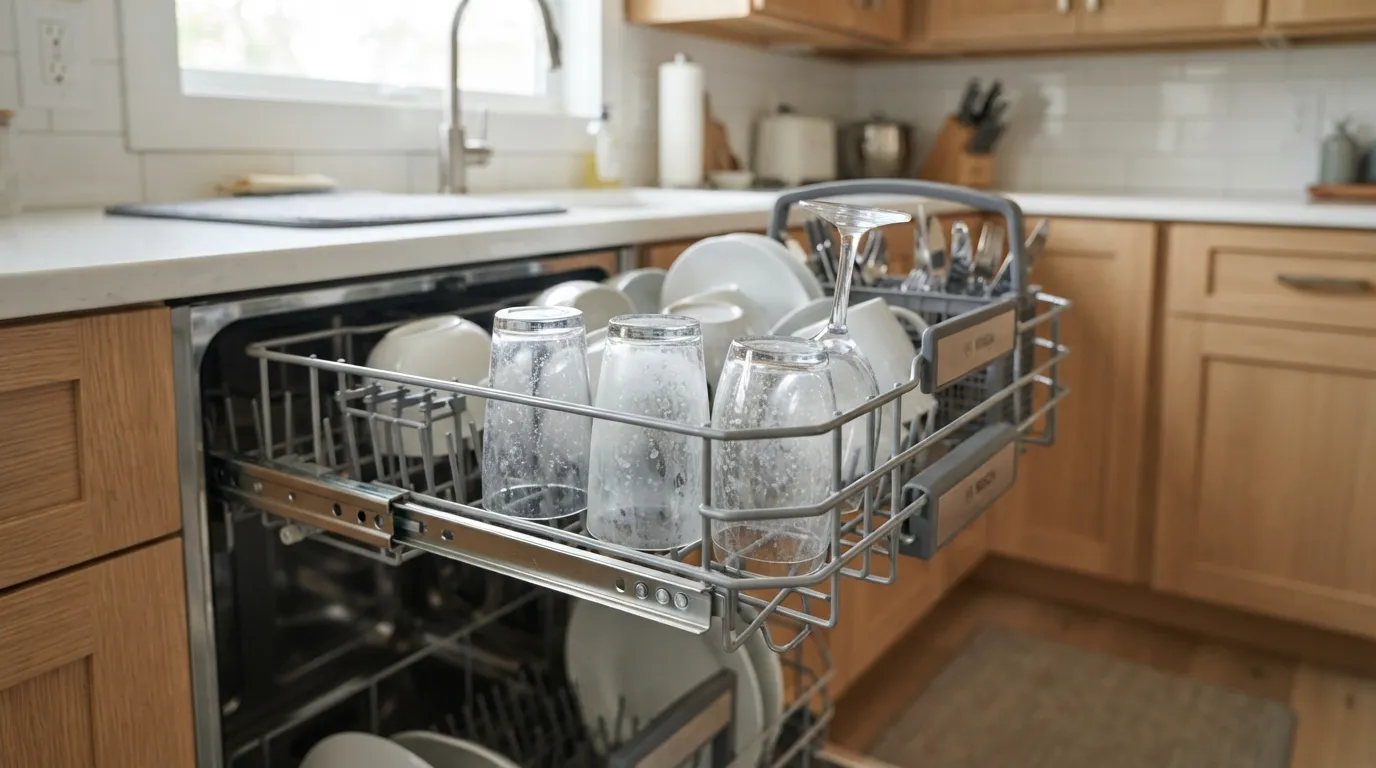
When a dishwasher stops cleaning the top rack but the bottom comes out fine, the water isn’t reaching the top with enough pressure. The usual suspects: a clogged or stuck upper spray arm, a blocked feed path, a loading problem, or the slow one nobody names — hard-water scale plugging the spray holes. Around Waco, start by assuming the water. Here’s how to check each piece in about fifteen minutes.
Why the top rack always fails first
The top rack lives at the far end of the plumbing. Your dishwasher pumps water up through a feed tube to the upper spray arm, and that climb is where weak pressure shows itself. The bottom arm sits right on the pump, so it keeps working even when flow drops; the top arm is the canary. Glasses come out with grit in the bottom, bowls hold a film, and the plates downstairs look perfect.
That’s also the diagnostic gift: if the bottom rack is clean, your pump probably works. Something is choking the path to the top, and most of those somethings are fixable at the kitchen counter.
Spin the upper spray arm first
Pull out the top rack and give the spray arm under it a spin with one finger. It should turn freely and keep coasting for a rotation or so.
If it doesn’t spin: look for a utensil, a bone, or a twist-tie jammed above it, and check that the arm still sits snug on its mount. An arm knocked loose from its dock sprays sideways and cleans nothing.
If it spins, check the holes. Hold your phone light up to the arm. Every one of those little holes should be open. What you’ll usually find in Central Texas is white crust: calcium scale narrowing the holes until the arm mists instead of jets. Food bits and seed husks do their share too.
To clear it: pop the arm off if your model allows (most twist or unclip; check the manual), soak it in white vinegar for 20–30 minutes, and run a toothpick through each hole. Rinse and remount until it clicks. While it’s off, peek into the feed tube it docks onto; scale builds there too.
The hard-water tax, again
Waco-corridor water runs hard, McLennan and Bell County both, and dishwashers pay the tax more visibly than anything else in the kitchen. Scale narrows spray holes, films glassware, and packs the filter mesh. If your glasses come out cloudy and the shower heads at home need vinegar bags twice a year, the top rack was never the machine’s fault. The USGS explains water hardness if you want the geology; the practical version is that our water carries dissolved rock, and the rock stays behind when the water dries.
The maintenance rhythm that keeps a top rack working here: a citric-acid or vinegar cycle in an empty machine monthly, a filter rinse every couple of weeks, and rinse aid in the dispenser always. Rinse aid isn’t a scam upsell; in hard water it’s the difference between sheeting and spotting. We put the full routine in our dishwasher rack cleaning guide, and the bigger picture lives in what hard water does to your appliances.
One honest caveat: in hard-water country the scale comes back. This isn’t a fix-it-once symptom, it’s a maintenance rhythm, and anyone promising permanent is selling something.
Loading: the sheet pan did it
Before you blame any machinery, replay the load. A tall cookie sheet or cutting board parked at the front of the bottom rack can block the water column feeding the upper arm. Mugs loaded flat instead of angled collect gray water. Bowls nested together shield each other from spray. And a top rack packed edge-to-edge doesn’t leave water a lane to work in.
The test that settles it: run the machine half-empty, everything angled down, nothing tall in the bottom front. If the top rack comes out clean on that run, the machine was fine all along. That’s the “dishwasher leaving food residue on the top rack” complaint solved with zero parts, and it’s more common than anyone wants to admit.
The boring settings that matter
Run the kitchen tap hot first. Your dishwasher fills from the hot line, and the first fill otherwise arrives lukewarm. Twenty seconds at the sink before you hit start buys the wash cycle 20 degrees.
Use enough detergent, and the right kind. Hard water eats detergent. If you’re on basic pacs and getting film, switch to a detergent with built-in water softening or add a hard-water booster. More rinse aid, not more soap, fixes spotting.
Pick the normal or heavy cycle, not the quick one. Quick cycles are for lightly used dishes in soft-water towns. That’s not us.
Brand footnote: if you’re searching “Whirlpool dishwasher not cleaning,” the checks are identical. The top-rack complaint is universal; the badge on the door doesn’t change the plumbing.
When it’s actually the machine
Work through everything above and still getting a dirty top rack? Now the machine has earned suspicion. A worn circulation pump, a cracked spray arm mount leaking pressure, or a partially clogged water inlet valve all produce weak top-rack washing, and all three are tech territory: they involve disassembly, live water connections, and parts you shouldn’t guess at.
That’s the point where a written quote on dishwasher repair beats another bottle of dishwasher cleaner. Those cleaner tablets can’t unclog a spray arm or revive a pump; skip them until the mechanical stuff is ruled out. If the machine’s past ten years old, it’s worth asking the repair-or-replace question before spending anything; same-day visits are usually available around Waco, Temple, and Belton.
Common questions about a top rack that won’t clean
Why is my dishwasher not cleaning the top rack?
Why does my dishwasher leave residue on the top rack?
Should I run hot water before starting the dishwasher?
Why are my glasses cloudy after the dishwasher?
Where to go from here
Spin the arm, clear the holes, rethink the load, run the tap hot. That sequence rescues most top racks by the weekend. If yours still won’t clean after all that, the machine’s earned a professional look: request a written quote or call , and you’ll get a straight answer on whether it’s a $6 bottle of citric acid or a real repair.
The On Point Team · On Point Service Company — family-owned HVAC & appliance repair, McGregor, TX · Serving Waco, Temple, Belton, and surrounding Central Texas towns · Licensed & insured, TDLR License TACLB00069239E ·