






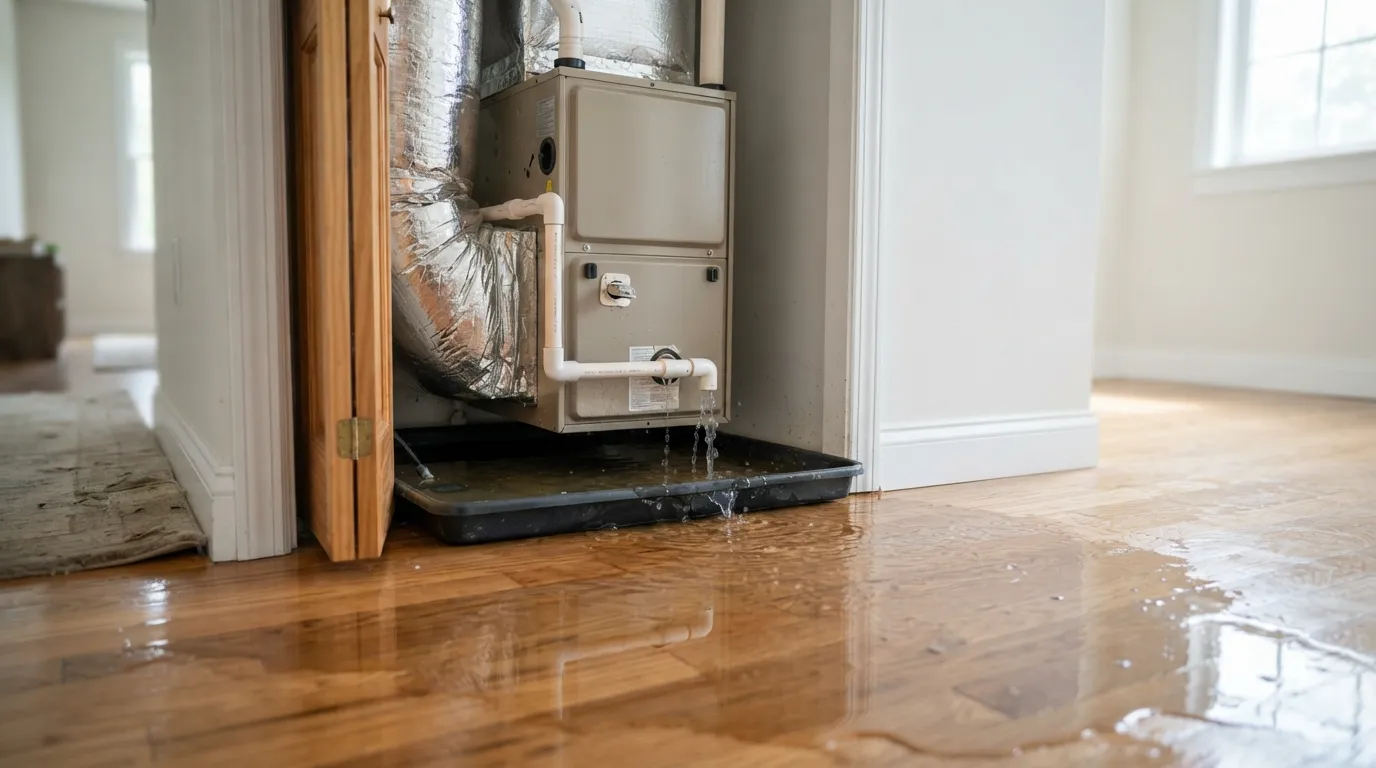
An AC leaking water inside the house is almost always a clogged condensate drain line, an overflowing drain pan, or a coil that froze and is now melting all over your floor. First five minutes: switch cooling off at the thermostat, soak up the water, and check the drain pan under the indoor unit. The fix is usually a $10 jug of vinegar and a wet/dry vac, and it’s one of the few AC repairs you’re genuinely allowed to do yourself.
Here’s the whole playbook, in the order the water demands.
Why your AC makes water in the first place
Your AC is also a dehumidifier. In a muggy Central Texas summer, the indoor coil wrings anywhere from 5 to 20 gallons a day out of your air, and every drop is supposed to slide down the coil, into a pan, and out a PVC drain line that exits near your foundation.
That line is dark, damp, and warm. Algae and gunk think it’s paradise. Sooner or later the slime wins, water backs up the pan, and the overflow finds your ceiling, closet, or hallway floor. Around Temple and Belton we see the drain-clog wave hit hardest in the sticky months, when the system is pulling moisture nonstop and the line never gets a break.
Point is: water isn’t strange. Water in the wrong place is.
The first five minutes
- Turn cooling OFF at the thermostat. No more condensation gets made, and if the cause is a frozen coil, the thaw starts now.
- Get the water up. Towels now, fan on the wet spot after. Attic units over a ceiling: put a bucket under the drip and move anything stored nearby.
- Find the drain pan. It’s under or inside the indoor unit (air handler or furnace coil cabinet). Full pan or crusted waterline? That’s your confirmation: the drain line’s clogged.
If the pan is bone dry but water is pooling anyway, skip ahead to the frozen-coil section, because you may be looking at meltwater instead of overflow.
The drain line fix you’re allowed to do
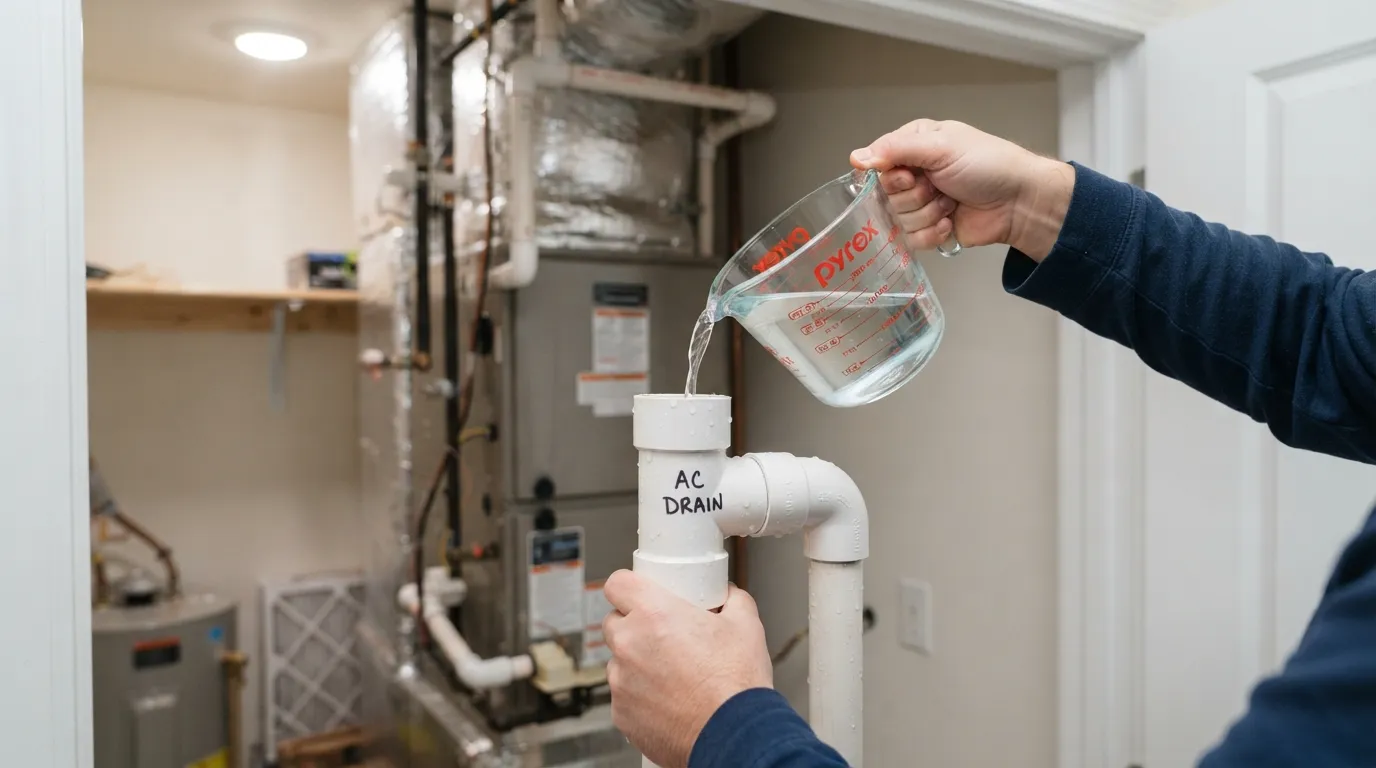
Find the PVC line at the indoor unit, usually 3/4-inch pipe with a T-shaped access fitting and a cap near the unit. Outside, the same line ends near the foundation or a flower bed.
The quick version of the fix:
- Pop the cap on the access tee.
- Pour in a cup or two of plain white vinegar and let it sit 30 minutes to eat the slime.
- Outside, seal a wet/dry vac to the line’s end with a rag or your hand and run it a couple of minutes. When the clog gives, you’ll hear it — and you’ll wish you hadn’t looked in the vac.
- Chase it with water at the tee to confirm the line runs free, then re-cap.
Restart cooling and watch the pan for an hour. If water moves through the line and the pan stays shallow, you just saved yourself a service visit.
We keep the full routine (timing, the shop-vac tricks that actually seal, and how often to repeat it) in our AC drain line cleaning guide. Bookmark that one; done twice a summer, it makes this whole article something you never read again.
Check the float switch before you panic
Many systems have a small safety device on the pan or the drain line: a float switch. When water rises too high, it kills the AC on purpose so the pan can’t overflow into your ceiling.
So if your AC “died” on the same day water appeared, that’s probably the switch doing its job, and no fuse or breaker will bring the system back until the water level drops. Clear the clog, empty the pan, and the switch resets on its own (a few models have a small reset button on top). An AC that shuts itself off before ruining your drywall is a feature, and if your system doesn’t have a float switch, having one added during any service visit is the best low-dollar insurance in this whole trade.
If the coil froze, the “leak” is a thaw
Ice is the sneaky cause. A coil that froze (dirty filter, blocked vents, or low refrigerant) eventually melts, and a fully iced coil sheds more water than the pan and line were sized to handle at once. The giveaway pattern: weak airflow for a day or two before the puddle, or frost you can see on the copper lines.
That’s a different repair path with its own rules (including the one about never running a frozen system), and we wrote it up in our frozen AC thaw guide. Fair warning from the other direction, too: every thawed coil dumps its meltwater through this same drain system, so a freeze and a clog love to show up as a double feature.
When the water is telling you something worse
A few versions of this problem are past the vinegar jug, and pretending otherwise gets expensive:
- The clog won’t clear with vinegar and suction — it may sit at the trap or inside the coil cabinet, which means opening things up.
- The pan itself is cracked. Common on units past 12–15 years; metal pans rust, plastic pans fatigue. That’s a parts-and-labor fix, quoted in writing before anyone touches it.
- Water keeps coming with cooling OFF. Then it may be a plumbing or roof issue wearing an AC costume, and better to know now.
- The ceiling under an attic unit is already stained or sagging. Secondary pans and switches up there exist precisely because this failure ruins sheetrock fast.
For any of those, our air conditioner repair team will give you a written assessment and quote before any work, and same-day slots are often available in season. One of our Waco customers, Ashley Hale, put it better than our marketing could: “responded quickly with same-day service… very affordable.” That’s the standard we aim for when there’s water where it shouldn’t be.
Common questions about an AC leaking water
Should I turn off my AC if it’s leaking water?
Why is my AC leaking water inside?
How much does it cost to fix an AC drain line clog?
Is water around the outdoor unit a problem?
Where to go from here
Cooling off, towels down, pan checked, vinegar in, vac on — that sequence resolves most of these before dinner. If the water keeps winning, request a written quote or call for a straight an
The On Point Team · On Point Service Company — family-owned HVAC & appliance repair, McGregor, TX · Serving Waco, Temple, Belton, and surrounding Central Texas towns · Licensed & insured, TDLR License TACLB00069239E ·