



A furnace tune-up is a once-a-year service visit where a tech cleans and tests the parts that fail first: burners, flame sensor, igniter, blower, and the safety controls. In Central Texas, the month to book it is October — after cooling season finally lets go, before the first cold snap asks every furnace in the county to light on the same morning.
Here’s what’s actually on the checklist, what it typically costs, what it can’t do, and the free half you can handle yourself this weekend.
What’s actually in a furnace tune-up
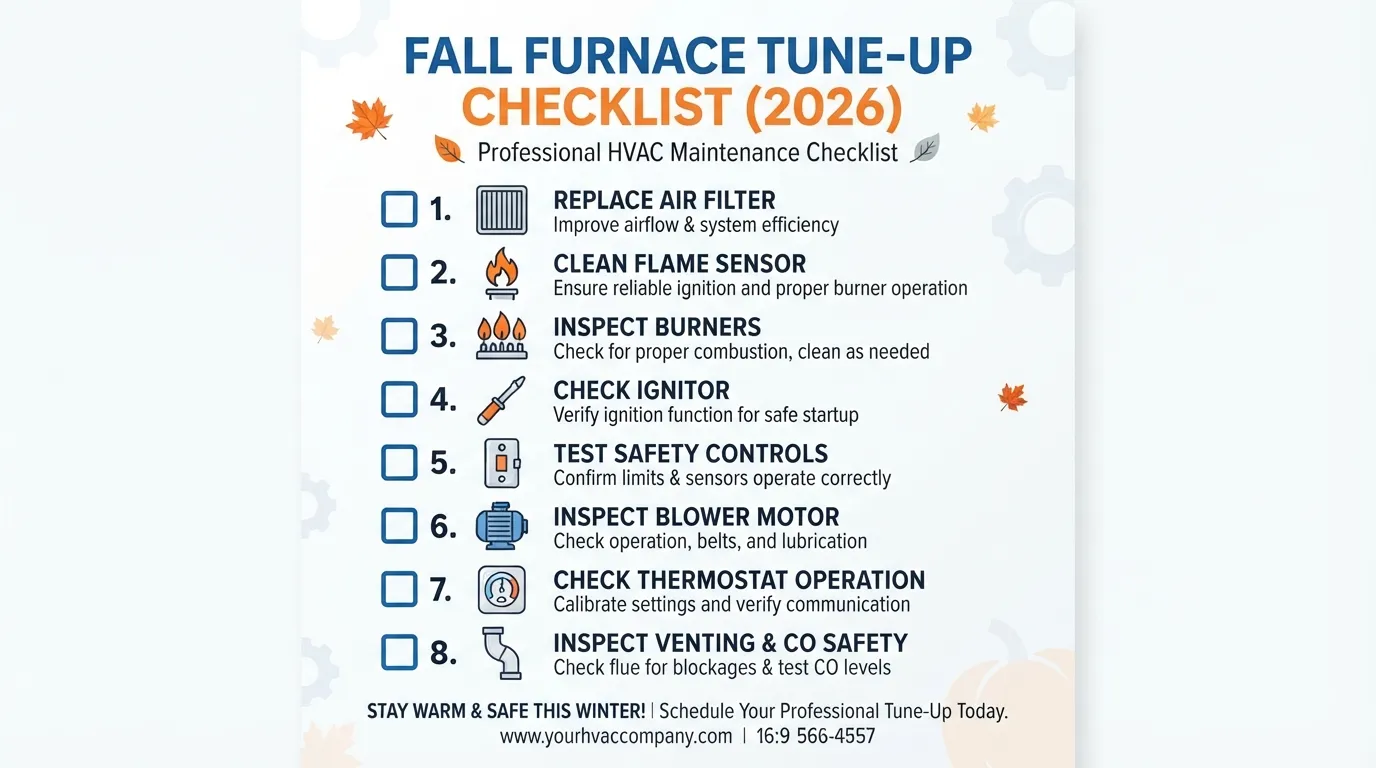
A real fall furnace tune-up runs 45 to 90 minutes and covers roughly this list. Shorter than that, ask what got skipped.
- Filter check and swap. The two-minute item that protects everything downstream.
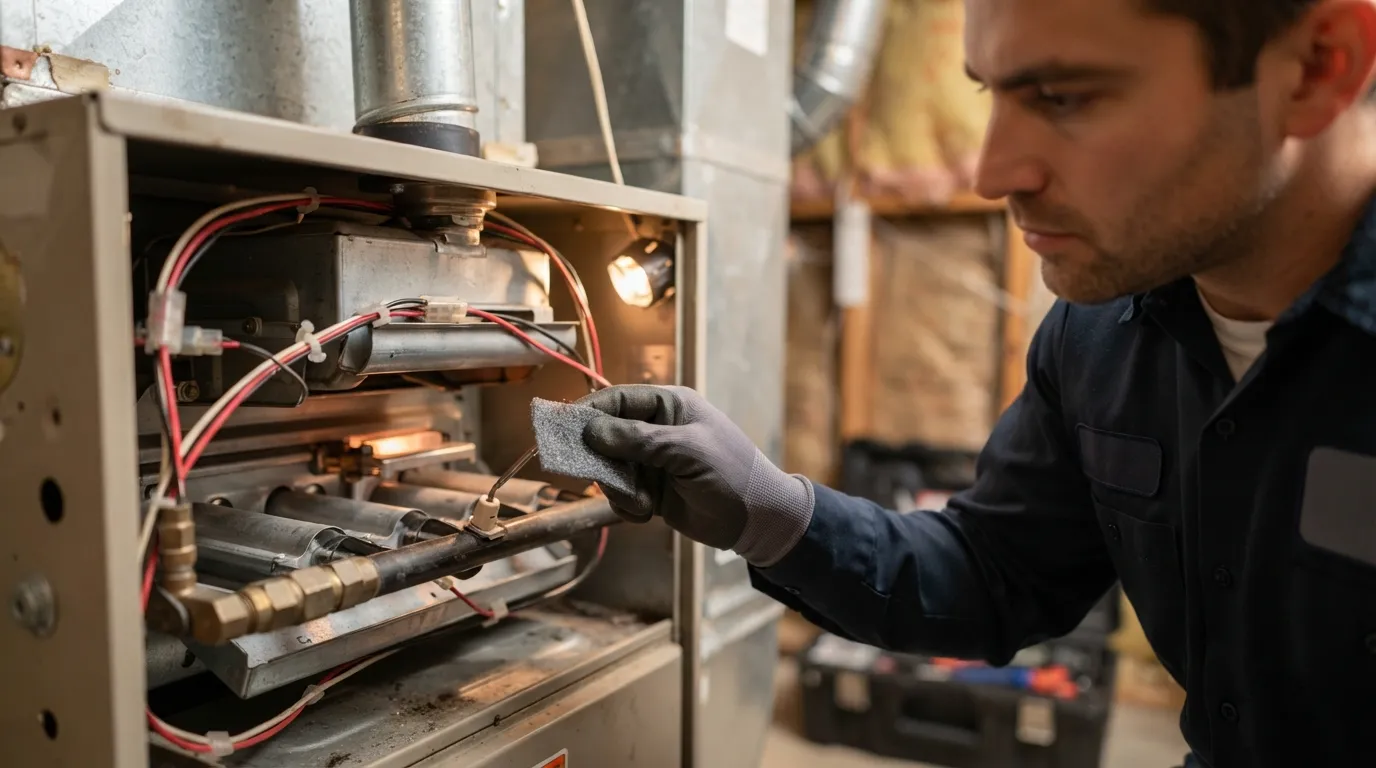
- Burner inspection and cleaning. Dust and summer cobwebs burn off the first cold morning; cleaning them out means even flames and no scorched smell.
- Flame sensor cleaning. A thin rod that confirms the burners lit. A season of buildup makes it lie, and the furnace shuts itself off. This one item prevents more January no-heat calls than anything else on the list.
- Igniter check. Hot surface igniters wear like light bulbs; a resistance test catches one that’s about to quit.
- Heat exchanger inspection. A visual check for cracks and rust on the furnace’s core.
- Safety-control test. The high-limit switch and rollout switches, the parts that shut things down before trouble spreads. You want these tested annually, and never bypassed.
- Blower service. Cleaning and an amp-draw reading that catches a motor working too hard for its own good.
- Venting and combustion check. Confirming exhaust goes where exhaust should go, with a combustion reading to prove it.
Notice how much of that list involves the burner compartment and gas side. That’s exactly why this is a tech visit, and why the DIY version further down is deliberately shorter.
Why October is the month
The first real cold snap is a countywide furnace test nobody scheduled. Every system from China Spring to Troy lights within about 48 hours, the weak flame sensors and tired igniters all fail the same week, and every tech calendar in McLennan County fills at once.
Book in October and you’re ahead of that stampede: you pick the appointment slot, small problems get found in shirtsleeve weather instead of during a freeze, and if a part needs ordering, nobody’s cold while it ships. ENERGY STAR’s maintenance guidance recommends the same pre-season timing; we’d just add that in Texas, “pre-season” means before Thanksgiving, not before Halloween decorations come down.
Our opinion, plainly: October beats November, and November still beats the morning after the first freeze.
What a furnace tune-up costs
A standalone furnace tune-up typically lands between $80 and $200 in our area, depending on what’s included and whether it’s bundled into a maintenance plan. Treat anything dramatically cheaper as a marketing visit with an upsell waiting at the end.
That’s as far as this post takes the money question, because we already took it apart properly — plan math, what’s worth paying for, the loss-leader trap — in what an HVAC tune-up costs. This post is the what and the when; that one is the how much.
What a tune-up won’t do
Honesty section, because the industry oversells this visit.
A tune-up won’t add years to a furnace that’s already 20. It won’t fix undersized ductwork, and it won’t turn an 80% furnace into a 96% one; the efficiency gains from cleaning are real but modest. It’s an inspection and a cleaning, not a resurrection.
What it’s genuinely for: safety checks on a gas appliance, and catching $100-class ignition wear in October instead of during the January stampede. If the inspection does turn up a real repair, typical part-by-part prices are in our furnace repair cost table, and our furnace repair work is quoted in writing before anyone touches a wrench.
And if a $120 tune-up somewhere turns into a $2,000 surprise pitch, slow down. That’s exactly what free second opinions are for, and we give them.
The half you can do yourself, free
Change the filter now, then every 30 to 60 days through heating season.
Clear the furnace closet. Boxes, paint cans, and Christmas decorations migrate toward furnaces all year. Give the unit room to breathe and keep anything flammable away from it.
Fresh thermostat batteries and open registers. Two minutes, and it prevents the two most embarrassing no-heat calls we run.
Test-run the heat on the first cool evening. Ten minutes of runtime in October, when you don’t need it yet, tells you whether you’ll have it when you do. A little dust smell at first light-off is normal and burns off quickly. This is the free tune-up step almost nobody does, and it’s the one we’d make mandatory if we could.
Where you stop: the burner compartment, gas connections, and anything behind a screwed-shut panel. Cleaning burners and sensors on a gas appliance is the tech’s half for good reason.
The spring mirror, while you’re thinking about it
Furnaces get October; cooling gets the other shoulder season. The AC version of this visit is covered in what a pro AC tune-up actually includes, and the cadence question in how often you should service your AC in Central Texas. Same logic, opposite calendar.
Common questions about furnace tune-ups
What does a furnace tune-up include?
How often should a furnace be serviced?
Is a furnace tune-up worth it?
How long does a furnace tune-up take?
Where to go from here
Book the furnace tune up in October, do the free half yourself this weekend, and let the first cold snap be everyone else’s problem. If your test run turns up trouble, request a written quote or call — same-day slots are often available before the winter rush hits.
The On Point Team · On Point Service Company — family-owned HVAC & appliance repair, McGregor, TX · Serving Waco, Temple, Belton, and surrounding Central Texas towns · Licensed & insured, TDLR License TACLB00069239E ·