


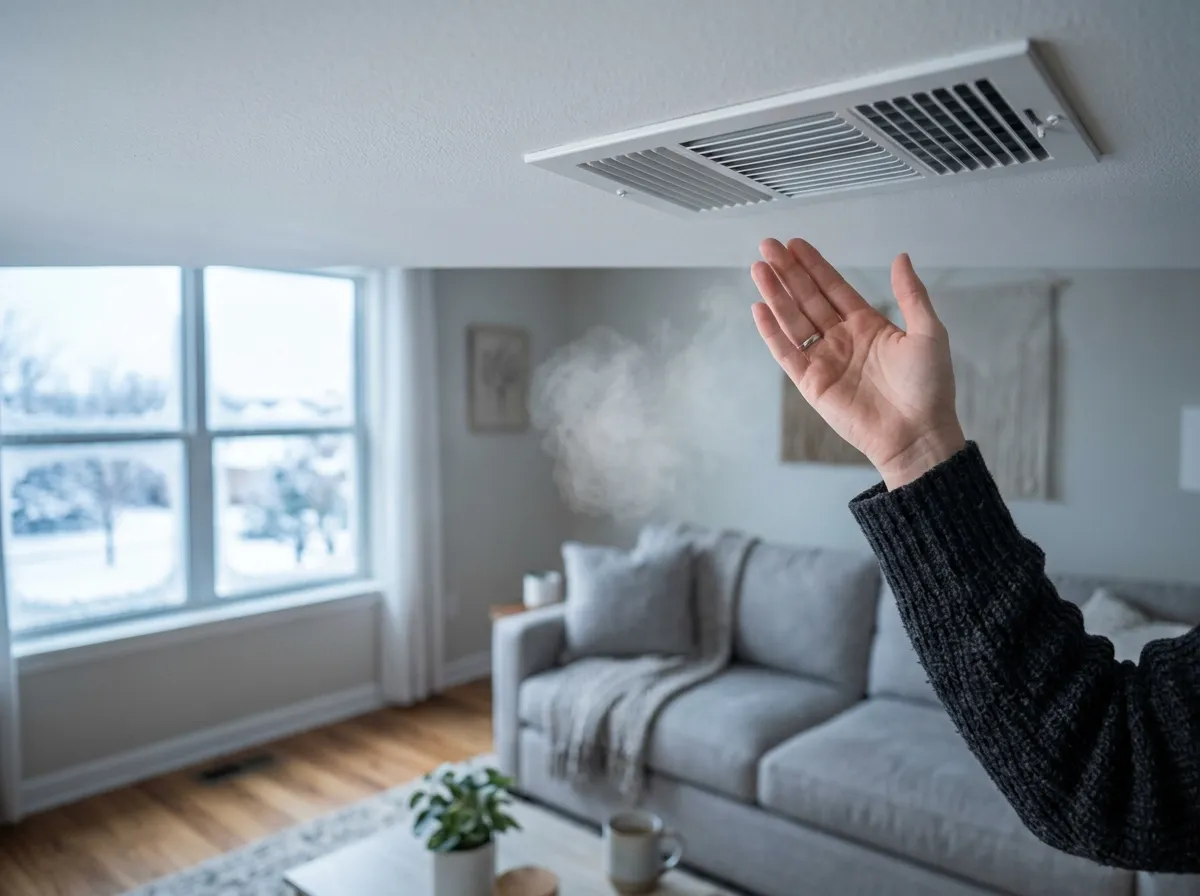
The first real cold night of the year has a ritual in Central Texas: the heater kicks on, the vents push air, and the air is… cool. Before you assume the furnace died, know this — about a third of “heater not blowing hot air” calls end without a repair, because the cause was a setting, a switch, or a filter.
Work through this list in order, cheapest first. You’ll either fix it in ten minutes or know exactly what to tell the tech.
The 5-Minute Checks (Fix-It-Yourself Territory)
When a heater stops blowing hot air, five checks solve the most common causes: thermostat set to HEAT with the fan on AUTO, fresh thermostat batteries, the furnace breaker and power switch on, a clean filter, and open vents. Each is safe, free, and takes about a minute.
In order:
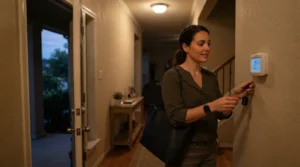
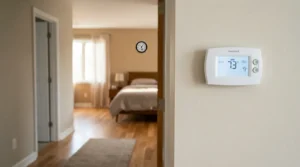
- Thermostat mode and fan setting. HEAT, not COOL — yes, check; someone in your house touched it. Then fan: AUTO, not ON. On ON, the blower runs between heating cycles and pushes room-temperature air that feels cold from a vent. This one setting explains a remarkable share of “broken heater” calls.
- Thermostat batteries. A dying thermostat does strange things before it does nothing. Two fresh AAs are the cheapest furnace repair in Texas.
- The breaker — and the other switch. Check the furnace breaker in the panel, then look for a plain light switch on or near the furnace itself. It’s the furnace power switch, it looks exactly like a closet light, and it gets flipped off by accident constantly. Reset a tripped breaker once. Only once — more on that below.
- The filter. A filter choked with a summer’s worth of dust makes the furnace overheat and shut its burners down for safety, so the blower keeps pushing air that never got heated. If the filter looks like felt, swap it and give the system 30 minutes.
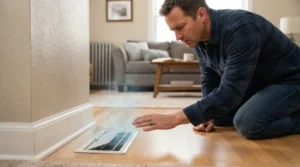
- Vents and returns. Furniture over a return, closed registers in half the house — airflow problems masquerade as heating problems.
Fixed it? Good — set a filter reminder and enjoy the evening. Still cold? Keep going; the next section is the full diagnosis.
Why Is My Furnace Blowing Cold Air? The 8 Causes, Cheapest First
# | Cause | What you’ll notice | Who fixes it |
|---|---|---|---|
1 | Thermostat settings or batteries | Fan ON instead of AUTO; blank/erratic display | You, 2 minutes |
2 | Clogged filter → overheat shutdown | Warm air briefly, then cool; short cycles | You, 5 minutes |
3 | Power: breaker or furnace switch | Nothing runs at all | You, 1 minute |
4 | Pilot light out (older furnaces) | No warm air; pilot window dark | You maybe — see next section |
5 | Dirty flame sensor | Burners light, then quit seconds later | Licensed tech |
6 | Failed ignitor | Clicking, no ignition; blower runs cold | Licensed tech |
7 | Duct leaks heating the attic | Weak, lukewarm air at far vents | Licensed tech |
8 | Heat pump quirks (defrost, aux heat) | Cool-ish air in cold snaps; occasional steam outside | Often normal — see below |
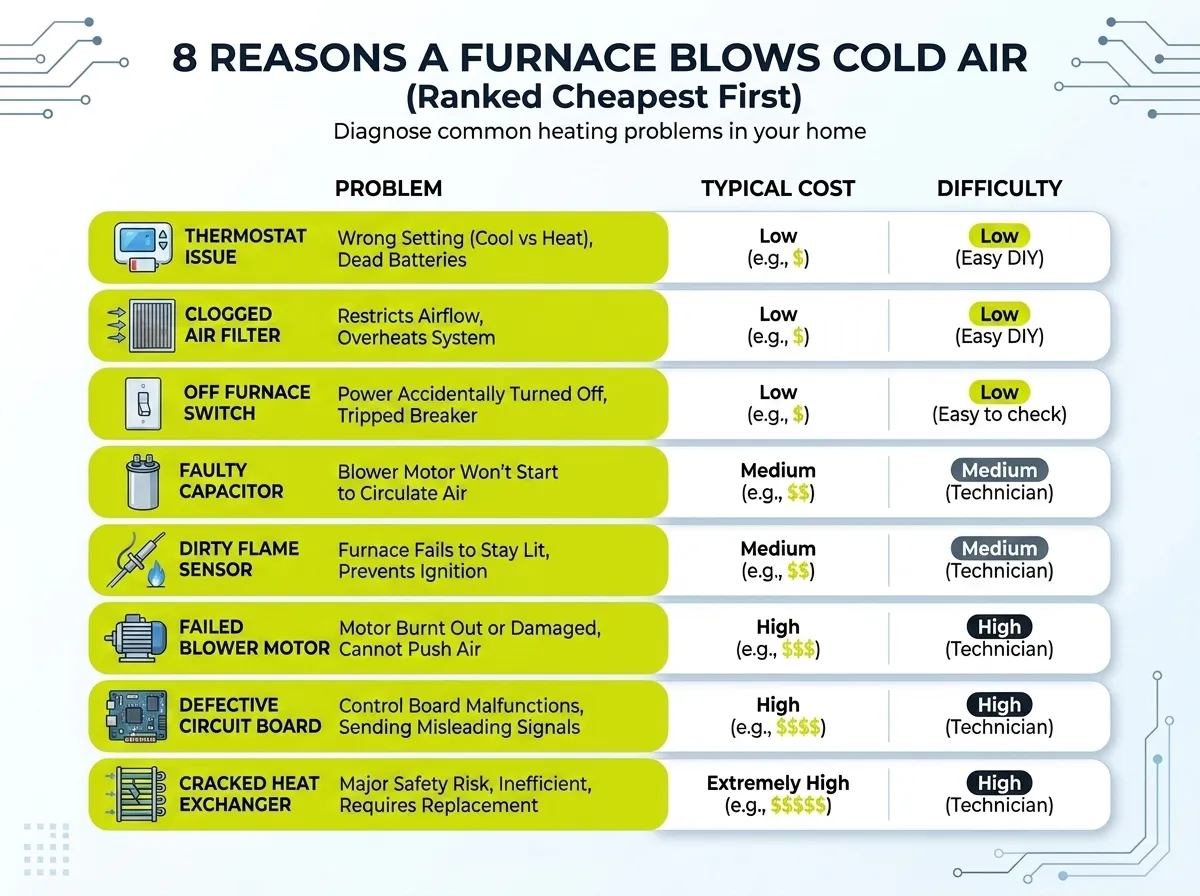
Two patterns worth naming. Warm-then-cold cycling is almost always airflow: the furnace overheats, a safety switch kills the burners, the blower keeps running. Check the filter before you spend a dollar. Lights-then-dies — burners ignite for a few seconds and quit — is the classic dirty flame sensor, a $10 part wearing a $150 service call, and one of the most common furnace calls we run every November through February.
Gas Furnaces: Pilots, Ignitors, and Where You Stop
If your furnace is old enough to have a standing pilot light (roughly pre-2010), look through the little sight window near the bottom of the unit. Dark means the pilot’s out. Relighting it by the printed instructions on the furnace label is a reasonable homeowner job if the steps are followed exactly and the room doesn’t smell of gas. If the pilot won’t stay lit after one careful attempt, stop — a pilot that keeps dying usually means a failing thermocouple, and that’s a tech visit, not a third match.
Most furnaces in the Waco area now use a hot surface ignitor instead — a small ceramic element that glows orange, cracks with age, and fails on the first cold morning after a long idle summer, which is why our phones ring in unison that week. You’ll hear the click and hum of a start attempt, but the burners never light. That’s a tech part: brittle, specific, and living next to the gas train.
Now the hard lines, and we mean them:
- If you smell gas — rotten eggs, sulfur — stop touching things. Don’t flip switches, don’t relight anything. Leave the house and call your gas provider from outside, then call for the repair after the utility clears it.
- Never work on the gas valve, gas lines, or burner assembly. Not to tighten, not to adjust, not to clean. Licensed-tech territory, full stop.
- Don’t open sealed panels or bypass switches. Those safety switches shutting your furnace down are doing their one job.
A relit pilot is a win. Everything past it is where DIY stops paying and starts costing.
Heat Pumps in Central Texas: Cold Air That’s Actually Normal
Plenty of homes from Temple to China Spring heat with a heat pump — and heat pumps generate the most false-alarm “no hot air” calls of any equipment, because two of their normal behaviors feel broken:
The air is warm, not hot. A gas furnace blows air at 120–140°F. A heat pump blows 90–105°F — warmer than the room, colder than your 98.6° hand. It’s heating the house fine; it just doesn’t feel like a campfire. Check the thermostat reading over an hour: rising means working.
Defrost mode. On cold, damp mornings the outdoor coil ices up, and the system briefly runs in reverse to melt it — cool air indoors, steam rising off the unit outside. Five to ten minutes, entirely normal, alarming the first time you see it.
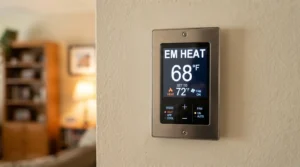
What’s not normal: the outdoor unit encased in ice like a margarita glass (airflow problem or failed defrost — tech visit), or a thermostat that’s dropped to EM HEAT / emergency heat without you choosing it. Emergency heat runs electric strips that heat fine and bill savagely — it’s a limp-home mode, not a setting to live on. If your heat pump only warms the house on emergency heat, the heat pump side has a problem worth diagnosing before the electric bill diagnoses it for you.
The February Freeze Problem
Central Texas winters are short, but you don’t have to have lived here long to know what a February hard freeze does — to pipes, to schedules, and to every heating system that spent the fall unexamined.
Freeze weeks produce three specific failures we see across McLennan and Bell County:
- Heat pumps working past their design day. When it’s 18° outside, a heat pump extracts less heat and runs nearly continuously, leaning on those electric strips. Houses that felt fine at 38° feel drafty at 18°. That’s physics, not failure — but it’s also why the pre-season tune-up matters; a system with a marginal charge or dirty coil falls off a cliff exactly when you need it most.
- Blocked intake and exhaust pipes. High-efficiency furnaces breathe through PVC pipes exiting a wall or roof. Wind-driven sleet and ice can block them; the furnace senses it and refuses to run. If yours died mid-storm, find those pipes outside and clear them — that’s a safe, legitimate homeowner fix and it works more often than you’d think.
- The space-heater cascade. One heater per circuit, never on an extension cord, never unattended. Every freeze event, space heaters cause house fires that started as furnace problems. If the heat’s out and you’re bridging with portables, spread them across rooms and circuits.
And a standing rule for any fuel-burning appliance working overtime: working carbon monoxide detectors on every sleeping floor. The CPSC’s carbon monoxide guidance is a five-minute read worth doing before the next front, not after.
What Each Fix Typically Costs
Typical Central Texas ranges — every furnace and attic differs, which is why the number that matters is a written quote on your actual unit, not an internet table. But these are the honest lanes:
Repair | Typical range (Central TX) |
|---|---|
Thermostat replacement (installed) | $150–$500 |
Flame sensor cleaning/replacement | $80–$250 |
Hot surface ignitor | $150–$400 |
Thermocouple (standing pilot) | $100–$250 |
Limit switch | $150–$350 |
Blower motor | $450–$1,500 |
Gas valve | $300–$800 |
Duct sealing/repair | $300–$1,500+ |
The one that changes the conversation: a cracked heat exchanger. That’s not a part swap, it’s a carbon-monoxide risk and usually a repair-or-replace decision on the whole furnace — expect the honest version of that conversation to include the unit’s age, a look at furnace replacement numbers, and zero pressure to decide in the driveway. If a company condemns your heat exchanger, ask to see the crack on camera. Good techs document it; it’s how you know the diagnosis is real.
If a quote you’ve received doesn’t line up with these lanes, get a second opinion before you commit — ours are free, and about the most useful thing we do with them is tell you when the first quote was fair.
Where You Stop and Call a Licensed Tech
Yours, safely: thermostat settings and batteries, breakers (one reset), the furnace power switch, filters, vents, relighting a standing pilot per the label, clearing iced intake pipes outside.
A licensed tech’s, always:
- Anything gas — valves, lines, burners, and any smell of gas (that one starts with the gas company, from outside the house).
- Flame sensors, ignitors, and control boards — they live inside the burner compartment next to the gas train.
- Sealed electrical components and bypassed safeties. 240 volts and safety switches are not puzzle pieces.
- A breaker that trips twice. Once is a fluke; twice is a fault hunting for a fire. Leave it off.
- Any CO alarm activation — out of the house first, diagnosis second.
This is the line between a homeowner saving a service fee and a homeowner becoming a story we tell at safety trainings. When you hit it, stop and call — furnace repair is exactly what we’re licensed, insured, and equipped for, and a written quote before any work means you’ll know the price before the panel comes off.
Keeping It From Happening Again
Three habits cover most of it:
- Filter cadence — monthly checks in heavy-use months, and always one fresh filter before the first cold front.
- A fall tune-up — the heating-side inspection catches ignitors, flame sensors, and heat exchanger issues in October, when the fix is scheduled instead of suffered. Here’s what a real HVAC tune-up includes and costs so you know what to ask for.
- Listen in week one. Furnaces telegraph failures — new rattles, booms, or squeals on startup mean something. Our furnace noise diagnostic guide translates the sounds before they translate themselves into invoices.
FAQ: Heaters Blowing Cold Air
Why is my heater running but not blowing hot air?
Most often: fan set to ON instead of AUTO (blows unheated air between cycles), a clogged filter causing overheat shutdowns, or — on gas furnaces — burners that aren’t lighting due to a pilot, ignitor, or flame sensor problem. Run the 5-minute checks first; they resolve a large share of these without a service call.
Why does my furnace blow cold air at first, then warm up?
That’s normal for 30–90 seconds — the blower often starts before the burners have heated the exchanger. Some systems deliberately delay the fan. Only worry if it never warms up, or if it warms up and then goes cold again (airflow problem — check the filter).
Why does my heater blow cold air only sometimes?
Intermittent cold air usually means overheat cycling (dirty filter or blocked vents), a flame sensor that’s marginal, or a heat pump in defrost mode. Note when it happens — during cold snaps points to the heat pump; after long run times points to airflow.
Is it bad to run emergency heat?
It won’t damage anything — it’s built for exactly this — but it heats your home on electric resistance strips at several times the cost of normal heat pump operation. Use it while you wait on a repair; don’t live on it. If the system switched itself to emergency heat, that’s the diagnostic clue right there.
How much does furnace repair cost in the Waco area?
Typical Central Texas lanes: $80–$250 for flame sensor work, $150–$400 for an ignitor, $450–$1,500 for a blower motor. Diagnostic visits usually run $75–$150 across the industry. Get the diagnosis and price in writing before work starts — on any furnace, from any company.
My furnace quit after a power outage — why?
Check the breaker and the furnace power switch first; outages trip both. Some furnaces also lock out after several failed ignition attempts — turning the furnace switch off for 60 seconds and back on clears many lockouts. If it locks out again, the ignition system needs eyes on it.
Warm House, Straight Answer
Cold air from a heater is usually a small problem wearing a big coat. Run the list, fix the free stuff, and when you hit the stop line, get a number in writing before anyone works on anything.
If the list ends at “call a tech” anywhere in our area — Waco, McGregor, China Spring, Robinson, Lorena, Crawford, Moody, Troy, Temple, or Belton — call for a straight answer and a written quote. Same-day availability when the schedule allows, free second opinions on any repair-or-replace verdict, and 10% off repairs for seniors and military.
On Point Service Company is a family-owned HVAC and appliance repair company in McGregor, TX, serving the greater Waco area with 20+ years of combined experience. Licensed & insured · TDLR License TACLB00069239E ·