




If a 96% gas furnace costs $1,500 more to install than an 80% model, how much gas would you need to use for the upgrade to pay for itself in ten years? At an illustrative $1.20 per therm, the answer is 750 heating therms a year on the 80% option. Use half that much gas and the payback doubles. That is why two neighbors in Waco can get the same two quotes and reasonably make different choices.
Here is how to do the calculation with your own bills. All prices and fuel quantities in the examples are hypothetical. Both furnaces are assumed to deliver the same amount of heat to the same home.
Find the number on the quote that has to pay you back
Start with two installed prices. Say one proposal is $6,000 and another is $7,500. If both include the same necessary work, the efficiency decision concerns the extra $1,500. If you also need to decide whether to replace the furnace at all, start with the furnace replacement cost guide. Keeping the old furnace is a different comparison with a different baseline.
Read the line items before subtracting. For example, suppose the higher quote includes duct repairs that would also be necessary with the lower quote. Ask for the lower bid with that work included. On the other hand, if a venting or condensate change is required specifically to install the higher-efficiency model, keep that cost in its column. Our side-by-side furnace quote worksheet helps identify these differences.
What moving from 80% to 96% AFUE actually saves
Annual fuel utilization efficiency (AFUE) expresses how much of the furnace’s fuel input becomes useful heat over a typical heating season. Imagine you need 80 units of heat. An 80% furnace needs 100 units of fuel to supply them. A 96% furnace needs about 83.3. The rating rises by 16 percentage points, while the fuel needed for the same heat falls by about 16.7%.
Estimated fraction of heating fuel saved = 1 − (lower AFUE ÷ higher AFUE). For 80% versus 96%, use 1 − 80/96 = 0.1667. For 92% versus 96%, use 1 − 92/96 = 0.0417. The same premium buys a much smaller fuel saving in the second comparison. Check the two exact model ratings on the proposals. ENERGY STAR’s furnace guide explains the ratings and identifies Texas in its southern region.
Use the heating portion of your gas bill
Gather twelve months of gas usage and check the unit printed on the bill. If it uses therms, total the therms first. Pick several months when the furnace was off and estimate average monthly gas use for cooking, hot water and other appliances. Multiply that baseline by twelve and subtract it from annual use. For example, 780 total therms minus 12 × 15 non-heating therms leaves 600 estimated heating therms.
This is a rough household estimate. A summer pool heater, winter changes in hot-water use, or a long vacation can distort the baseline. If one month looks unusual, try a lower and higher baseline and keep both answers. If you share a meter or lack a full heating season, ask the contractor to show the heating-use assumption behind the proposal.
Use the variable price per therm you expect to avoid, including applicable usage-based delivery charges. Leave the monthly customer charge out if you will keep gas service with either furnace. If your bill is in another unit, use the utility’s conversion or do the entire calculation in that unit. A per-therm price and a usage figure in cubic feet cannot be multiplied directly.
A worked example you can reproduce
Suppose those 600 heating therms represent annual usage on the proposed 80% baseline. The 96% option would use roughly 600 × 80/96 = 500 therms. At $1.20 per therm, the 100-therm difference saves $120 per year. Divide the $1,500 installed premium by $120 to get 12.5 years of simple payback.
Here is the step that is easy to miss when using an old bill. If those 600 therms came from an existing furnace rated at 70%, the same heat would require an estimated 525 therms at 80% and 437.5 at 96%. The difference between the two new options is 87.5 therms, or $105 per year at the example rate. Payback becomes about 14.3 years. An old nameplate rating is only an approximation of current performance. If its rating is unknown, flag the estimate accordingly.
Work backward from the years you expect to own the home
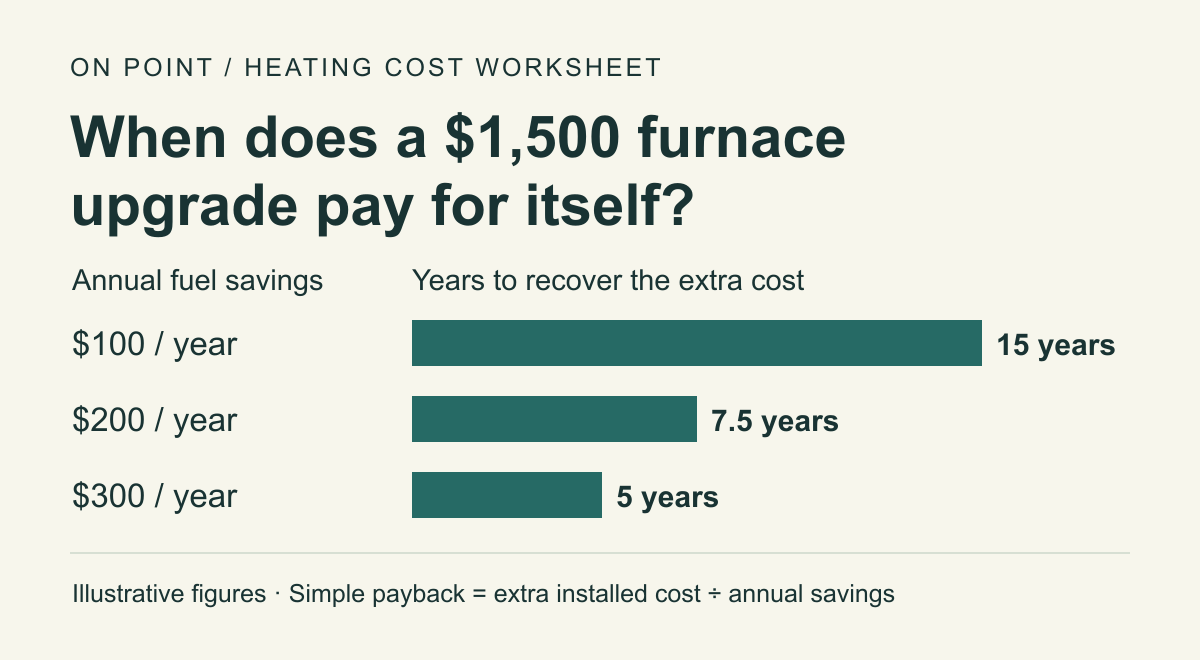
The featured chart holds the $1,500 premium constant. Saving $100 each year takes 15 years to recover it. At $200 it takes 7.5 years, and at $300 it takes five. To test your own deadline, turn the division around.
| Time to recover cost | Savings needed each year | Annual heating use needed on the 80% option |
|---|---|---|
| 5 years | $300 | 1,500 therms |
| 10 years | $150 | 750 therms |
| 15 years | $100 | 500 therms |
For the ten-year case, $150 ÷ $1.20 means you need to save 125 therms each year. Saving one-sixth of the baseline usage requires 750 heating therms. If your estimated usage is 400, the example upgrade saves about $80 a year. Over ten years that recovers $800 of the premium. You can now decide whether the other features are worth the remaining $700 to you.
Your furnace payback worksheet
- Write down both installed prices after any confirmed rebates. Subtract to get the net upgrade premium.
- Record the two AFUE ratings and your annual heating-only fuel use on the lower option. If using an old furnace bill, multiply heating use by old AFUE ÷ lower-option AFUE first.
- Multiply lower-option usage by 1 − lower AFUE ÷ higher AFUE, with the division performed first. This gives annual units of fuel saved.
- Multiply the fuel units saved by your variable unit price. Divide the premium by those annual dollar savings.
- Repeat with the lowest and highest plausible fuel usage or price. Write down the resulting range alongside the years you expect to stay.
Frequently asked questions
Does a 96% furnace cut my whole gas bill by 16.7%?
The 16.7% calculation applies only to heating fuel when moving from 80% to 96% for equal heat output. Water heating, cooking and fixed customer charges have their own costs. If only half your variable gas spend is for the furnace, the reduction in total variable gas spend would be about 8.3% under those assumptions.
What if one quote includes financing?
Compare cash installed prices first. Then compare the down payment, term, monthly payments and total payable on each financing offer. A loan that runs beyond your fuel-payback period can change the decision. Keep interest and fees visible when comparing the total you expect to spend.
Can comfort make the more expensive option worthwhile?
Yes, if the equipment and installation address a problem you actually have. Tell the contractor which room is uncomfortable and when. Ask how sizing, airflow or duct work will address it, and whether the less expensive option includes the same remedy. ENERGY STAR’s installation checklist explains why those checks matter. AFUE alone cannot tell you how the back bedroom will feel.
What happens if the premium is zero or the estimated saving is zero?
If both comparable options cost the same and the higher rating saves fuel, there is no extra upfront cost to recover. If annual fuel savings are zero and the premium is positive, fuel savings alone will never repay it. Price other benefits separately.
What should I bring to a Waco furnace replacement visit?
Bring the two proposals, a year of utility usage if available, and your target ownership period. Mark where the numbers are estimates. When discussing furnace replacement with On Point, ask which differences in the proposals buy fuel savings and which pay for other installation work.
References and calculation assumptions
- ENERGY STAR furnace buying guidance covers efficiency ratings and regional labels.
- ENERGY STAR HVAC Quality Installation covers sizing, system airflow and duct evaluation.
The examples assume equal delivered heat, constant fuel price and unchanged duct losses. The simple payback figures exclude financing, changes in blower electricity use, maintenance differences and the time value of money. The example prices are supplied solely to make the arithmetic reproducible.