




A bottle marked “rust remover” does not automatically belong on a dishwasher rack. Start with two documents: the dishwasher's care instructions and the exact cleaner's label. If either leaves compatibility unclear, ask the manufacturer before applying it.
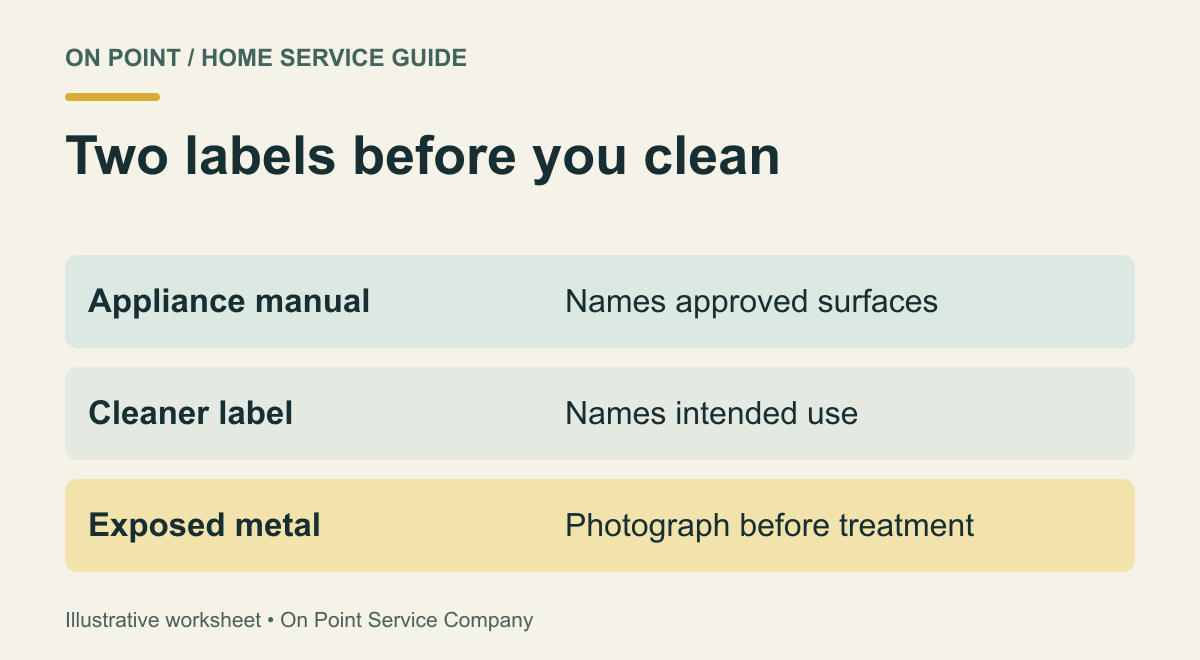
Two labels before you clean
Suppose a bottle says “stainless steel” and the rack looks silver through a chip. The surface you would clean includes a coating, an exposed spot and nearby materials. Permission to use the product on a stainless sink does not answer the rack question. Check whether the appliance instructions and the actual product label both cover the intended use. If either is silent, leave the spot alone while you check.
| Appliance manual | Names approved surfaces |
|---|---|
| Cleaner label | Names intended use |
| Exposed metal | Photograph before treatment |
When the cleaner label and rack manual answer different questions
Lay out the decision in two columns. The first column describes the surface you can see: intact coated tine, chipped coating, exposed metal or an adjoining plastic wheel. The second records the surfaces and methods the cleaner label specifically permits. A bottle may list stainless cookware without saying anything about coated dishwasher racks. If the exact surface or intended application is missing, keep the spot untreated until the manufacturer clarifies it.
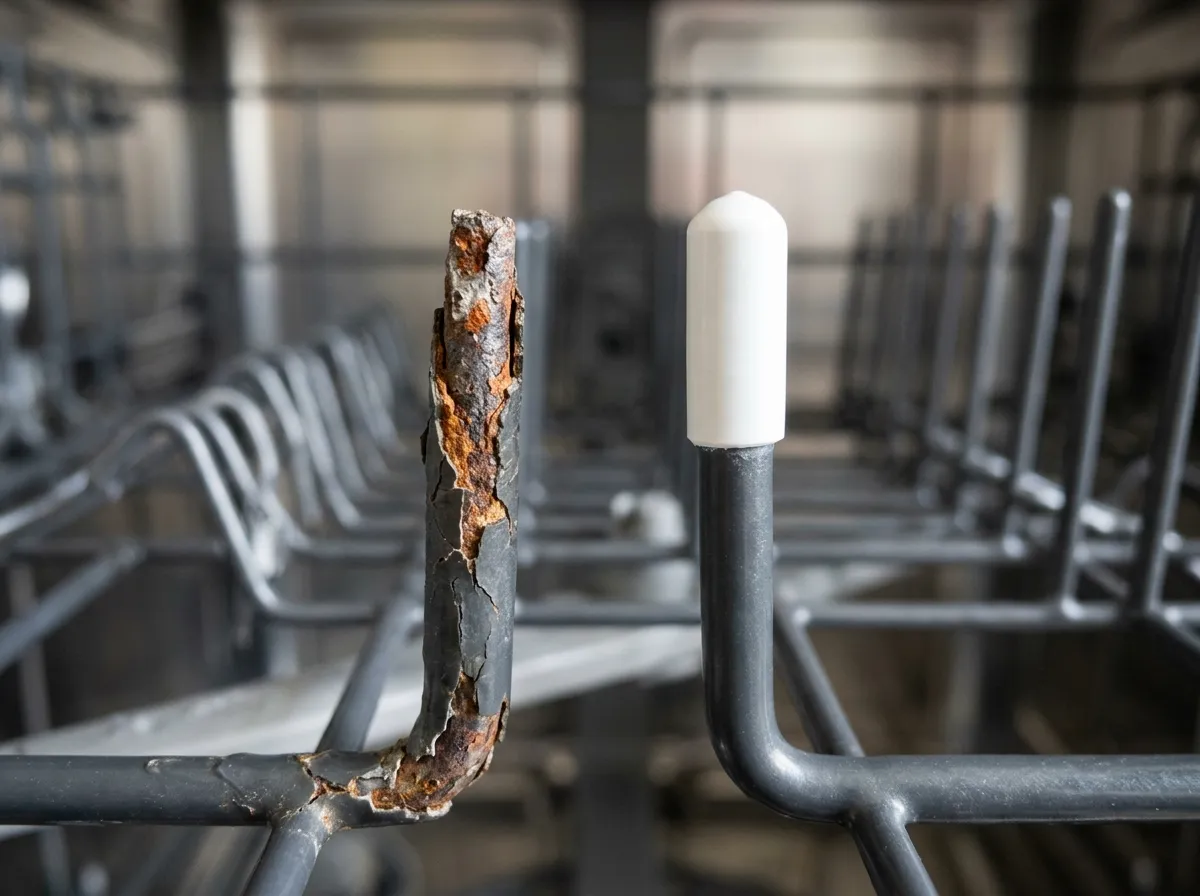
A separate decision is whether cleaning could accomplish what you want. A water mark on intact coating and a chip that has lifted from exposed metal might occur side by side. Removing a deposit will not replace lost coating. Take a photograph before treatment and describe each location separately if you contact support. Do not combine cleaners or experiment with stronger chemicals to make an unexplained mark disappear.
Identify the surface and the product
Write down the dishwasher model and where the residue appears. The rack, its moving parts and the tub are different surfaces; instructions for one are not permission to treat all three. Record the cleaner's full name, not just the brand. Different products from the same manufacturer can have different uses and restrictions.
For the broader issue, see How to Clean Dishwasher Racks (the Hard-Water Way).
Turn vague advice into a specific question
Ask: “Is this product approved for the coated rack on model ___, and what dilution, contact time and rinsing instructions apply?” A clear question is more useful than asking whether vinegar, bleach or an acid is generally safe. Do not mix cleaning products or invent a stronger concentration. If the coating is peeling or metal is exposed, cleaning and repairing are separate decisions.
Keep a small maintenance record
Save the care instructions and product directions you used. Photograph the rack before and after only if doing so is safe and useful. A cleaner removing visible residue does not prove that the underlying coating is intact. If the problem returns, that record helps you explain what changed without repeating increasingly aggressive treatments.
Two labels before you clean worksheet
- Dishwasher model
- Exact model, including suffix
- Surface
- Rack coating / wheel / tub / other
- Product
- Full product name and label directions
- Compatibility
- Confirmed / unclear / prohibited
- Outcome
- Date, method and remaining damage
What to ask the rack manufacturer
“The top of one lower-rack tine has a chip, with a chalky deposit on the coated wire next to it. The cleaner lists stainless surfaces. Does your model guidance allow it on this rack coating, and should an exposed spot be handled separately?” Include a picture showing the boundary. If the response addresses stainless tubs alone, ask about the coated rack before using the product.
Frequently asked questions
Can I use a cure time from another repair kit?
No. Cure and return-to-use instructions belong to the exact product and approved application. Ask the manufacturer when the rack may safely return to service.
What if the bottle says dishwasher-safe?
Read what the phrase describes. It may refer to an object that can be washed in a dishwasher. Look for explicit instructions for applying the product to that rack surface.
What if a spot comes off but the same tine still feels rough?
Separate the two observations. A removable deposit and an underlying coating defect can occupy the same place. Once the rack is cool, document what remains without scraping at it. Ask the manufacturer whether that location is suitable for an approved coating repair or requires a replacement component.
For help with this equipment, see On Point’s dishwasher repair service.
References
- GE Appliances model-specific manuals — For GE equipment, enter the complete model number to find its use, care and installation instructions. For another brand, use its equivalent manual.
- GE Appliances on dishwasher rust staining — GE distinguishes transferred stains, water-related staining and visible marks on dishwasher components.