


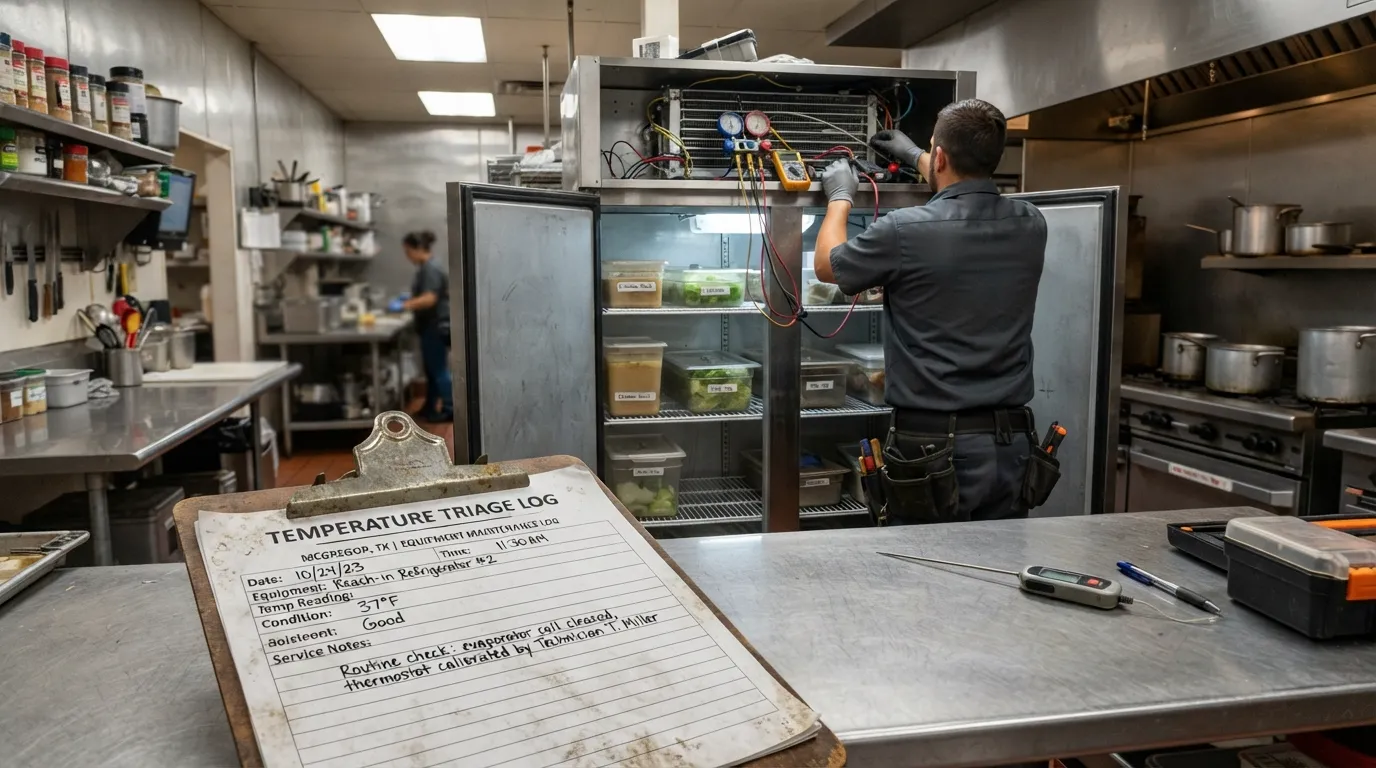
It’s 4:50 on a Friday and the line fridge reads 48°. First tickets hit at 5:30. If you’re searching commercial appliance repair McGregor TX right now, you already know the uncomfortable part: almost everything that comes up serves McGregor from somewhere else.
Here’s this guide’s promise, and its limit. On Point Service Company is a family-owned HVAC and appliance shop physically at 403 W 2nd Street in McGregor. Our daily bread is residential. [CONFIRM: commercial service scope — if OPSC’s commercial line is confirmed, the direct service statement goes here.] Whether your specific commercial unit is work our techs take on is a two-minute phone call, and we’d rather you ask than assume in either direction. What we can hand you regardless is the guide we’d want as a McGregor business owner: what to do in the first 30 minutes, who to call in what order, what commercial repairs typically cost, and the repair-or-replace math on used gear.
The Friday problem: who’s actually near McGregor
Geography first, promises never. McGregor sits about twenty minutes from Waco and closer to forty from Temple. Factory-authorized service for most commercial kitchen brands dispatches from metro hubs, sometimes Waco, often the Dallas or Austin radius, and a small town on the edge of the route map waits accordingly. That’s not a knock on anyone. It’s route math, and your restaurant pays for it in hold time and mileage line items.
One appliance-repair shop operates inside McGregor city limits, and it’s ours, two minutes off Highway 84. That is a statement about distance, not about scheduling, and we won’t pretend otherwise; whether and when anyone can come out is a phone conversation, not a blog claim. But distance still matters twice: on the clock, and on the trip charge that somebody’s dispatcher calculates from forty miles away.
The practical takeaway for a food business here is blunt. Know before the failure who you’d call, in what order, with what information ready. The rest of this guide builds exactly that.
The first 30 minutes: triage for a food business
When cold equipment fails with product inside, the food comes first and the machine second. In order:
- Shut the doors and keep them shut. A loaded box holds cold for hours if nobody grazes it. Tape a sign on the handle if you have to.
- Log the time and temperature now. Write down when you found it, what it read, and keep logging every 30 minutes. The FDA Food Code works cold holding at 41°F and treats roughly four hours out of temp as the edge of the map. Your log is what separates “we moved product correctly” from a full discard, and your inspector will ask.
- Move the expensive and the risky first. Proteins and dairy into the walk-in or a working reach-in, packed tight. Condiments last. Don’t overload a healthy box past airflow, and don’t crank its setpoint down to compensate.
- Photograph everything. The thermometer, error codes, water on the floor, the serial plate. It helps the tech diagnose, and it helps any insurance or landlord conversation later.
- Then, and only then, pick up the phone with the model, serial, symptom, and your log started. That call goes better prepared than panicked.
Frozen product gets one honest note: a full freezer rides out most of a day shut, a half-full one much less, and refrozen-after-thawed is a food-safety decision, not a taste decision. When in doubt, the Food Code and your health authority outrank optimism.
The call order: warranty, local, supplier, landlord
Most owners call in the wrong order and pay for it. Here’s the sequence that protects your money.
Under warranty? Manufacturer first, always. Commercial warranties are short, usually a year or two, and famously picky: unauthorized work can void what’s left. If the unit is inside its window, your first call is the brand’s service line, and you say yes to their authorized network even if it’s slower. Losing a compressor warranty to save a day is bad math.
Out of warranty? Now a local shop can make sense. Ask two questions before anyone rolls: is this machine’s type and fuel in your lane, and how does the diagnostic fee work? Any honest shop answers both on the phone. We broke down the anatomy of that fee in what a service call costs, and the logic is identical for commercial gear, with bigger numbers. If you want the question answered about a specific machine, ask for a straight answer with the model in hand.
Your food supplier and neighbors, in parallel. Distributors can often source rental or loaner cold storage, and the restaurant two doors down has walk-in space more often than you’d think. Small-town operators lend shelf space; that’s half the point of being one.
Your landlord, if the equipment came with the lease. Read the lease before you spend. Plenty of strip-center and small-town leases put equipment repair on the landlord for included equipment, or split maintenance and replacement. Paying a repair bill that was contractually your landlord’s is a self-inflicted wound.
What commercial repairs typically cost
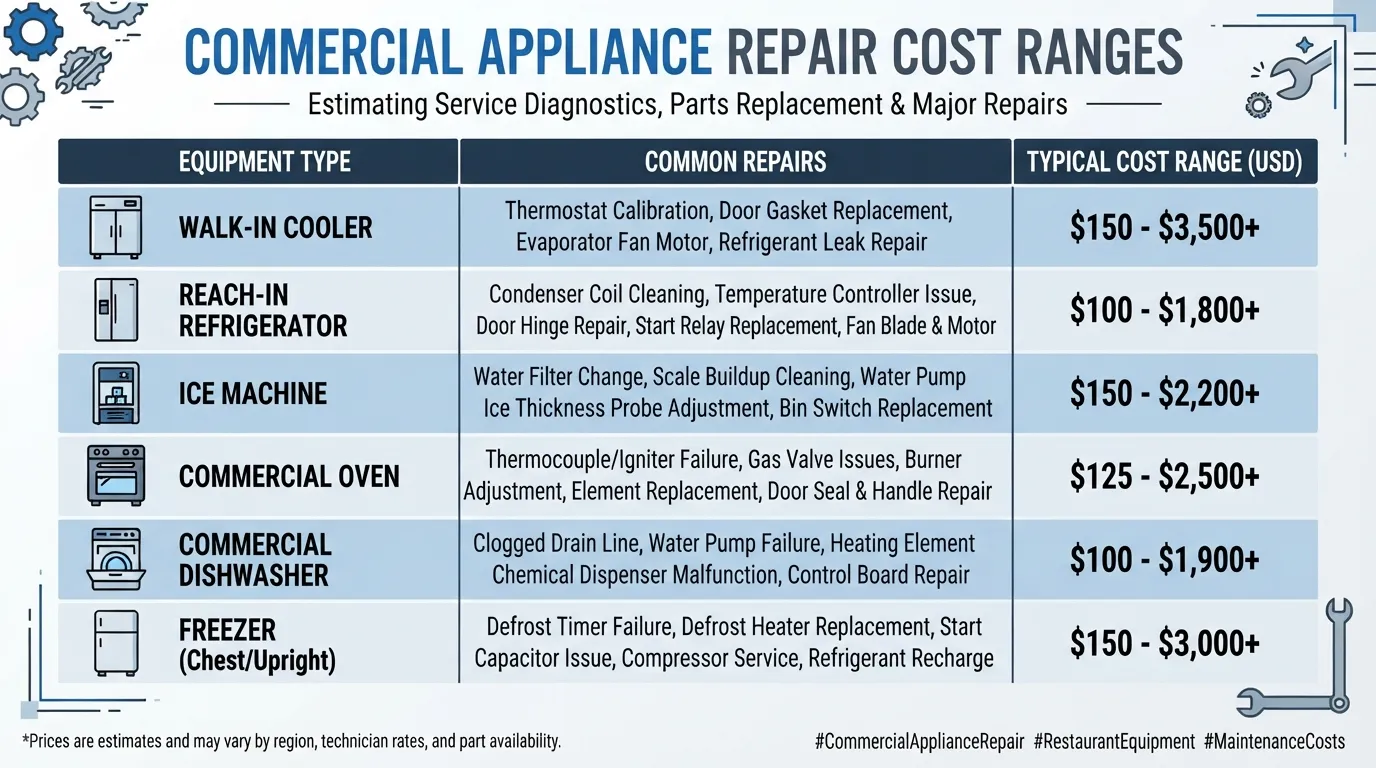
These are industry-typical commercial ranges for Central Texas, parts and labor, gathered for budgeting. Nobody’s price list, least of all a promise; commercial quotes swing with brand, refrigerant, and access. A written quote before work is the only number that counts.
| Equipment | Common failure | Typical commercial range | First move |
|---|---|---|---|
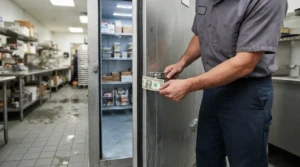
| Reach-in fridge / freezer | Door gaskets, evaporator fans, iced or filthy coils | $150–$800 | Clean the coil, dollar-bill the gasket, log temps |
| Reach-in or walk-in compressor | Sealed-system failure | $800–$3,000 | Get repair vs. replace math in writing first |
| Walk-in cooler | Fan motors, defrost failures, door sweeps | $200–$900 | Check door seal and ice; move product at 41°F |
| Commercial range / stove | Igniters, pilots, burner valves, thermostats | $150–$600 | Confirm gas and power; nothing past the knobs |
| Convection oven | Fan motors, elements, door springs, controls | $200–$700 | Note error codes; one breaker reset, max |
| Dish machine | Wash pumps, fill valves, scaled heaters | $200–$800 | Descale and clear spray arms before booking |
| Ice machine | Scale, inlet valves, pumps | $150–$700 | Run a clean cycle and change the filter |
Read the last column twice. On roughly a third of commercial calls, the first move either fixes the problem or changes the quote, because a scaled dish machine and a dirty condenser coil imitate dying equipment convincingly.
Commercial fridges and freezers: the cold section
Commercial cold equipment fails the same three ways over and over, and two of the three are maintenance failures wearing a repair costume.
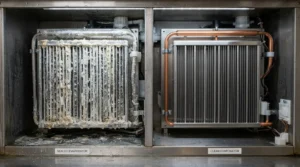
Gaskets go first. A reach-in door gets opened more times in one lunch rush than your fridge at home sees in a week, and every degraded gasket makes the compressor pay the difference. Fans go second, and they announce themselves: chirping, grinding, then silence. Coils cause the third wave, because kitchen air is flour, grease haze, and lint, and a matted condenser coil in a 100° Texas summer takes capacity away exactly when the kitchen needs it most.
The full prevention routine, gaskets through defrost cycles, is in our walk-in cooler maintenance checklist; the same habits scale down to reach-ins.
As at home, the sealed system is the fork in the road. Fans, gaskets, defrost parts, and controls usually deserve the repair. Compressors and refrigerant leaks demand the replacement math before anyone touches a gauge, and refrigerant work is EPA-certified territory by federal law, full stop. The decision logic mirrors the household version we wrote in refrigerator repair cost, with commercial-sized numbers on both sides of the equation.
Ranges and commercial ovens: the hot section
Search commercial oven repair McGregor TX and you’ll find the thinnest results of any category on this page, which tells you how few hands actually work on hot-side gear out here. The failures themselves are ordinary: igniters and pilots on gas ranges, burner valves gummed by boil-overs, thermostats that drift until the bake chart lies, door springs and gaskets on convection ovens that leak heat and stretch cook times.
Two of those are worth money to catch early. A thermostat drifting 25° costs you product quality daily, and it’s a calibration visit, cheap. A convection door that won’t seal burns gas or amps every hour it runs; that’s a spring-and-gasket job, also cheap.
The stop-line on the hot section is gas, and it’s absolute. Smell gas, and the sequence is: no switches, everyone out, call the gas utility from outside, and only then think about repair techs. Nothing on a gas line, valve, or manifold is owner work, ever. Electric commercial stoves give you exactly one breaker reset as a diagnostic; a second trip means a fault, and the panel stays shut.
What you can do: keep the burner ports clean, don’t foil-line anything the manual didn’t bless, and write down what the oven does (error codes, which burners, at what settings) before calling. Hot-side diagnostics over the phone are twice as fast with specifics.
Dish machines and ice machines: scale country
Every water-fed machine in a McGregor kitchen fights the same enemy, and it isn’t age. Central Texas water runs hard enough that scale is the default diagnosis until proven otherwise: crusted heaters and starved fill valves in dish machines, choked evaporator plates in ice machines, slow death by mineral everywhere in between. The full story is in our hard water guide, and it’s the single most useful thing a food business here can read about its own equipment.
Dish machines telegraph scale as dishes that stop coming out clean and hot: the heater element crusts, wash temps sag below sanitizing range, and the health inspection gets interesting. Descale on schedule, keep the spray arms clear, and the machine will outlive its pump warranty.
Ice machines got their own post, ice machine repair, because they’re the worst case: the machine concentrates minerals as it works, so it scales itself even faster than the water alone would manage. Filter every six months, clean quarterly here, and read that guide before approving any four-figure quote on one.
Residential vs. commercial equipment: what surprises owners
Owners moving from a home kitchen to a paid one get surprised by the same five differences, so here they are in advance.
Duty cycle is a different sport. A diner reach-in door moves more in one rush than a home fridge does in a week, and commercial gear is built (and priced) for exactly that abuse. It’s also why used residential equipment dies fast in commercial duty.
Your health authority has opinions about equipment. Licensed kitchens are generally expected to run commercial (NSF-listed) equipment, and the garage-sale household fridge in the prep area is a classic inspection write-up. Check with your local health authority before furnishing a kitchen on the cheap; the used-appliance math changes when a citation is on the other side of it. (For a home, that logic flips, and we covered the honest version in the used-appliance market posts on this blog.)
Warranties are shorter and stricter. A year or two, parts and labor if you’re lucky, and authorized-service requirements with teeth. File the paperwork the day the machine lands, because proving a purchase date two years later is miserable.
Parts cost commercial money. The same OEM fan motor concept that costs $120 residential can be $400 commercial, and proprietary controls can hold a repair hostage for weeks. Ask about parts availability before you buy any brand; the exotic import with no parts network within 500 miles is cheap for a reason.
Refrigerants and configurations vary more. Newer commercial boxes increasingly run R-290 and other refrigerants with their own service rules, remote condensers live on roofs, and everything sealed remains EPA-certified-only work. The practical effect on you: the pool of people who can legally and competently touch your machine is smaller than the ad listings imply.
Here’s the opinion, since this section earns one: buying a $500 household fridge for a busy line isn’t thrift, it’s a subscription. You’ll buy it again next year, and the inspection risk rides along free.
Repair or replace on used commercial gear
McGregor and Waco food businesses run a lot of used equipment, sensibly; capital is real. The repair-or-replace math on used gear needs one modification from the household version: downtime counts more than the part.
Start with the standard rule. If the repair quote runs past half the price of the replacement you’d actually buy, replace. A used one-door commercial reach-in typically trades between $800 and $2,500 around here, industry-typical, which means a $900 compressor job on a $1,200 used box fails the rule before you finish saying it.
Then add the commercial modifier: what does a day without this machine cost you in sales and prep? A repair that’s 40% of replacement but takes ten days waiting on a proprietary board can lose to a replacement that’s in a Waco warehouse this afternoon. Uptime is a line item; pride isn’t.
Age brackets, adapted for hard use: under 4 years, repair almost anything that isn’t sealed-system. Four to eight, the 50% rule decides, with downtime as the tiebreaker. Past eight on unknown service history, only the cheap mechanical fixes make sense, because the surrounding parts share the odometer.
And when buying used: pull the serial plate and decode the build date, ask for service records like you’d ask for a truck’s, look at the coil (a filthy coil is a biography), and run it loaded for 24 hours before money moves if the seller allows. Used commercial gear without history isn’t a bargain, it’s a raffle ticket. Buy used for backup and low-duty stations; buy new or documented for the station that makes payroll.
Where On Point fits, honestly
Time to answer the question the headline raised, with the honesty this blog is built on.
What’s confirmed and true: we’re a family-owned shop at 403 W 2nd Street in McGregor with 20+ years of combined experience, licensed and insured, doing HVAC and appliance work under one roof. Residential is our documented lane, and the hometown-shop version of this guide covers it end to end. Every policy in it travels: written quote before any work, no surprise line items, price match, free second opinions.
[CONFIRM: commercial service scope — if confirmed, this paragraph becomes the direct commercial service statement: which equipment types, fuels, and brands OPSC takes on. Until then, ask-first framing below stands.]
So here’s the ask-first version. If you run a McGregor, Crawford, Moody, or Waco-corridor business and a machine is misbehaving, call with the brand, model, and fuel type, and ask the one question that matters: is this unit work your techs take on? You’ll get a yes or a no in two minutes, and a no comes with whatever honest pointer we can give. What you won’t get is a shrug, an upsell, or a tech who bluffs through unfamiliar equipment on your dime. And if another outfit already handed you a four-figure quote, a free second opinion on the math costs nothing and has changed more than one decision.
FAQ: commercial appliance repair around McGregor
Is there commercial appliance repair based in McGregor, TX?
Who repairs commercial refrigerators near Waco?
Can I use a residential refrigerator in my restaurant?
How much does commercial appliance repair cost?
Is used commercial kitchen equipment worth buying?
Should I repair or replace a commercial fridge compressor?
The short version
Commercial appliance repair in McGregor, TX is mostly a routing problem: warranty to the manufacturer, scale problems to a clean cycle, gas to the utility, and everything else to whichever shop answers the lane question honestly. Keep the triage list taped inside a cabinet, log temps the moment anything cold fails, and never approve a compressor without the replacement math beside it.
The lane question itself takes two minutes: ask us directly or call . [CONFIRM: commercial service scope — swap in the confirmed commercial CTA when settled.] A straight answer is the house specialty either way.
The On Point Team [CONFIRM byline] · On Point Service Company — family-owned HVAC & appliance repair, McGregor, TX · Serving Waco, Temple, Belton, and surrounding Central Texas towns · Licensed & insured, TDLR License TACLB00069239E ·