



Type “AC repair near me” anywhere in the Waco corridor and you’ll get three dozen results: local shops, national franchises, lead-generation sites pretending to be local shops, and a few guys with a gauge set and a Facebook page. They all look fine on a phone screen at 97°.
Five checks separate the ones who’ll fix your AC from the ones who’ll fix their revenue. Run them before anyone’s truck is in your driveway — the whole list takes about ten minutes.
The 10-Minute Vet: 5 Checks Before Anyone Comes Out
Searching “AC repair near me” gives you proximity, not quality. Before booking any Waco-area company, verify five things: an active Texas HVAC license, insurance, a real local address, review patterns over review scores, and a written-quote policy. Each takes about two minutes to confirm.
Here’s the checklist in full:
- License — look up their TACL number on the state site (walkthrough below). No number, no callback.
- Insurance — liability coverage shows up in the same TDLR record. This is who pays if a repair goes wrong.
- Address — a real shop in McLennan or Bell County, not a call center routing “local” leads to whoever pays for them.
- Review patterns — recent, specific, and answered. A 4.6 with detailed stories beats a suspicious wall of five-star one-liners.
- Written quote policy — will they put the diagnosis and price on paper before work starts? This one question filters more bad actors than the other four combined.
The rest of this guide shows you how to run each check, and what good and bad answers sound like.
Check the License First — Here’s Exactly How
In Texas, air conditioning work isn’t a suggestion-based industry. The Texas Department of Licensing and Regulation (TDLR) licenses HVAC contractors, and the license means the person signing off on your repair passed state exams, carries required insurance, and answers to a regulator with the power to pull their livelihood.
The lookup takes two minutes:
- Go to the TDLR license search at tdlr.texas.gov.
- Search the company name — or better, ask the company for their TACL number and search that. Any legitimate outfit will rattle it off; Texas requires the number in their advertising anyway. Check the truck, the website footer, the business card.
- Read the record. You want status Active, the license class (A or B — class A can work on equipment of any size, class B is capped, either is fine for your house), and insurance on file.
- Match the name. The license should belong to the company you called, not a “partner contractor” you’ve never heard of. Lead-gen sites fail exactly here.
Try it on us right now: search TACLB00069239E and On Point Service Company comes up. We put that number at the bottom of every page and post because Texas law asks us to — and honestly, because we’d rather you check than take our word for it. Make every company on your shortlist pass the same two-minute test.
If a company’s response to “what’s your license number?” is any version of “don’t worry, we’re fully certified,” you’ve learned what you needed to know. Move on.
Licensed Company vs. Handyman: Why It Matters for AC Work
The Facebook Marketplace guy quotes $60 less. We get it — and we’d be lying if we said the delta isn’t real. Licensed companies carry insurance, certified techs, and state compliance costs, and those show up in the price of every job. That’s the honest trade-off.
Here’s what the extra money buys. Refrigerant work legally requires EPA certification — a handyman “topping off” your system is breaking federal law inside your property line. If an uninsured repair burns out a compressor or starts an electrical fire, your homeowners policy may look hard at who did the work. And when an unlicensed job goes wrong, there’s no regulator to complain to; the phone number just stops answering. We’ve written a full breakdown of when a licensed HVAC company beats a handyman — the short version is that AC work is one of the trades where the license isn’t paperwork, it’s the difference between a fixed unit and an expensive story.
A license doesn’t guarantee brilliance. Plenty of licensed companies still upsell. What it guarantees is accountability — a record you can check, insurance that pays, and a regulator who takes complaints. Brilliance you screen for with the next two checks.
Who You’re Actually Calling: Local Shop, Franchise, or Lead Site
Those “near me” results sort into three species, and they behave differently once your AC is involved.
Local independents. The owner’s name is on the license, the shop is in the county, and the reputation walks around town with them. When something goes sideways, the person who makes it right is the person whose kids go to school here. The trade-off: smaller crews mean tighter schedules in peak weeks, and quality varies shop to shop — which is exactly what the license lookup and review patterns sort out.
National franchises. Real companies with real techs, plus corporate playbooks: standardized pricing menus, scripted inspections, and sales targets that travel down from somewhere that isn’t Texas. None of that makes the work bad. It does mean the person quoting you may have a “recommended replacements” screen open, and the tech you liked in June may be a different tech in August. Judge them by the same five checks — the good franchises pass without blinking.
Lead-generation sites. The species to actually watch for, because they aren’t AC companies at all. They’re websites built to rank for “AC repair near me,” collect your details, and sell the “lead” — you — to whichever contractor pays for it. You never chose the company; an auction did. The tells are consistent: no physical address, no license number anywhere, stock photos of smiling models in clean uniforms, and a phone number that answers with a generic “home services” greeting. Some route to fine contractors. You just have no way to know, and neither check on your list can be run on a shell.
The fix takes ten seconds: before you call, find the license number and the street address. A real McGregor or Waco shop shows both without being asked — it’s literally required of them. A lead site shows a form.
Reading Reviews Like a Repairman
Unpopular opinion from people who live off reviews: they’re the weakest of the five checks, not the strongest. Scores get bought, begged, and gamed. But review patterns are hard to fake, and that’s what you should read for:
- Specificity. “Great service!” tells you nothing. “Diagnosed a bad capacitor, showed me the reading, had it running in 40 minutes” tells you everything. Real customers describe the job.
- Recency and spread. Steady reviews across months beat 30 reviews posted the week after a marketing push.
- How the company answers criticism. Every company gets a bad review eventually. A calm, specific reply (“we refunded the trip fee and re-did the repair on the 14th”) is worth more than ten five-stars. Defensive or absent replies are data too.
- The words that repeat. When the same trait shows up across dozens of unrelated reviewers, believe it. In ours, the word that keeps repeating is “honest” — that’s a pattern no single review could fake, and you can read them yourself.
- Check a second source. Google first, then Nextdoor or the BBB. Nextdoor is underrated for this — neighbors name the actual tech who showed up. Third-party contractor scores help too; BuildZoom, which tracks state license and permit records, scores us 107 — top 6% of 222,249 licensed Texas contractors. We didn’t write that; the data did.
One caution: don’t let a single one-star review sink an otherwise solid company. Read the review, read the reply, and judge the exchange. You’re hiring how they handle problems, because AC repair is handling problems.
Five Questions That Sort Honest From Upsell
You’ve got a shortlist of two or three. Now call, and ask these — in this order:
- “What’s the service call fee, and what does it cover?” Good answer: a specific dollar figure and what you get for it (trip + diagnosis, often credited toward the repair). Bad answer: “depends,” or a free diagnostic that somehow always finds $2,000 of problems. Typical Central Texas range is $75–$150; be suspicious in both directions.
- “Do I get the diagnosis and price in writing before work starts?” The only acceptable answer is yes. A written quote — the part that failed, the reading that proves it, the price — is your protection against the driveway renegotiation. It’s the core of how we run every AC repair call, and any company can offer it. The ones that won’t are telling you why.
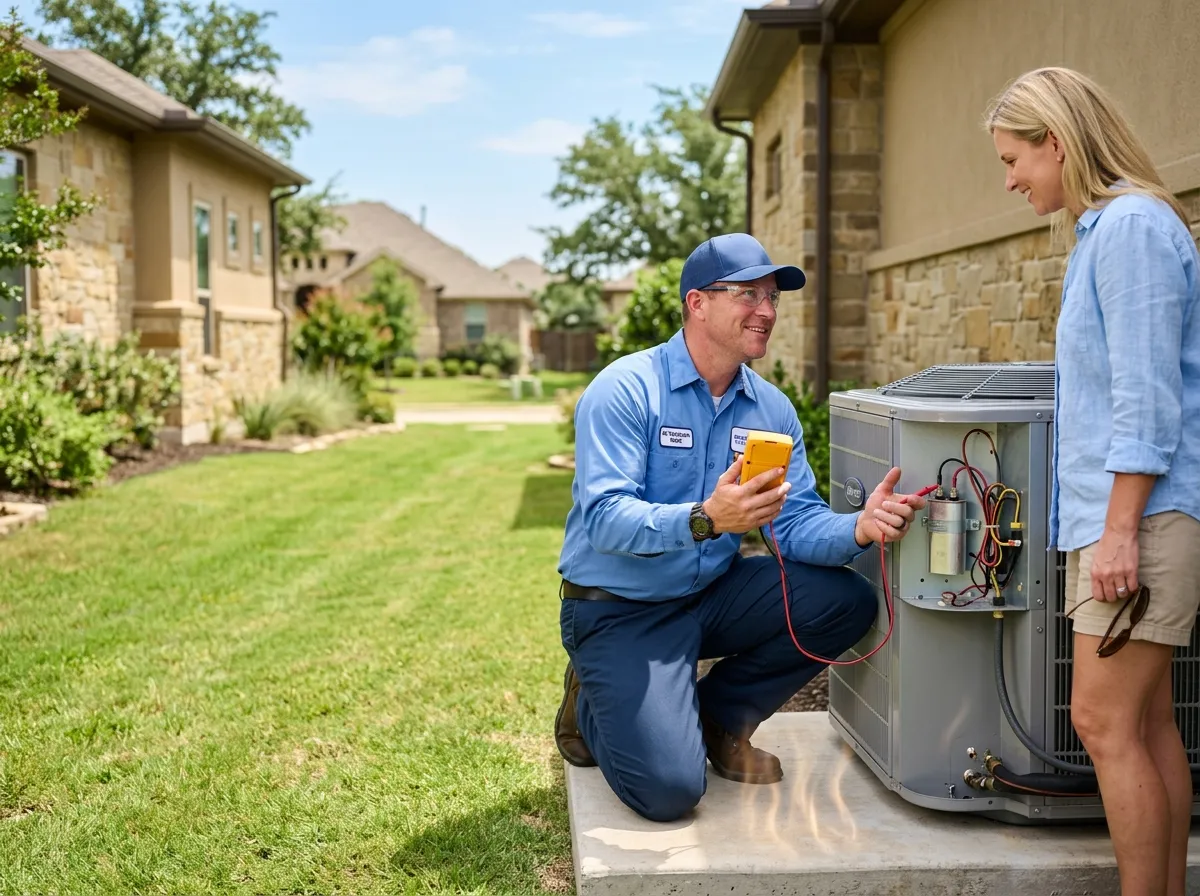
- “If you recommend replacement, will you show me what failed?” A tech who found a dead compressor can show you the reading. “It’s just old” is not a diagnosis.
- “Do you offer second opinions?” Companies confident in their diagnoses don’t fear yours. We give free second opinions, and roughly the most useful thing we do with them is confirm when the other quote was fair — that happens, and hearing it costs you nothing.
- “Who exactly is coming out?” Employee or subcontractor? Background-checked? You’re letting this person into your home, likely while you’re at work. It’s a fair question and good companies answer it without flinching.
Notice what’s not on the list: “how fast can you get here?” Ask it last, not first. Companies know desperation when they hear it, and the ones that lead with speed over process are pricing your panic, not your repair.
Red Flags You Can Hear Over the Phone
Hang up, or at least slow down, when you hit these:
- No license number anywhere — not on the site, the truck, or the person answering. In Texas that’s not an oversight; it’s a legal requirement they’re ignoring.
- Full-system talk before anyone’s seen the unit. A company quoting replacement over the phone isn’t diagnosing, it’s fishing. Nobody knows if you need a $200 capacitor or a $9,000 system until a meter touches the equipment.
- Pressure with a countdown. “This price is good today only” is not how honest repair works. Heat doesn’t negotiate, and neither should fear.
- Cash up front for parts. Established companies carry common parts on the truck and bill on completion.
- The too-cheap trip fee. A $19 service call has to earn its money somewhere, and it will — inside the repair quote.
- Storm-chaser season. After a big Central Texas hailstorm, out-of-town trucks flood in for a few profitable weeks. Some do fine work; you just can’t check any of it. When the yard signs bloom overnight, run the license lookup twice.
None of these alone proves a scam. Two together is a pattern. Trust the pattern.
What the Repair Should Cost
Vetting the company is half the defense; knowing the honest price range is the other half. Most common AC repairs in the Waco area land between $150 and $650 — capacitors, contactors, fan motors, drain lines — with compressors and coils running $1,200–$3,000. We’ve published a full breakdown of what AC repair costs in Waco in 2026, including the part-by-part table and the repair-or-replace math.
Print the table, keep it by the phone, and any quote that lands wildly outside those lanes earns the follow-up question: “which part, and can I see the reading?”
FAQ: Choosing AC Repair in the Waco Area
Is a license actually required for AC repair in Texas?
Yes. TDLR requires a licensed air conditioning and refrigeration contractor for HVAC repair work, and the license number must appear in the company’s advertising. Refrigerant handling additionally requires EPA Section 608 certification. A homeowner can work on their own system; anyone charging you cannot, without the license.
How do I look up an HVAC company’s license in Texas?
Search the company name or TACL number at tdlr.texas.gov. Check for Active status and insurance on file, and make sure the licensed name matches the company you’re actually hiring — not a third party behind a lead site.
What should an AC service call cost around Waco?
Typically $75–$150 in Central Texas, usually credited toward the repair if you proceed. Treat dramatically cheaper or pricier trip fees as a question worth asking, not a deal or an outrage.
Are the sponsored results at the top of “AC repair near me” any good?
Sometimes — an ad tells you about a company’s marketing budget, not its work. Judge ads and organic results by the same five checks. The license database doesn’t care who paid for placement.
Can I get a reliable quote over the phone?
For a ballpark range, yes, and honest companies will give one with caveats. For a firm number, no — anyone quoting a firm repair price sight-unseen is guessing, and you’ll meet the real price in your driveway. The document that matters is the written quote after diagnosis, before work.
What if I’m outside Waco proper?
Most established Waco companies run the whole corridor. We serve Waco, McGregor, China Spring, Robinson, Lorena, Crawford, Moody, Troy, Temple, and Belton — if you’re in McLennan or Bell County, you’re on somebody’s route today.
Make Them Pass the Test
The company you want exists in your search results right now — licensed, insured, local, reviewed by name, happy to put the price on paper. The ten minutes of checking is what finds them.
Ready to skip to the end? We’ve already passed our own test: license TACLB00069239E, checkable at TDLR in the time it takes your AC to cycle once. Request a written quote or call 254-640-2350 for a straight answer — same-day service when the schedule allows, a written price before any work, and a free second opinion if you’ve already got a quote that doesn’t sit right. Seniors and military take 10% off repairs.
On Point Service Company is a family-owned HVAC and appliance repair company in McGregor, TX, serving the greater Waco area with 20+ years of combined experience. Licensed & insured · TDLR License TACLB00069239E ·