




Appliance acting up? This guide breaks down repair vs replace costs, lifespan clues, and differences so you don’t waste money or guess wrong.
A broken appliance has a way of ruining your day at the worst possible moment. Whether it’s an AC not blowing cold air or a washing machine that suddenly refuses to spin, the immediate question hits. Is it worth fixing or should you replace an appliance altogether?
In the classic ‘replace vs. repair’ appliances debate, there’s a widely accepted rule. If the repair cost exceeds 50% of the price of a new one, replacement is usually the smarter move. However, real life isn’t always that simple.
This homeowner’s guide will help you make a confident decision by looking at the age of the appliance, energy efficiency, and long-term costs. If you’ve ever struggled with whether to repair or replace, you’re in the right place.
Key Factors to Consider Before Making a Choice
When deciding whether to repair or replace appliances, it helps to step back from the immediate inconvenience of a broken appliance and look at the bigger financial and practical picture. A quick fix might feel tempting, but the smarter decision often depends on long-term value, not just short-term cost.
- Appliance lifespan matters
Every appliance has a general lifespan, and understanding this helps you avoid spending money on repairs that only extend the inevitable for a short time.
- Refrigerator: 10-12 years
- Dishwasher: around 9 years
- Washing machine: about 10 years
Once an appliance is approaching or past its expected lifespan, even a successful repair may only buy you a limited amount of time. Older components are more likely to fail one after another, so a single repair can quickly turn into multiple service calls.
If your appliance is already showing signs of wear, like louder operation, inconsistent performance, or slower cycles, it’s often a sign that replacement may be the more practical option.
- Frequency of breakdowns
One breakdown is usually not a big deal, but repeated issues tell a different story. If your appliance keeps needing attention, whether it’s the same issue returning or different problems popping up, it’s usually a sign that internal components are wearing out as a system, not in isolation. At that point, even a successful repair doesn’t guarantee long-term stability.
It’s also important to consider the cumulative cost. Multiple repair visits, service fees, and parts replacement can quietly add up and eventually surpass the cost of a new appliance. In these cases, replacement becomes the more cost-effective decision rather than continuing to invest in an aging unit.
- Energy efficiency and newer models
Older appliances were not designed with today’s energy standards in mind. Many consume significantly more electricity and water than modern equivalents, even when they appear to be functioning normally.
Newer appliances are engineered for efficiency. Energy-efficient appliances use less water and electricity while delivering the same or better performance. This means your monthly utility bills can gradually decrease after upgrading.
While a new appliance is an upfront investment, the savings from improved efficiency can offset part of the purchase cost over time. This is especially important for high-use appliances like refrigerators, washers, and dryers, which run frequently and impact utility costs year-round. Newer models can significantly reduce your utility bills and are a practical way to reduce long-term costs.
- The 50% rule (repair vs. replacement threshold)
A widely used guideline in the industry is the 50% rule. If repair costs exceed half the purchase price of a new unit, replacement is often the better decision. In many cases, it’s better to replace your unit, especially when facing major repairs. This rule helps simplify what can otherwise feel like an emotional decision. It shifts the focus from “can this be fixed?” to “is fixing this worth it compared to replacing it?”
However, this rule should also be considered alongside age, efficiency, and reliability. A low repair cost on a very old appliance may still not be a good long-term investment if additional failures are likely to happen.
When Repairing Makes the Most Sense
There often comes a point where you are ready to upgrade, especially when it feels like the best time to start shopping for replacements. For many homeowners, replacement is the best option when performance declines.
However, not every broken appliance is a candidate for replacement. In many situations, appliance repair is still the most practical and affordable solution, especially when the issue is isolated and the unit is otherwise in good condition.
- Simple and inexpensive fixes
Many appliance issues are caused by small, replaceable parts rather than major system failures. These types of repairs are often quick, affordable, and extend the appliance’s usable life significantly. Common examples include:
- Worn or broken belts in dryers
- Damaged door seals in dishwashers
- Clogged pumps or drainage filters
These problems usually don’t indicate full system failure. When addressed early, normal function can be restored without requiring a full replacement.
- Check your warranty first
Before assuming you need to pay for repairs, always check your purchase records. Many homeowners forget about extended warranties, which may cover repair costs.
If your appliance is still under warranty or covered by extended protection, repair costs may be partially or fully covered. In some cases, the manufacturer may also provide replacement parts or service at no charge.
It’s also worth contacting the manufacturer directly, as warranty terms can vary depending on model, purchase date, and service history. Many homeowners overlook this step and end up paying out of pocket unnecessarily.
- High-end or specialty appliances
Luxury or professional-grade appliances are often built with higher-quality components, and maintenance can extend their lifespan significantly. Even when repairs are needed, the cost may still be justified due to the higher original investment and longer design life. In these cases, repair is often preferred over replacement, especially when parts are available and the appliance has been well-maintained.
Signs It’s Time to Replace Your Appliance
When major parts fail, it often becomes necessary to replace an appliance rather than continue repairs. Recognizing these signs early can prevent wasted money and repeated frustration.
- Major component failure
When critical parts such as a compressor, motor, or control board fail, repair costs can become significant. For example, a refrigerator compressor failure in an older unit often leads to a decision to replace rather than repair, especially if the appliance has already seen many years of use.
- Repair costs exceed value
If the repair cost is close to or exceeds 50% of the cost of a new appliance, replacement is typically the smarter financial choice. At this point, continuing repairs may not provide meaningful long-term value.
- Hard-to-find parts
Older models may require discontinued or rare parts. This can increase both cost and wait time for repairs. In some cases, parts may need to be sourced from third-party suppliers, which can add uncertainty to both pricing and repair reliability.
- Poor or inconsistent performance
If your appliance no longer performs its core function reliably, such as an oven baking unevenly or a washing machine failing to complete cycles, it may be nearing the end of its functional life.
These performance issues often indicate deeper internal wear rather than a single repairable fault. If performance declines to the point of inefficiency or even improperly cooked food, replacement becomes more reasonable.
- Frequent breakdowns
If breakdowns are becoming more common, it’s usually a sign that multiple systems are deteriorating at once. At this stage, repairs tend to become reactive rather than preventative, making replacement the more stable long-term solution.
The Hidden Costs of Keeping Old Appliances
Hidden costs matter when deciding whether to replace or repair appliances. The true cost of an aging appliance isn’t always obvious on a repair bill. On the surface, a repair might seem cheaper than replacement, but older units often create ongoing expenses that add up quietly over time. These hidden costs don’t always show up immediately, but can have a real impact on your budget, comfort, and even your home’s condition.
- Higher energy and water consumption
One of the most common hidden costs comes from efficiency loss. As appliances age, internal components like motors, heating elements, pumps, and seals naturally wear down. Even if the appliance is still functioning, it often has to work harder to produce the same results.
For example, an older refrigerator may run longer cycles to maintain temperature, or a worn-out washing machine may need extra rinse cycles to properly clean clothes. A dishwasher with aging spray arms or a weakened pump may require heavier loads or repeated runs.
This extra effort translates directly into higher electricity and water usage. Over time, even small inefficiencies can noticeably increase utility bills. In many cases, homeowners don’t realize how much their older appliances are costing them monthly until they compare usage with newer, more efficient models.
- Increased risk of secondary damage
Another overlooked cost is the potential for damage to your home. As appliances age, seals, hoses, and internal connections become more prone to wear and failure. What starts as a small issue can escalate quickly if not addressed in time.
For instance, a minor leak in a dishwasher might seem manageable at first, but over time it can lead to water damage in flooring, baseboards, or nearby cabinetry. Similarly, a washing machine hose or internal seal failure can result in flooding that affects surrounding structures and finishes.
These issues often cost far more to repair than the appliance itself. In some cases, homeowners end up paying for both repairs and home restoration work, which can far exceed the cost of a replacement unit.
- Declining performance and daily inconvenience
Beyond financial costs, older appliances can also affect everyday comfort and efficiency. As performance declines, tasks that were once quick and reliable start taking longer and producing less consistent results.
A dishwasher might leave residue or require pre-rinsing. An oven may struggle to maintain even heat, leading to uneven cooking results. Even a refrigerator with weakened cooling performance can cause food to spoil faster than expected.
These issues disrupt household routines. Over time, you may find yourself running appliances more frequently, repeating cycles, or adjusting how you use them just to compensate for reduced performance.
- Long-term inefficiency adds up
When you combine higher utility usage, potential repair needs, and reduced performance, the overall cost of keeping an old appliance becomes more significant than it first appears. Even if individual repairs seem affordable, the ongoing inefficiencies and risks can make continued ownership less practical.
This is why evaluating appliances based only on immediate repair costs can be misleading. The real cost includes energy consumption, potential damage, and day-to-day inconvenience – not just the price of fixing a part. Choosing newer models is a practical way to reduce costs while improving efficiency.
Appliance Breakdown: A Quick Reference Guide
Different appliances fail in different ways, and the decision to repair or replace often depends on the type of failure, the age of the unit, and how critical the damaged component is to overall function. This section is meant to help you quickly understand when repair still makes sense and when replacement becomes the more practical option.
- Refrigerator
A refrigerator is one of the most important household appliances because it runs continuously, 24/7. That constant workload means certain parts naturally wear out over time. If the compressor fails, especially in a unit that is more than 8 years old, replacement is often the more practical decision.
The compressor is essentially the “heart” of the refrigerator, and replacing it can be costly enough that it approaches the price of a new unit. In many cases, even if refrigerator repair is possible, it may only extend the appliance’s life by a limited number of years.
On the other hand, smaller issues like a faulty thermostat, damaged door seal, or dirty coils are usually worth repairing. These problems can significantly affect cooling performance but are generally inexpensive to fix and don’t indicate full system failure.
A refrigerator that is still relatively young and structurally sound can often benefit from repair, but older units with major failures tend to be better candidates for replacement.
- Washing Machine
A washing machine experiences heavy mechanical stress due to constant spinning, vibration, and water exposure. Due to this, internal components like the motor and transmission are more prone to wear over time. Washer repair is often effective when issues are limited to smaller components rather than core system failure.
When major components such as the motor or transmission system fail, repairs can become expensive and complex. In many cases, the cost of repair begins to approach the value of the machine itself, making replacement the more practical choice.
However, not all issues point toward replacement. Smaller problems such as worn belts, clogged drains, faulty lid switches, or minor pump issues are typically straightforward and cost-effective to repair. These types of fixes can significantly extend the appliance’s usable life without requiring a full replacement.
The key factor here is severity. If the failure is mechanical and central to operation, replacement becomes more reasonable. However, if it is isolated and minor, repair is usually the better option.
- Dishwasher
Dishwashers generally have shorter functional lifespans compared to other major appliances because they combine water, heat, and mechanical movement in a compact space. This constant exposure to moisture and heat can lead to wear in seals, pumps, and internal hoses. Dishwasher repair is often a practical option when the issue is isolated and the unit is still within a reasonable lifespan.
If a dishwasher is leaking, cleaning inefficiently, or breaking down frequently and is already over 7 years old, replacement is often the more sensible decision. At this stage, multiple components may be aging at once, making repairs less reliable over time.
Common repairable issues include clogged spray arms, faulty door latches, or pump blockages. These are typically inexpensive and can restore performance quickly.
However, once leaks become recurring or cleaning performance drops significantly despite repairs, it often signals that the appliance is nearing the end of its functional lifespan. In such cases, replacing the unit can be more cost-effective and prevent potential water damage to floors or cabinets.
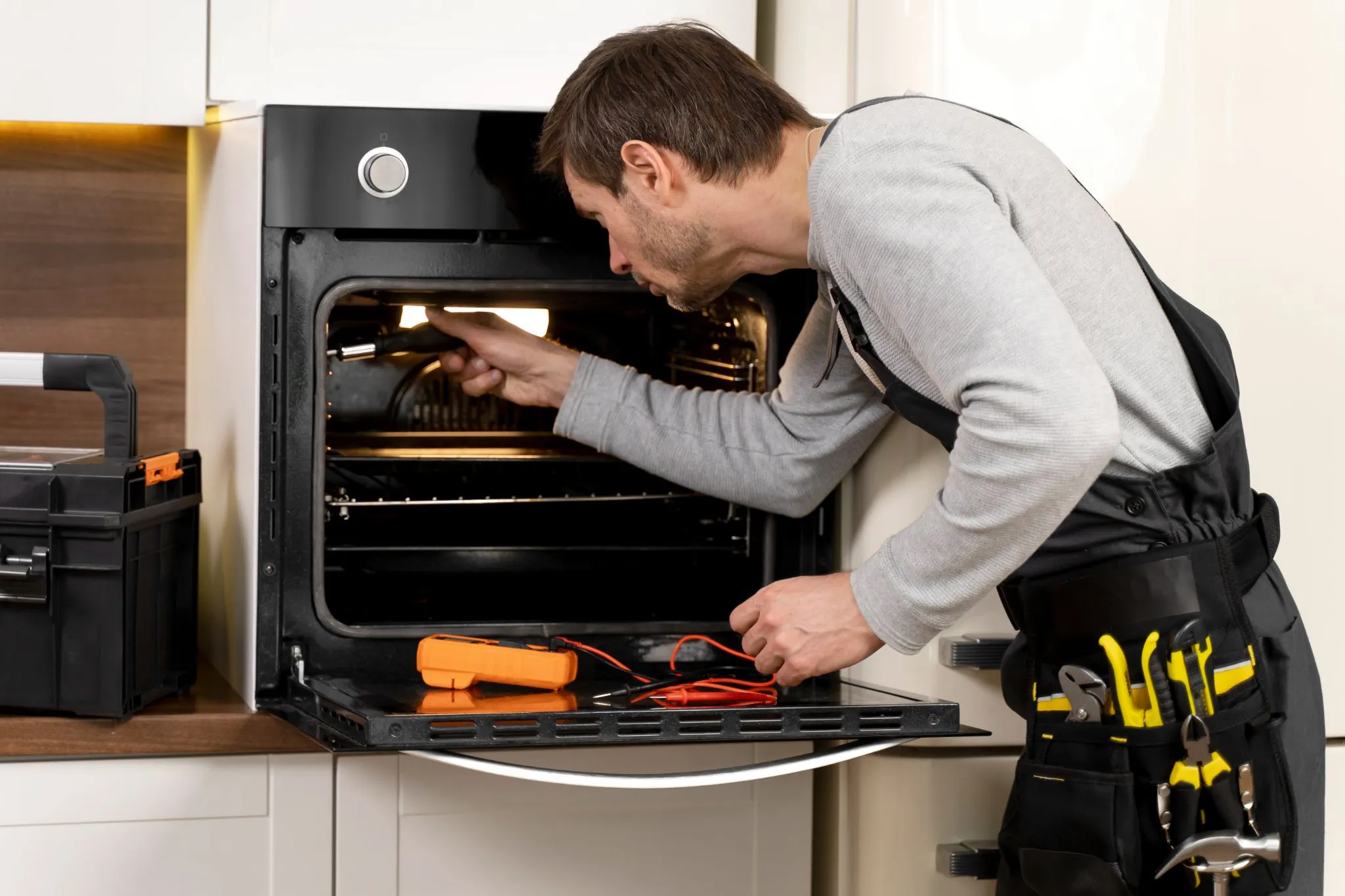
Close-up of appliance maintenance work in progress
How Professional Advice Saves You Money
A professional diagnosis can make a major difference in your decision-making process. A trained repair technician can identify the root cause of the issue rather than just the symptoms.